
Two fragmentary plaques with biblical scenes
Rome, about 300-310 Marble. 372: 58 x 101 cm. 373: 92 x 113 cm. Rome, Museo Nazionale Romano, 67606, 67607. Both fragments still show traces of polychromy, though they are rapidly fading (Reutersward, 1960, pp. 237-238). The condition of the upper register of no. 372 does not permit a sure identification of the scenes. Visible are the feet and long garment of a female, the foot of a man and supports of a chair (?), and a pair of sandals (Moses at the burning bush ?). In the lower register at the left Christ (lower part broken off), wearing tunic and pallium and holding a scroll, grasps with his right hand the bed that the paralytic (in tunica exomis, right leg broken off) is carrying away (Mark 2:12).
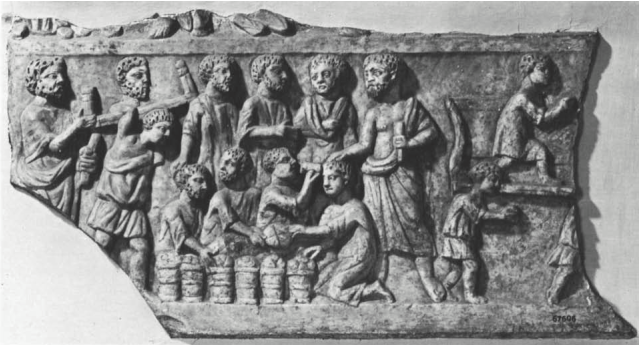
In the background, the head of a bearded disciple is visible. Further right is the Feeding of the Five Thousand (Matt. 14:13-21), designed after a pagan model: behind six baskets of bread are four men, two of whom hold a loaf with a cruciform bread stamp (not the Christian symbol: Dolger, 1943, V, p. 536, no. 12; the christogram seems to be a later addition). Behind the group are three bearded disciples and the bearded Christ holding a scroll in his left hand and laying his right upon one kneeling man's head in a gesture of blessing. Christ wears only the pallium, the costume of an itinerant Cynic philosopher. The next scene shows two men (one partly destroyed) carrying a bed with dolphinshaped back, upon which a man, beardless in ungirdled tunic, steps forward with outstretched arms.
The break running through the scene and the lack of iconographic parallels make reconstruction and identification impossible. The Miracle of Nain (Luke 7: 11—17) seems unlikely, because the paralytic is represented on a bed instead of in a coffin (or on the ground). A mere repetition of the paralytic (Mark 2:1-12; Matt. 9:1-8; Luke 5:17-26) is not probable, but not to be excluded.
On no. 373, the damages concern especially the upper left, which shows a rocky landscape with a resting sheep (bucolic scene ?); a small kneeling figure with head broken away toward the right and, opposite, three youthful men in tunics, seated, looking upward, and stretching out their arms; above them, on a hill, the hem of a pallium and two feet in sandals, which resemble in posture those of the seated figure in the scene below. At the outer right edge is a group of three: in the center, a man in a girdled short tunic holds a basket before him; on either side is a man in tunic and pallium, the left one holding a scroll. It remains open whether a New Testament theme (e.g., John 6:8- 10) or, typologically, an Old Testament one (e.g., 2 Kings 4:42-44) was represented.
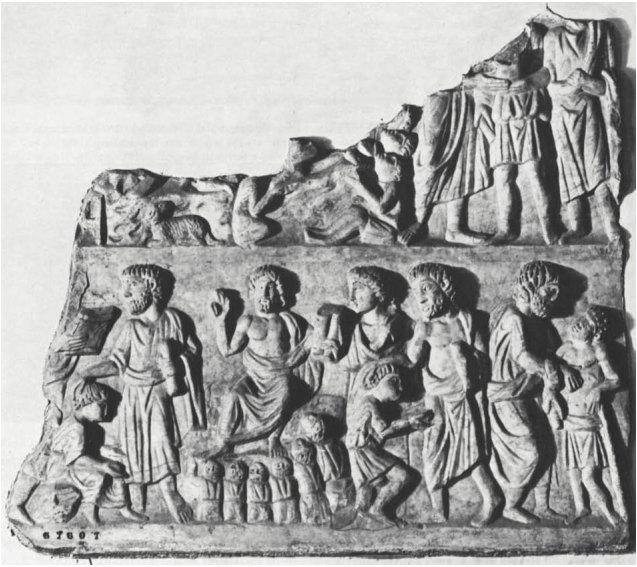
The fragmentary scene in the center is not the Sermon on the Mount (Matt. 5:1 ff.), which forms the main theme of the lower register. Here, Christ, once more wearing only the pallium, his head modeled after an image of Zeus-Asklepios, is seated on the mount. Raising his right hand in a gesture of speech, he is teaching from a scroll in his left hand. At the foot of the hill, six men in tunics look up to him. The iconography is unique (a sarcophagus fragment [Bovini and Brandenburg, 1967, I, no. 110] uses for the same theme an entirely different composition). On either side of Christ the teacher, the healing Christ appears. It is noteworthy that on both fragments the procedure of healing is achieved, not by the virga thaumaturga, but by Christ's hand (de Bruyne, 1943, pp. 135 f., 142 f., 159 f.). At the left, Christ heals a seated female, perhaps the bent woman (Luke 13:11-13); behind her, a fragmentary figure, perhaps "the ruler of the synagogue indignant with Jesus" (Luke 13:14). At the right of the seated Christ stands a woman with noble profile, possibly taken from a group of a philosophical teacher with female pupil (no. 370). In front of her, Christ is healing the blind beggar Bartimaeus (?) (Mark 8:1-4); and, at the right edge, the leprous man (?) (Matt. 8:1-4).
Though the interpretation of the single scenes must remain tentative, the general meaning of the imagery can well be grasped in such a text as Matt. 8:16-17, following the Sermon on the Mount: "he healed all who were ill, to make good the prophecy of Isaiah, he took away our illness and lifted our diseases from us."
On both fragments no scenes but the paralytic carrying his bed and the scene of the meal follow the usual pattern, and some take up hitherto unknown themes, for which no iconographic analogies exist. As the source of the "extraordinary iconography," Hanfmann (1951, II, p. 33, no. 34) assumes a painted cycle. Uncertain also is the function of the plaques; they were probably somehow related to one another. Garrucci (1879, V, p. 154, pi. 404, figs. 1, 2) suggested that they belonged to sarcophagi, and Wilpert (1927, p. 273) that they served for loculus tombs; von Schoene- beck (1936, pp. 246-247) and de Bruyne (1948, pp. 115-116) considered them part of a wall frieze of three plaques, with the Sermon on the Mount in the center.
The relief is flat and was partly painted (von Schoenebeck, 1936, p. 293). The loose grouping with empty background suggests a pre-Constan- tinian date. The drill is used sparingly in the heads.
Their unique features place the fragments among the most significant pre-Constantinian sculptures.
Found in the Vigna Maccarani, on the Aventine Hill, and bought for the Museo Kircheriano by P. Marchi, the fragments came to the newly founded Museo delle Terme, now Museo Nazionale Romano, soon after 1889.
bibliography: Gerke, 1940, pp. 207-233; Gerke, 1941, pp. 11-14; Bovini and Brandenburg, 1967, I, no. 773 (biblio. to 1963); Dassmann, 1973, pp. 35, 313, 363, 365; Engemann (2), 1973, p. 87.
Date added: 2026-07-14; views: 153;