
Plaque from loculus tomb of a child
Rome, 290-300 Marble. 30 X 105 cm. Rome, Musei Capitolini, Sala 11/70. At three corners small pieces are broken away. Splits occur in the outer panels.
The relief is divided by vertical ledges into five rectangular panels. In the central one is the medallion portrait of a child with a flying bird in each upper spandrel. Underneath is a peasant (in tunica exomis) under a tree, milking a ewe—a bucolic genre subject such as was favored in this period (cf. Bovini and Brandenburg, 1967, I, no. 778; Gerke, 1940, pp. 286-287, 363). Left of center is the only Christian subject on the plaque, the Raising of Lazarus with the mummy standing within the aedicula in frontal view. The youthful Christ, dressed as a philosopher, carries a scroll in his left hand and touches the mummy's feet (unusual) with his staff.
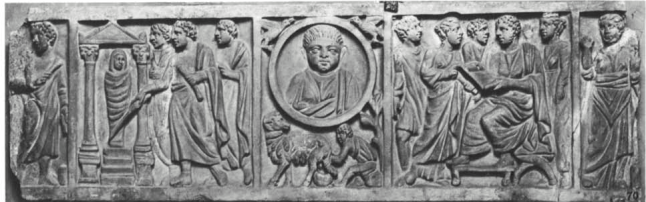
Two beardless disciples accompany him. As a counterpart, a youthful teacher with a short beard, seated on a chair with a footstool, reads from an open scroll. Before him stands a woman, her right hand raised in a gesture of speech. (The interpretation by Stuart Jones [1912, p. 361] that this is a Daniel and Susanna scene is unacceptable.) Behind the teacher is another woman making a gesture of acclamation. Two other attentive male pupils contribute to the impression of a crowded audience. In the outer, narrower panels are depicted two standing figures, adapted to the philosophical context of the plaque: a man in philosopher's costume with a scroll and an orant female (left hand broken off), both with scrinia at their feet.
The plaque gives an explicit Christian notion to the neutral scene of the philosopher-teacher (no. 238), a widespread theme in the second half of the third century. Joined with the Raising of Lazarus, the scene expresses the idea that Christian faith is the true philosophy, proclaiming the resurrection guaranteed by Christ (John 11:23: 'T am the resurrection and the life”).
The relief is flat; the garment folds are smooth and not schematic. Drill holes mark details of the face. The plaque is significant as one of the rare five-panel compositions (Gerke, 1940) and as the earliest representation in sculpture of the Raising of Lazarus.
bibliography: Gerke, 1940, p. 337, 1/6, esp. pp. 284-295; Bovini and Brandenburg, 1967,1, no. 811 (biblio. to 1963); Engemann (2), 1973, pp. 19 n. 42, 75, 85.
Date added: 2026-07-14; views: 153;