
Four plaques with Passion scenes. Rome, about 420-430
Ivory. 7.5 x 9.8 cm. London, The Trustees of the British Museum, 56, 6-23, 4-7. The four plaques from a casket have suffered some damage. The upper left corner of the Pilate plaque is lost; the trunk of the tree in the Crucifixion scene has been restored and the lance of Longinus is missing; the door of the domed tomb in the Marys scene has been partially broken off; hinge mounts have injured the Doubting Thomas plaque and the thumb of Christ's raised hand is missing. Surface details, especially facial features, on all four ivories have been worn away by abrasion.
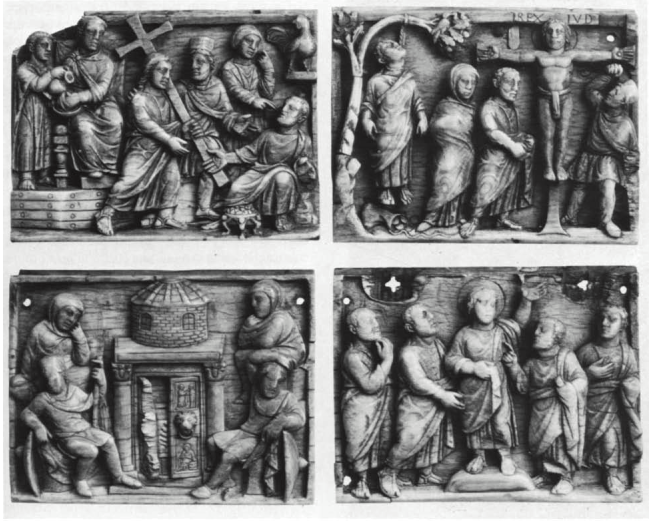
On the first plaque, Pilate washing his hands, Christ carrying the cross, and the denial of Peter are portrayed. The last two scenes have been merged, so that the Roman soldier accompanying Christ seems to be directing him toward Peter. The apostle sits behind a brazier; a woman points at him accusingly, and a rooster, whose crowing signified the fulfillment of Christ's prophecy, is perched behind him. On the second plaque, the Crucifixion is juxtaposed with the death of Judas. Mary and John stand to the left of Christ, and Longinus, his arm raised, is seen to the right of the Savior. Christ's eyes are open: he is the victor over death. Over his head is inscribed: rex iUD(aeorum) ("King of the Jews"). Judas hangs from a tree at the left, a sack spilling coins lying at his feet. A bird feeding her young symbolizes the life-giving power of Christ's death. The third plaque portrays only one event—the two Marys at Christ's tomb. Corresponding to mourning figures on ancient funerary monuments, the women sit on either side of the tomb, while the soldiers sleep in the foreground. The fourth plaque presents the disbelieving Thomas probing Christ's wound in the presence of three other apostles.
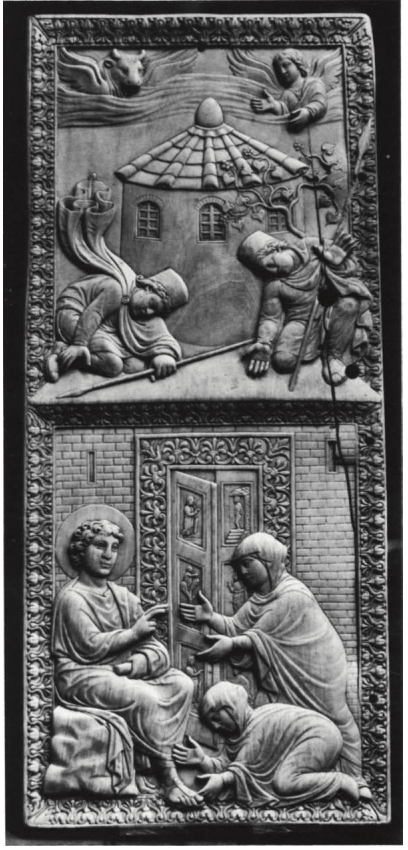
The nearly three-dimensional carving of the London plaques recalls that of the Munich Ascension ivory (fig. 67), while the facial features and squat proportions of the figures closely resemble those of the Probianus diptych (no. 53) and especially of the Peter and Paul ivories in London (no. 455). All of these ivories are products of a Roman workshop and represent a diminution of the classical impulse best represented by the Nicomachi-Symmachi diptych (nos. 165, 166).
Although some scholars have attributed the Passion plaques to north Italy on the basis of iconography, parallel subject matter can be found on Roman works. The Crucifixion here, which is the earliest known portrayal of this important theme, predates by only a few years that on the carved door of Sta. Sabina in Rome (no. 438), which also contains a sequence of scenes showing Pilate and Christ carrying the cross. Similarly detailed cycles appear on the Passion sarcophagi, in the nave mosaics of S. Apollinare Nuovo in Ravenna, and on the Brescia ivory casket (fig. 87).
An illustrated Passion text has been the presumed model for the Brescia casket, and such descriptive details on the London plaques as the brazier and Judas' coins point to the same origin.
The plaques must have come from a casket similar to that in Brescia. The function of such decorated ivory boxes, whether private or ecclesiastical, is unknown.
Acquired in 1856 from the Maskell collection, London.
bibliography: Delbrueck (3), 1952, pp. 95-98; Ottolenghi, 1955, p. 19, fig. 23; Beckwith (2), 1958, pp. 31-34, fig. 41; Kollwitz, 1959, pp. 1119-1121; Volbach, 1976, no. 116.
Date added: 2026-07-14; views: 173;