
Pyxis with Nativity. Syria-Palestine (?), 5th-6th century
Ivory. 10, diam. 10.5 cm. Essen-Werden, Probsteikirche St. Ludgerus. Except for occasional chips and drill holes, and the loss of the original ivory lid, this pyxis is in very good condition. Two compositions decorate its oval circumference: the Nativity of Christ and the annunciation to the shepherds.
The Nativity shows several distinctive monographic elements, including Joseph's brooding posture, the large mattress on which the Virgin lies, and, most significantly, the conspicuous altarlike manger with a “niche" in its base. These motifs are found in a number of early Syro-Palestinian monuments, including the Sancta Sanctorum reliquary lid in the Vatican (fig. 76). The unusual manger may even reflect the actual stone altar in the Nativity grotto at Bethlehem; it is among the most characteristic motifs marking the series of New Testament scenes developed in association with the famous pilgrimage sites of the Holy Land.
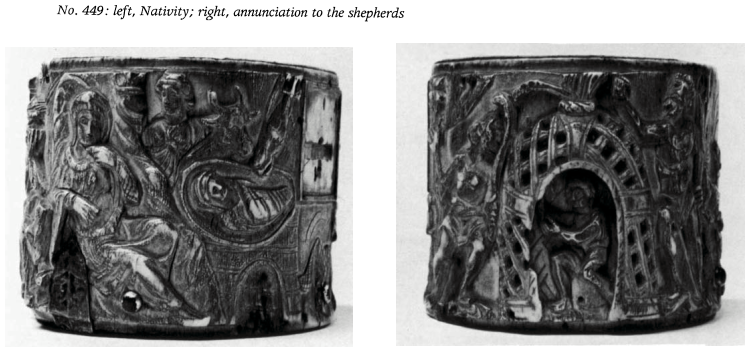
That the iconography in the Werden pyxis' annunciation to the shepherds may also be characteristically Palestinian is suggested by the appearance of similar compositions on other objects thought to be Syro-Palestinian; these include several cast bronze censers (Elbern, 1970, p. 14, fig. 9) and an ivory plaque in a Paris collection (Volbach, 1976, no. 133). Also closely related are the shepherds appearing on pyxides in Florence and Rouen (Volbach, 1976, nos. 171, 173). Like the Nativity, this scene may ultimately reflect a composition developed in conjunction with a holy site.
Among the several dozen ivory pyxides from the Early Christian period, the one in Werden is distinguished by the technical skill of its carver and by the classical style of its figure types. The subtle modeling of the shepherds' bodies is especially striking, as is the vivid evocation of receding space conveyed by the interplay of several levels of relief. Joseph's pose recalls that of an antique philosopher absorbed in thought; the two striding shepherds evoke ecstatic satyrs in a Dionysiac procession. Stylistically, the Werden pyxis has been associated with the Maximianus cathedra (fig. 60), which is generally attributed to Constantinople. At the same time, its apparently Palestinian iconography and its stylistic links to a Palestinian icon in the Monastery of St. Catherine at Mt. Sinai (Weitzmann, 1976,1, no. B.22) suggest that it was produced in the Holy Land.
The decoration on a number of Early Christian pyxides suggests that they were intended for use in the Divine Liturgy (no. 549), perhaps to hold incense. Such a use would be especially appropriate for the Werden pyxis, since its image of Christ on the altar has an obvious eucharistic symbolism.
bibliography: Wessel, 1953-1954, p. 2; Schnitzler, 1957, I, pp. 9, 34, no. 51, pis. 162, 163; Elbern, 1970, p. 14; Testini, 1972, pp. 316-318, fig. 27; Volbach, 1976, no. 169; Weitzmann, 1976, I, p. 47, fig. 23.
Date added: 2026-07-14; views: 155;