
Rabbula Gospels. Northern Mesopotamia, 586
Vellum. 292 fols.; 33.6 x 26.6 cm. Florence, Biblioteca Laurenziana, cod. Plut. I, 56. In 586, the scribe Rabbula, working in the monastery of St. John at Beth Sagba, completed the Syriac Gospel book that today bears his name. Rabbula's bold estrangelo lettering has won high praise, but it is the anonymous pictorial decoration that accounts for the manuscript's fame. This decoration, which is confined to the first fourteen folios, comprises eight full-page miniatures and a set of canon tables adorned with portraits and scenes from the New Testament.
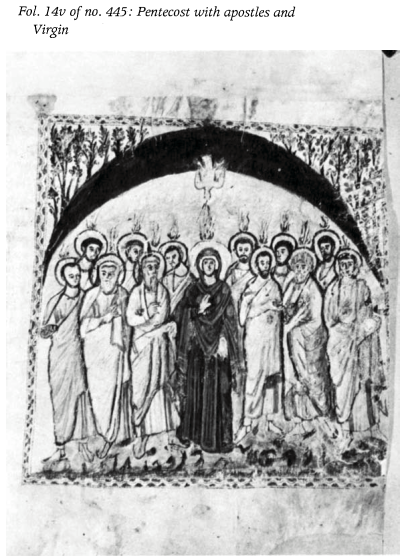
Bright, fluid colors and agitated brushwork distinguish the Syriac style from the more refined illusionism of Constantinopolitan and Syro-Pales- tinian manuscripts (nos. 179, 442, 443), but even in this late sixth-century work from northern Mesopotamia, the Hellenistic heritage is strong. Lively, expressive figures enact the biblical drama in spacious, airy settings. The Crucifixion, for example, is rich in narrative detail and includes such topographical features as the mountains of Gareb and Agra behind Golgotha.
Scholars have long deduced that the formal, hieratic character of the full-page pictures derives from monumental paintings, and Weitzmann (1974) has recently adduced specific sites for the prototypes: the chapel of the Holy Spirit in the Sion Church (Pentecost), the church on the Mt. of Olives (Ascension), and the church on Golgotha (Crucifixion). Close iconographic parallels in such works as the ampullae (nos. 524, 526, 527) and the lid of the Sancta Sanctorum reliquary box (fig. 76) support the conclusion that models of certain Rabbula Gospels miniatures originated in the environs of Jerusalem.
Features of the loca sancta also intruded into the tiny scenes painted alongside the canon tables, but the model of these marginal pictures was certainly a narrative cycle, perhaps an illustrated Gospels. Similar scenes adorn the canon tables in the closely related Syriac Gospels in Paris (Bibliotheque Nationale, Cod. syr. 33). The sequence is chronological and has no specific relation to the passage referred to in the accompanying concordance. Similarly, the portraits of Old Testament figures painted above the Gospel episodes suggest the Messianic predictions but lack the precise relationship of prophecy and fulfillment that is established in the Sinope and Rossano Gospels (nos. 442, 443).
Notes in the codex provide a general provenance. During the twelfth century, the Gospel book belonged to the monastery of Maiphuc in the province of Bostra and passed from there to Kanubin. The manuscript came into the possession of the Laurenziana at the end of the fifteenth century.
bibliography: Cecchelli, Furlani, and Salmi, 1959; Leroy, 1964, pp. 139-206; Wright, 1973; Weitzmann, 1974.
Date added: 2026-07-14; views: 168;