
Front of sarcophagus with story of Jonah
Rome, about 290 Marble. 67 x 220 x 19 cm. Vatican City, Monumenti, Musei e Gallerie Pontificie, Museo Pio Cristiano, Lat. 119. Chief restorations are enumerated in Bovini and Brandenburg, 1967, I (note especially the restoration of the head of Christ in the Lazarus scene). The main theme is the Jonah trilogy, flanked by maritime and bucolic scenes: to the left, two fishermen holding a basket with fish; to the right, an angler with a boy and a great heron. The Jonah cycle begins at the left with a sailing boat below a bust of Sol (with crown of rays) and a Wind personification blowing a horn (lost).
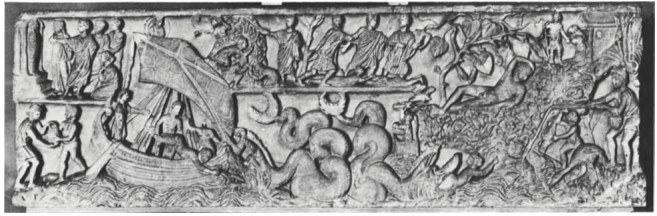
One member of the three-man crew throws the naked Jonah into the sea, where the ketos is ready to swallow him. In the next scene, Jonah cast up, the monster is repeated, so that the curving bodies and tails form an ornamental center for the relief. Above is a small abbreviated scene: Noah, in a rare profile view, in the ark with the dove approaching, and, to the right, in larger scale, Jonah under the gourd vine, resting in the typical pose of Endymion or Dionysos (Stommel, 1958, pp. 112-115; Sichter- mann, 1966, pp. 96-100). To the right is the bucolic scene of a herdsman with sheep and a hut. The water and shore are alive with small creatures —fish, a crab, a snail, a lizard. An analogous Jonah cycle exists on the child sarcophagus in Copenhagen (Klauser, 1965-1966, p. 165), which, better preserved, affords criteria for analysis of style and accuracy of restoration.
On either side of the sail are abbreviated biblical scenes on a ledge: Christ raising Lazarus (John 11) in the presence of both sisters and two male witnesses, the tomb aedicula balancing the hut at the right. This scene is one of the earliest representations of its theme on sarcophagi (cf. no. 370), as is the next scene, Moses Striking the Rock (Exod. 17 : 6), with three Israelites drinking. The scene to the right of the tree is unique and controversial, perhaps representing Moses attacked by the people who “murmur for water" (Exod. 17:3; Num. 20: 2-5) or by the men of Korah (Num. 16 : 1-2).
Style and technique are of excellent quality. The relief is not very high, the drill is rarely used, and most work is chiseled. The composition shows the tendency of marked corner scenes and a distinct center and is at the same time a preliminary step to the two-zone sarcophagi. Noteworthy is the fusion of biblical stories and profane genre subjects. An example of bucolic and maritime genre in profane art is the fountain-sculpture in Rome at the Villa Borghese, probably of the third century (Helbig, 1966, II, no. 1966).
The Jonah story is frequent in funerary art beginning in the third century, mostly as a trilogy. Its Christian significance is rooted in Matt. 12 : 39- 40, where Jesus relates the Jonah story to his own death and Resurrection. The Water Miracle of Moses owes its frequency to its baptismal connotation (see nos. 381, 382).
Found in the sixteenth century in Vatican territory, the sarcophagus was brought to the Medici Gardens on the Pincian Hill to be used as a fountain. At the time of Bosio (1632, p. 103) and Bottari (1737, I, p. 186), the casket—though with damaged relief—was still complete (Ficker, 1890, pp. 61-62).
bibliography: Gerke, 1940, pp. 38-46, 339 VI/1; Bovini and Brandenburg, 1967, 1, no. 35 (biblio. to 1963); Engemann (2), 1973, pp. 72-73, 75, 86.
Date added: 2026-07-14; views: 167;