
Altar Implements and Liturgical Objects
For the Early Christians, the implements used in the liturgy and the furnishings around the altar had symbolic meaning as well as practical function: each implement came to represent an event in the life of Christ. A commentary (Historia ecclesiastica et mystica contemplatio) on the liturgy, attributed to the Byzantine patriarch Germanos (d. about 733), compares the apse of the church to the manger in Bethlehem, the altar with Christ's tomb, and the altar ciborium with Calvary. The eucharistic chalice represents the Holy Communion cup, but it also symbolizes the bowl in which Christ's blood was collected at the Crucifixion. The paten, the plate used to distribute the eucharistic bread, is compared to the hands of Joseph of Arimathea and of Nicodemus, the men who took the body of Christ down from the cross. The liturgical service, the focus of Christian ritual, became revered as a reminder of the sacrifice of Christ and the hope for salvation through its symbolic reenactment. The large number of diverse objects created to perform the actual service enjoyed a similar reverence in the Early Christian Church.
Germanos' observations reflect a tradition that dated from the early centuries of the cult and extended throughout the Christian world. In the Early Christian period, the liturgical implements were even more highly regarded than pictures of the life of Christ. As a Western source from Carolingian times explains: “Through the vessels, therefore, is the sacrifice offered to God, not through the images.... If on these [vessels] images are represented, they are not for the sake of veneration or because without them the power of the holy offerings would be less, but rather that they might be made more beautiful by the applied materials" [Libri Carolini 2. 1. 29).
Of these vessels, those highest in rank are the chalice and the paten, the only implements that can be truly considered “vasa sacra." The earliest and most significant example of a eucharistic drinking vessel is the Antioch chalice from around 500 (no. 542), which is characterized by its very low foot. It is made of silver and partially gilded—like many chalices of the period. Represented on the chalice are two complex scenes, each with Christ among apostles and with symbolic animals or objects. The scenes probably depict, on one side, Christ teaching and, on the other, the resurrected Lord with the lamb and the eagle. Such elaborate scenes are unusual on surviving chalices, and the low-footed form was never repeated on chalices in the Early Christian period.
The most common form for early and middle Byzantine chalices was one with funnel-shaped foot, with or without knop, and with a bowl-shaped kuppa. This form, judging from silver stamps found on many chalices, originated in the sixth century. This development in form was accompanied by a gradual simplification in decoration. By about 600 chalices with inscriptions only are the most numerous ; those with pictorial decoration are often limited to simple bust medallions. The only sixth-century silver chalice that is rich with figures is the one in Baltimore (no. 532), which shows crosses alternating with saints. Of a similar iconographical type is a fragmentary glass chalice in the Dumbarton Oaks Collection (no. 545); one of its sides shows the cross between saints, the other an aedicula flanked by angels. Both representations can be connected with Palestinian iconography. In another similar glass chalice, in the Amman museum, the gem-studded cross is flanked by lambs. Although liturgical usage for these glass chalices cannot be excluded, they may also have been pilgrims' souvenirs from Palestine. The chalice said to be from Christ's Last Supper was displayed in a chapel near the Church of the Holy Sepulcher at Jerusalem from early Byzantine times.
Most of the silver chalices known today were probably used for the communion of the faithful, as they are still used today in the Eastern Church. They often have handles, as the one in the Museum of Fine Arts, Boston (no. 543). Chalices in use in the service can be seen on the silver patens from Riha (no. 547) and Stuma (fig. 82).
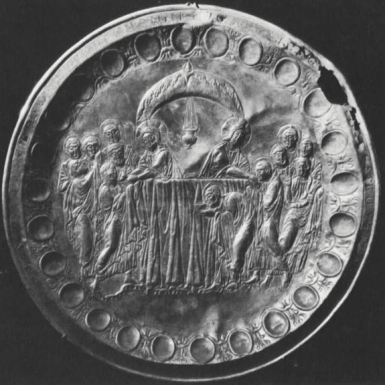
Fig. 82. Silver paten from Stuma with communion of the apostles. Istanbul, Archaeological Museum
Among Early Christian patens a widespread type was a platter with a raised, inscribed rim. An early example of the type, from the early sixth century, is the paten of the bishop Paternus, with a control stamp of the emperor Anastasius I (no. 546); it is adorned with a monogram of Christ in the center. Many eucharistic plates of the sixth century are decorated with such crosses, either engraved or in niello (no. 548). The emphatic Christian character of two patens at Dumbarton Oaks (Ross, 1962,1, no. 16, Al, A2) is revealed by their inscriptions, “Hope of God" and “Fear of God." It is, of course, possible that some of the plates with crosses were used for distribution of blessed, but not consecrated, bread —called eulogia. In some of these plates, the cross is included in the representation of paradise as a tree of Ufe standing over the four rivers of paradise. In a unique paten in the Hermitage (no. 482) a large gem-studded cross flanked by angels appears above the rivers.
In addition to the chalice and paten a range of other implements served the eucharistic liturgy. The derivation of the forms and liturgical usages of some of these implements from antique utensils is demonstrated particularly well by a group of objects found at Hamah and now in Baltimore (nos. 531-541). They include three chalices, several patens or platters, a small bucket, an oil phial, a hanging lamp, a sieve, and several spoons. Such auxiliary utensils as the ewer (ama or amula), ladle, and strainer were used for the preparation of the eucharistic wine. The function of the many spoons with Christian marks surviving from the period has recently been much discussed. The spoon was apparently an essential implement in the communion of the faithful. Bread stamps were used to mark the eucharistic bread with a variety of pictures and inscriptions (no. 565). Finally, there was a small knife, called the Holy Lance, used to divide the host into particles. As Germanos noted in his commentary, the knife became associated with the lance that Longinus used to pierce Christ's side at the Crucifixion.
With the patens from Riha and Stuma, certain disc-shaped silver objects were found, dated by their stamps to the time of Justin II. These objects, designed to be borne atop staffs, are engraved on their borders with peacock-feather eyes, indicating that they are fans, or rhipidia. Such fans continue to play a liturgical role in the Eastern Church today. The rhipidion was originally made of feathers and was used to keep insects and birds away from the altar. According to Braun (1932, pp. 642 ff.), the rhipidia from Riha (no. 553) and Stuma represent “petrified liturgical implements without a practical use." But their symbolic use, signified by a cherub (Stuma) or tetramorph above firewheels (Riha; Ezek. 1:5 ff.) is to characterize the altar as the realization of the throne of God. The winged beings at the altar symbolize the actual waving of the fans. Thus, the rhipidia very vividly keep physical and spiritual pollution away from the eucharistic elements on the altar. Their value is enhanced by the use of precious metal.
Still other altar implements are pictured on the patens of Riha and Stuma: a vessel for wine and water, a ewer, and an implement in the shape of a trulla (no. 114). Closely comparable are a ewer and a trulla from Malaia Pereshchepina Poltava in the Hermitage, but these utensils, dating from the time of Maurice Tiberius, may have served a secular use. A similar vase in the Louvre, decorated with handsome figure medallions (no. 552), and two others in the Abegg Stiftung, Riggisberg, with dedicatory inscriptions, are the most important surviving examples of this kind.
Candlesticks, or lampstands, as well as hanging lamps, may have had either secular or cultic use (nos. 556-559). A good, though undecorated, hanging lamp is preserved in the Hamah treasure. This type has a parallel in the silver lamp from the Hermitage, which has figure medallions and vegetal patterns on its neck. Of similar type is the gilded silver lamp from the Abegg Stiftung, which is unique in the high quality of its decoration. Dodd (1973, no. 3) relates the text of its dedication to the inscription on the Stuma paten. Most early Byzantine cultic implements from Syria are closely connected stylistically, while objects from the Antalya treasure are more formal and more sophisticated, perhaps an indication of the differences between metropolitan and provincial workshops.
Early Christian lamps, candelabra, and polycandela are preserved in large numbers and varieties. They were often made of silver or even of gold, which shows how highly the Early Christians valued light as a symbol of the splendor of God. The large candlesticks from the find at Hamah have no distinctive Christian connotations (no. 541). The form of such candlesticks as architectural supports, with base and capital atop three feet, emulates antique furniture. A smaller candlestick from Lampsakos (Dodd, 1961, no. 19) bears silver stamps of Emperor Justinian I. Most early Byzantine lamps and candlesticks, however, were made from bronze. They vary from a one- flame table lamp to a multiflame hanging lamp, and from very simple pieces to complex examples of iconographic and stylistic importance. A bronze statuette of St. Peter (no. 509) was thus originally used as a decorative lamp handle, and a multiflame poly- candelon takes the form of a basilica (no. 559). Early Byzantine polycandela are for the most part flat discs decorated in openwork with symbolic patterns, with the glass light-cups fitted into their round openings (no. 558). The most important piece of this kind artistically, from the Antalya treasure, now in the Dumbarton Oaks Collection [Handbook of the Byzantine Collection, 1967, no. 66) is made of partially gilded silver and has sixteen lamp openings between crosses, dolphins, and plant motifs. One can imagine the spectacular effect of the light of so many lamps reflected in shining silver, a sight recorded by the sixth-century poet Paulus Silentiarius in his description of Hagia Sophia at night [Descriptio S. Sophiae 806-884). Decorative hanging crowns added a further accent to the splendor of the early Byzantine house of God. Although none of these crowns seem to be preserved, they can be found in various liturgical representations of the time, such as the well-known Pola casket (fig. 83).
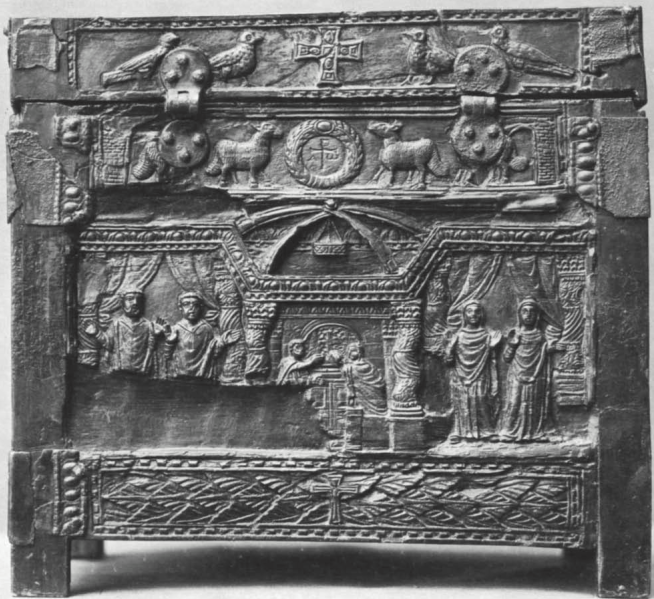
Fig. 83. Ivory casket from Pola with ciborium of St. Peter's (?). Venice, Museo Archeologico
As light was used in the church to please the eye, incense appealed to the sense of smell. Ascending clouds of incense symbolized, above all, the worshiper's prayers rising to God. Various kinds of early censers are preserved—from early undecorated bowls to openwork vessels with lids and figure-decorated thymiateria—which could be set up, hung, or carried and swung. The most beautiful Early Christian pieces are a silver censer with bust reliefs, now in London (no. 562), and a partially gilded censer with flat reliefs from Finike in Istanbul (Akurgal, Mango, and Etting- hausen, 1966, p. 98). The most important group of Early Byzantine thymiateria show reliefs with representations taken from Palestinian iconography, well known from the numerous pilgrims' souvenirs (nos. 563, 564).
In addition to light and incense, another element in the altar room was water. Holy water was present in church and home from the earliest times, since the first Apostolic Constitutions, but the forms of the liturgical implements used to contain it are known only from the early Middle Ages. A bronze bucket from the Vatican (du Bourguet, 1971, pi. p. 205) may be an earlier form of the holy water situla.
Just as the Christian altar is the center of the service commemorating the eucharistic sacrifice, it serves at the same time to announce salvation. Therefore, a prominent place on the altar was held by the Gospel book. Various representations show that the Gospel book on the altar was usually open. The bindings of such books could be adorned with precious decoration worthy of God's word. Representations of the holy book in the hands of the evangelists or the apostles, as depicted on Early Christian ivories, show, for the most part, crossshaped decoration (no. 486). An outstanding Western pair of book covers, in gold and dating to about 600, is that of Queen Theodelinda, now in the treasury of the cathedral in Monza (fig. 84).
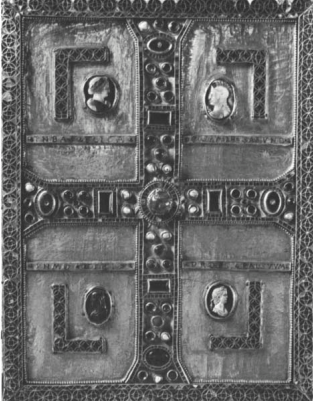
Fig. 84. Book cover of Gospels of Queen Theodelinda. Monza, Cathedral Treasury
Although it cannot yet be ascertained when book covers in ivory came into use, some Early Christian ivory five-part diptychs may have been used as book covers as early as the fifth and sixth centuries. In early representations, the holy book is laid down on a precious piece of cloth. There were also book supports, which sometimes bore pictorial decoration, like that on the wooden lectern of St. Radegundis at Poitiers (fig. 85). The lamb between paradisiac plants, christogram between birds, and evangelist symbols in bust form —a characteristic Early Christian iconography—are represented on the slanted top. Colonnades give this small work an architectural character.
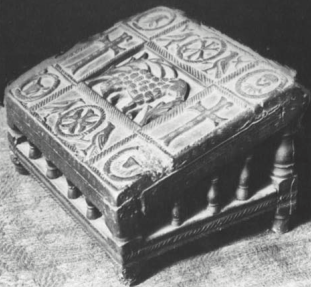
Fig. 85. Wooden lectern of St. Radegundis. Poitiers, St. Croix
Included in the range of precious metal objects that decorated the early Byzantine apse are three silver relief panels in New York (nos. 554, 555). Two of these represent the princes of the apostles, Peter and Paul, standing under arcades, one holding a staff and the other a book. The third shows the same apostles guarding the cross. These silver reliefs are considered by many scholars to have been book covers, but they might possibly have been intended rather as an iconic group. Whatever their function, such works, together with the other silver implements, must have made the early Christian altar room a place of unparalleled beauty. Paulus Silentiarius wrote: “For as much of the great church by the eastern arch as was set apart for the bloodless sacrifice is bounded not with ivory or cut stone or bronze, but it is all fenced under a cover of silver" [Descriptio S. Sophiae 682 ff. [Mango, 1972, p. 87]).
Early in the history of the Church, the altar table assumed significance as a symbol of the salvationbringing cross, although the cross was not placed upon it. Referring to the position of the altar cross, a Western source of the early Middle Ages states: “But above, suspended from the arch over the Holy Altar, glitters the exalted Cross, most precious, multicolored, and at the same time radiant" [Monu- menta Germaniae Historica 4. 574). Extant silver or bronze crosses from the early Byzantine period, like the so-called altar cross from the Hamah treasure (no. 540), mostly carry personal dedication inscriptions and no direct references to cultic use. They may therefore have been only votive gifts and not altar furnishings. Weitzmann (in Weitzmann and Sevcen- ko, 1963) has shown, by the example of the large Moses cross from the basilica of St. Catherine's Monastery on Mt. Sinai, that in the Justinianic period one possible location of such a cross was atop the beam of the altar screen; a similar setting has been reconstructed at Hagia Sophia in Constantinople.
The pyxis, usually cylindrical, served as a container for the host. It was generally made of precious materials, such as silver or ivory. The purpose of the pyxis is sometimes revealed in the decoration: the Great Berlin Pyxis (fig. 86), for example, shows two scenes-—Christ teaching, surrounded by apostles, and the typologically well understood scene of the Sacrifice of Isaac. The representation of the Women at the Tomb on a pyxis from New York (no. 520) indicates that it, too, was made to contain the host, as the new tomb of Christ. Finally, the pyxis from New York with the MultipUcation of the Loaves and Fishes (no. 549) and a silver-gilt pyxis from Hamah with christograms and vegetal symbolism (no. 534) could also be understood to be eucharistic.
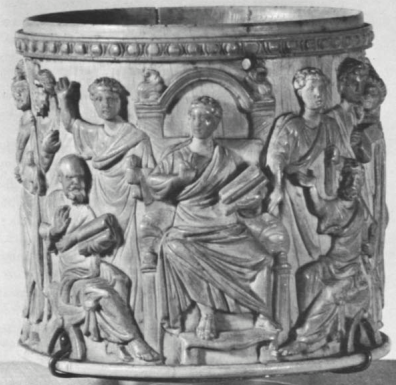
Fig. 86. Ivory pyxis with Christ teaching. Berlin, Staatliche Museen Preussischer Kulturbesitz, Fruhchristlich-Byzantinische Sammlung
In many cases it is difficult to distinguish between eucharistic pyxides and pyxis-shaped reliquaries. A close connection between the liturgy and the cult of the saints was well established in Early Christian times. The faithful recognized in the remains of the martyrs a confirmation of their hopes for immortality, which was obtained through the Eucharist. A box in Paris with the Raising of Lazarus (no. 571) and the lipsanothek of Brescia (fig. 87)—the most important ivory reliquary of Christian antiquity—both express the longing for eternal life. Such caskets—made of silver, bronze, wood, or stone—were kept near the altar where the Eucharist was performed (no. 569).
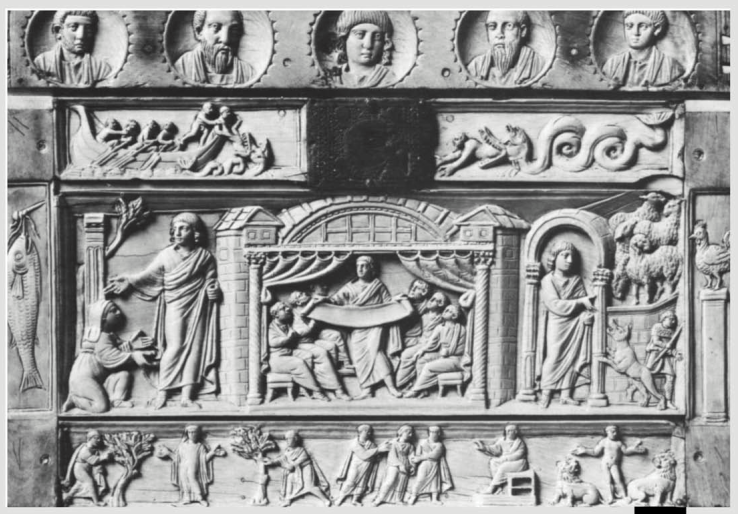
Fig. 87. Ivory casket with Old and New Testament scenes. Brescia, Museo dell'Eta Cristiano
The altar itself either encloses a reliquary, for example, in the form of a miniature sarcophagus (no. 570), or is raised above a scrinium with the relics. Figural representations on the preserved reliquaries reflect manifold aspects of Christian iconography. These representations often display, in miniature, the pictorial programs of such monumental works as church apses—transmitting to us these now lost compositions (see fig. 83). In turn, such monumental works as the mosaics of S. Vitale, in Ravenna (fig. 88) transmit to us the splendor that the Early Christian altars must have presented, with their elaborate vasa sacra and non sacra and their richly woven altar cloths.
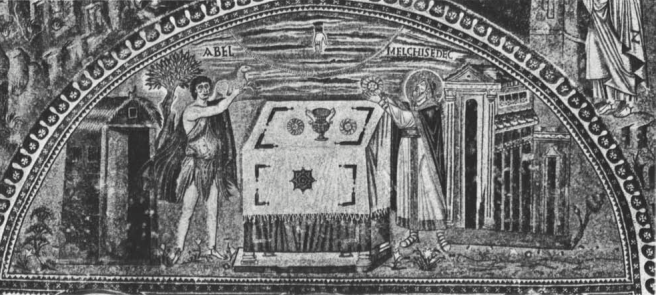
Fig. 88. Mosaic with Sacrifice of Abel and Melchisedek. Ravenna, s. Vitale
The lavish decor of Hagia Sophia described by Paulus Silentiarius was replicated in provincial churches. A Syrian text records an imperial donation from Anastasius I to the monastery of Qartarmin in Syria. The emperor not only contributed precious materials, he even sent his own goldsmiths to create the objects that decorated the church. Among the many items mentioned were two bronze “trees" twenty yards high flanking the altar room. They carried numerous lamps and various votive gifts of gold, silver, and bronze. Among them were "... red eggs, goblets, animals, birds, crosses, crowns, little bells, [and] engraved discs" (Leroy, 1956).
In the early Byzantine period, Christians had already begun to conceive of ritual as an analogy to the heavenly liturgy, even in the sense of “commemorative allegory" (Theodore of Mopsuestia, Maximus the Confessor). According to this concept, the priest represents in celebrating the liturgy all of its essential elements. He stands for the one who sacrifices as well as for the sacrificed and for the sacrificial meal; he executes the thrust of the lance of Longinus; and, as another Nicodemus, he places, in the form of the host, the body of Christ upon the paten on the altar cloth. In this identification of the priest with the liturgical actions and their religious intentions, the cult implements play an essential role.
bibuography: Braun, 1924; Braun, 1932; Braun, 1940; Leroy, 1956; Ross, 1962, I; Elbern (1), 1964; Elbern (2), 1964; Akurgal, Mango, and Ettinghausen, 1966; Volbach, 1976.
Date added: 2026-07-14; views: 247;