
Plate of Paternus. Constantinople, about 518
Silver with gilding. Diam. 61, base 31.8 cm. Leningrad, State Hermitage Museum, w 827. Parts of the plate's sloping sides and most of the left half of the decorative rim's inner border are missing. The rest has been reassembled and restored from fragments. The two cruciform decorations originally set on horizontal axis right and left on the rim are gone, and the pastes or garnets from the two remaining cruciform settings, plus the jewels from two of the oval settings, have been lost.
Fire gilding is preserved on the monogram, on the Greek letters in the center, and on the band of inscription, which reads: ex antiqvis renovatvm EST PER PATERNVM REVERENTISS(imum) EPISC(opum) nostrvm. amen ("[This plate] was renovated from the old [i.e., 'out of old objects,' or 'from old materials'] by Paternus, our venerable bishop. Amen").
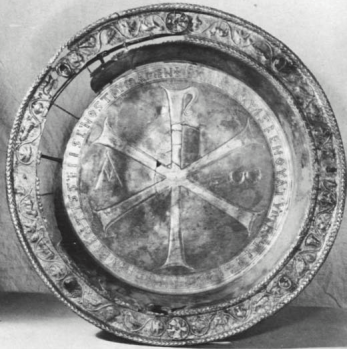
According to Matzulevich (1929), all the workmanship is contemporary with the inscription, and the amounts of silver and gold specified by weight marks in Greek on the ring foot's inner surface closely approximate the amount actually used in the work. The particulars of the design were all carried out according to one scheme and in one workshop, with the exception that the four cruciform medallions were substituted at an advanced stage of the execution for four of the eight oval-set jewels projected for the rim decoration. Yet in neglect of the technical evidence, some scholars have preferred to think of these Ostrogothic(?)-style medallions as later additions and have assumed they were applied at Tomi, in Scythia.
The Paternus mentioned in the inscription has been identified with a bishop at Tomi (Tomis), on the Black Sea. (For Paternus, see Zeiller, 1918, pp. 173, 383-384, 600.) Paternus was in Constantinople in 519 and again in 520, but he may have ordered the dish there near the end of the reign of Anastasius (d. 9 July 518), whose imperial stamp is one of three control stamps on the plate. On a successive trip to Constantinople the bishop could have ordered an alteration in its embellishment; perhaps he even brought the cruciform medallions from home.
The decoration of the rim revives a tradition of the third century, with a pictorial band that sets the dish apart from all known examples of early church plate. The decoration consists of meandering vine scrolls inhabited by a deer, a stag, a sheep, a lamb, peacocks, and other birds—all suggestive of paradise. This is an appropriate subject in combination with the christogram, which, with the likewise gilded symbols for Alpha and Omega, floats majestically within the silver field.
Stylistically, the christogram may be compared to crosses gracefully flared at the ends on a number of silver patens of the sixth and early seventh centuries found in Syria (cf. no. 533). However, Matzulevich (1929) has pointed to the sketchy quality in the modeling of the leaves and animals on the rim, and to the heavy employment of punchwork, features that place the piece securely in close stylistic proximity to those of Constan- tinopolitan monuments of the early sixth century.
The large Paternus dish must have been used as a paten and is the earliest preserved, precisely datable paten. It is also one of the greatest masterpieces of early Constantinopolitan silver production, a unique example of the application of Late Antique design on a silver object with hieratic symbols and a Christian inscription. The inscription is noteworthy because it contains the only Early Christian reference to a Tomitan bishop, and rare because it is in Latin. While Latin inscriptions are uncommon among surviving Early Christian inscriptions in Scythia, some bilingual inscriptions prove the dual existence of Greek and Latin culture there.
The object was found in 1912 in Malaia Pereshchepina, part of a hoard that included five other Byzantine silver objects dating between 527-565 and 629-641.
bibliography: Matzulevich 1929, no. 6, pp. 101—109; Rice, 1959, nos. 28-29, p. 293, ill.; Dodd, 1961, no. 2, p. 54; Elbern (1), 1964, p. 134, ill. p. 129, fig. 115; Beckwith, 1970, p. 43, fig. 79.
Date added: 2026-07-14; views: 255;