
Chandelier and hand holding cross
Palestine, 6th-7th century. Brass and bronze. 34.7 X 39.8 cm. New York, The Metropolitan Museum of Art, The Cloisters Collection, 1974, 1974.150. The chandelier is composed of two parts that do not belong together: a bronze hand, broken by a hole in the palm, holding an orb surmounted by a cross, and a brass globe with six branches for lights; one branch is modern. The cross is incised with figures of the enthroned Virgin and Child. The Virgin's face was destroyed when the cross was drilled at the top for suspension. On the cross- arm is St. Stephen holding a book and censer, flanked by Paul on the left and Peter on the right, who raise their right hands in acclamation. Between them is the inscription:  (“Christ help [me]"). SS. Cosmas and Damian, carrying medical boxes and inscribed
 (“SS. Cosmas and Damian be praised!"), decorate the bottom of the cross. The branches of the globe are linked by chains. They terminate in lotus-shaped cups with finger-shaped hooks that may have held polished reflectors (cf. Paulus Silentiarius Descriptio S. Sophiae 806).
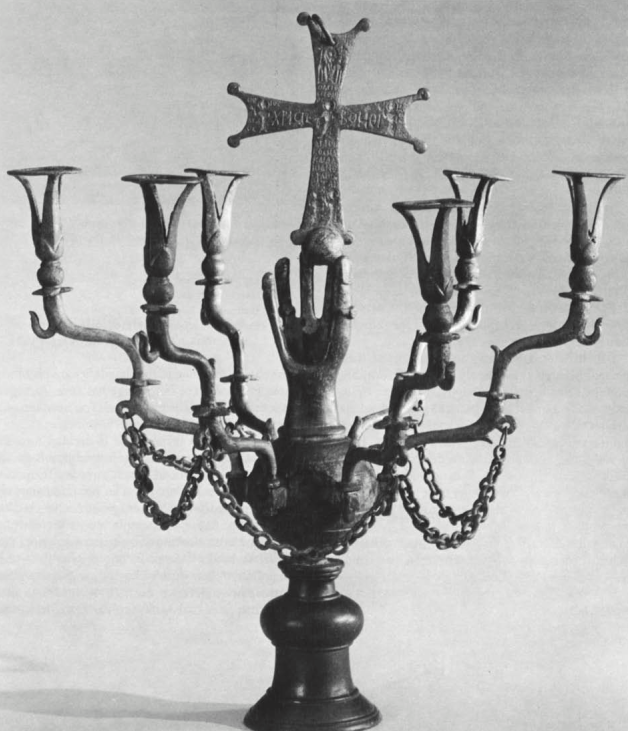
Both parts of the chandelier are Early Christian but were joined together much later. The globe and arms resemble a lamp hanging from a niche in the mosaics of St. George in Thessalonike (no. 491), but they may also be part of a many-tiered chandelier. Finger hooks are often found on Early Christian objects, including the torches held by the wise and foolish virgins in the Rossano Gospels (no. 443; cf. no. 255, and Underwood, 1960, fig. 13).
The hand holding the cross resembles several other examples dated by Ross, on the basis of the small size of the orb, to the sixth to seventh century. The cross is the most elaborately decorated of the group; only a fragmentary cross with hand in Lucerne appears to have had a similar program of figural decoration (Ross [3], 1964). The style of the figures is closely allied to that of the ampullae from Jerusalem (nos. 524, 526, 527).
It is difficult to identify the function of these hands, although they clearly derive in form and meaning from apotropaic hands of Jupiter Helio- politanus and of Sabazios (no. 163; see Zalesskaja, 1967). One of the latter in the museum at Amiens is hung with phalli around its base (Cumont, 1929, pi. xv, fig. 2) and may have decorated a staff. It is unlikely that the Christian hands crowned processional crosses, but they may have been mounted on staffs (the hole in the Metropolitan's hand corresponds to the placement of a rod inside the hand in Leningrad) as votive offerings, perhaps to be paraded before the faithful when the hands' healing powers were needed.
Date added: 2026-07-14; views: 311;