
Rhipidion with tetramorph. Constantinople, about 577
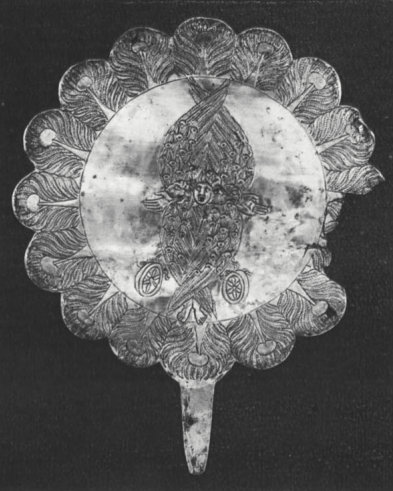
Silver with gilding. 30.9 x 25.5 cm. Washington, D.C., Dumbarton Oaks Collection, 36.23. This rhipidion, or liturgical fan, is in excellent condition save for the loss of a portion of its right border. Its decoration consists of a tetramorph (Ezek. 1:4-20) engraved on a central disc, surrounded by a scalloped border of sixteen peacock feathers; the same design has been summarily duplicated on the reverse. At its base is a tongue used to attach a wooden staff. On it are four imperial control stamps indicating that the rhipidion was produced in Constantinople during the reign of Justin II. Precisely the same series of stamps appears on a sumptuous silver paten (no. 547), which, like the fan, was said to have been discovered at Riha, Syria. It is likely that Megalos and Nonnous, a couple named in the inscription on the paten, purchased both objects in the Byzantine capital for presentation to a church in Syria soon after 577, dated by a name on one of the stamps (Dodd, 1961, no. 21).
Very closely related to the Dumbarton Oaks rhipidion, and very likely included in Megalos' presentation, is a liturgical fan in the Archaeological Museum, Istanbul (Dodd, 1961, no. 22); it differs in design only as it displays the tetra- morph's six-winged counterpart, the seraphim (Isa. 6:2). It is quite probable, moreover, that the so-called Stuma treasure, with which the Istanbul fan was found, and the Riha pieces were part of a single larger silver hoard; both finds were made at approximately the same time (late 1910s) and in virtually the same place, near Aleppo (Haleb, Syria) (London, 1977, p. 83). The Riha and Stuma rhipidia were thus likely part of a single set of sumptuous altar utensils, which may have included several more fans; both Pseudo-Dionysios [De ecclesiastica hierarchia 4.2) and George, Bishop of the Arabs (Connolly and Codrington, 1913, p. 22), describe a liturgy with twelve deacons carrying twelve rhipidia.
Originally the role of the rhipidia in the Divine Liturgy was purely practical; according to the Apostolic Constitutions (8. 12. 3-4), they were made of parchment, peacock feathers, or cloth, and were waved by the deacons in order to keep flies out of the chalices. It was not long thereafter, however, that their role became primarily ceremonial, their structure and ornamentation symbolic. Typical decoration for rhipidia of all periods, the tetramorph and seraphim on the Riha and Stuma fans reflect liturgical commentaries, which equate the fan-waving deacons with seraphim and cherubim (e.g., Monk Job's De verbo incarnato [Migne, PG 103, col. 769]). Hovering over the altar like the golden cherubim at the Ark of the Covenant (Exod. 25:18-22), these multiwinged celestial beings protected the eucharistic gifts from profanation, while leading the faithful in singing their seraphic hymn (Isa. 6:3).
The Dumbarton Oaks rhipidion at once bears witness to the high level of Byzantine silver craftsmanship in the sixth century, to the splendor of the Early Christian service, and to the ceremonial status of the altar fan.
Said to have been found at Riha, Syria.
bibliography: Dodd, 1961, no. 21, ill.; Ross, 1962,1, no. 11, pis. XIV, XV; Dodd, 1968, p. 147; Wessel, 1971, cols. 550-551; Dodd, 1973, pp. 35-48, figs. 29, 30, 32, 33; London, 1977, pp. 83-84, ill.
Date added: 2026-07-14; views: 270;