
Reliquary of the true cross
Syria-Palestine (Jerusalem ?), early 8th century Silver gilt, enamel, and niello 10.2 X 7.35 cm. New York, The Metropolitan Museum of Art, Gift of J. Pierpont Morgan, 1917, 17.190.715. In the early fifth century, a noble lady and pilgrim from Spain named Egeria wrote a vivid account of the homage paid to the true cross, which was kept in a gilded silver reliquary on Golgotha. The reliquary has not survived, but one of its most important early descendants has: this small silver- gilt box decorated with cloisonne enamels and niello, called the Fieschi-Morgan staurothek after two of its former owners. The inside of the reliquary is divided by thin silver partitions into a cross-shaped compartment that once held the relic, a small particle of the true cross. An incised cross with L-shaped corner brackets decorates the bottom. The reliquary is in excellent condition, except that the gilding has almost disappeared and the lock probably replaces an enamel plaque with saint.
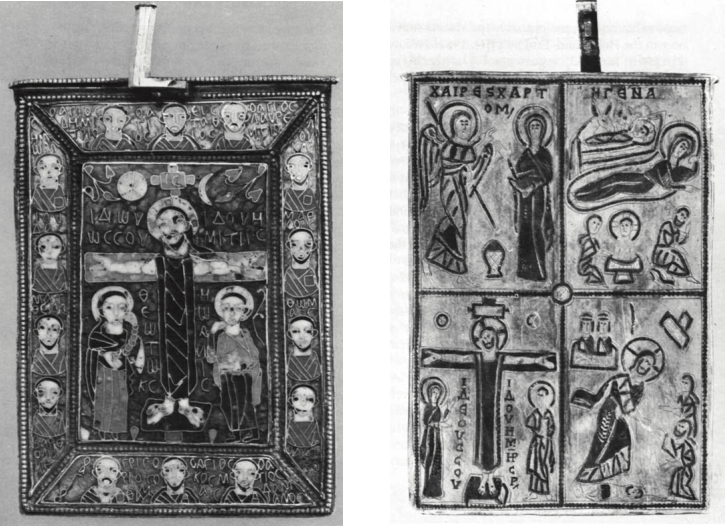
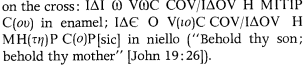
The reliquary's top and sides are decorated with enamels of the Crucifixion and busts of twenty- seven saints; scenes of the Annunciation, Nativity, Crucifixion, and Anastasis are worked in niello on the underside of the lid. On the lid the saints are, reading clockwise: Demetrios, Eustathios, Lawrence; Luke, Mark, Thomas, James; Damian, Cosmas, Gregory Thaumaturgos; Bartholomew, Matthew, Luke, Simon. On the sides are: Ana- stasios, Nicholas; George, Procopios, Theodore, Plato; Mercurios, Eustratios, Panteleimon; Andrew, John, Paul, and Peter. The scenes and the saints are identified by Greek inscriptions. The Crucifixion includes the words spoken by
The iconography and the style of the decoration are typical of sixth- to eighth-century work from the Holy Land. The Crucifixion, with Christ alive, dressed in a long tunic (colobium), and mourned by his mother and John, resembles the Crucifixion on the cross reliquary at Monza (Merati, 1969, pp. 22-23), in the Rabbula Gospels (no. 445), and on a silver niello cross at Vicopisano, Italy (Luc- chesi-Palli, 1962). As Lucchesi-Palli has shown, the Anastasis on this reliquary may be the earliest Syro-Palestinian example known.
The extensive program of enameling finds no parallel in surviving Early Christian work. The reliquary stands, rather, like the beautiful bracelets in Thessalonike (Athens, 1964, no. 463), at the beginning of the rich history of Byzantine and Western enameling, which flourished after the seventh century.
Lucchesi-Palli dates the reliquary in the second half of the seventh century, but, judging from its primitive style, it may be somewhat later, perhaps even after the destruction of Christian art in Jerusalem in 721 (Vasiliev, 1956). Although similar cross-reliquaries were probably produced much later in the Holy Land, Frolow's ([1], 1961; Frolow [2], 1961, no. 162) arguments for a tenth- or eleventh-century date for the Fieschi-Morgan staurothek are not convincing.
Although the reliquary is usually ascribed to Syro-Palestine generally, it is tempting to specify its provenance as Jerusalem. Except for the martyr Lawrence, the saints it commemorates are Eastern, and even he is listed with the other saints in a Georgian calendar written in the tenth century at the monastery of St. Sabas near Jerusalem and based to a large extent on an earlier Greek Jerusalem lectionary (Garitte, 1958). Furthermore, the bishop Anastasios (next to the lock on the side of the reliquary), identified by Rosenberg (1924, pp. 66-67) as one of two sixth- to seventh-century patriarchs of Antioch, may have been the Anastasios who was custodian of the sacred relics at the Holy Sepulcher and then patriarch of Jerusalem in 458.
Pope Innocent IV (Sinibaldo Fieschi, 1243-1254) is said to have given this reliquary to the church of S. Salvatore-di-Lavagna, Italy, where the relic remains (Williamson, 1913). Since he was involved in the Crusades, the reliquary may have been brought back to him from the Holy Land or it may have reached Italy centuries earlier.
Formerly in the Oppenheim collection.
bibliography: Frolow (1), 1961; Lucchesi-Palli, 1962; Wessel, 1967, no. 5.
Date added: 2026-07-14; views: 352;