
Chalice with crosses between angels and orants
Syria-Palestine, 6th century Glass 14, diam. 14.9 cm. Washington, D.C., Dumbarton Oaks Collection, 37.21. Blown, then wheel-cut and engraved, this pale green chalice is now severely fragmented and only partially preserved. Gone is its supporting foot, which may have been much like that of the Antioch chalice (no. 542); interruptions in the upper ornamental strips suggest that the vessel may originally have had handles.
On one face of the vessel is a large crux gemmata, flanked on the right by an Omega and an orant figure (Peter ?), for which counterparts (an Alpha and St. Paul ?) undoubtedly existed on the left. The height of the cross and the presence of foliage suggest that the cross rose over the hill from which, in some parallel representations, flow the four rivers of paradise. On the opposite face a smaller cross stands within a curtained, gabled ciborium at the top of a flight of steps. Approaching it from either side are angels with books (?) in their draped arms.
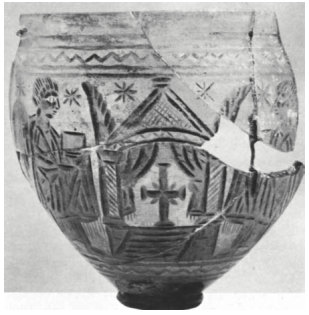
The shape and decoration of this vessel suggest that it was used to hold the eucharistic wine (cf., however, Engemann, 1972). We may, moreover, be fairly certain that it was the product of a Syro- Palestinian atelier, since it closely parallels in size, technique, and ornamentation a chalice now in Amman, which was discovered at Gerasa, Jordan (Elbern, 1962, pp. 34 ff.). It has been suggested by Elbern (1962) and Barag (1971, p. 62) that the cross beneath the ciborium ultimately reflects a monumental gemmed cross erected by Theodosius II on Golgotha. Pilgrims' accounts note that the cross was protected by a roof and that it stood at the top of a flight of steps (Geyer, 1898, pp. 140-141, 153-154). A simphfied version of this composition appears on a metal ampulla in Monza (Grabar, 1958, pi. x), and on a pair of glass pilgrims' flasks (Barag, 1970, fig. A, in); these Palestinian objects are datable to about 600, and are thought to reflect the Golgotha locus sanctus. A cross beneath an arch and flanked by angels also appears on an ivory plaque in Paris (Volbach, 1976, no. 132), datable to the same period and likely of Syro- Palestinian origin.
The decoration of a eucharistic vessel with the cross of Golgotha is fully appropriate to its function, since early Syrian commentators, such as Theodore of Mopsuestia, consistently identified the Divine Liturgy with the Passion of Christ. That angels should be carrying books or pyxides is also appropriate, since the deacons who participated in the liturgy were identified as angels. Finally, the tree of life in paradise, on the opposite side of the Dumbarton Oaks chalice, also belongs in a eucharistic context, since Christian exegesis drew parallels between Christ's cross and the arbor vitae, and between Golgotha and paradise: from its four rivers, as from the side of Christ (and from the chalice), flowed life for men and for angels.
Said to have been found in Syria. Purchased from Joseph Brummer in 1937.
bibliography: Elbern, 1962, pp. 17-41, figs. 1—3; Ross, 1962, I, no. 96, pis. Liv, LV; Elbern (1), 1964, pp. 125, 126, fig. 84; Dolger, 1967, pp. 12-14, pi. lib; Barag, 1970, p. 42; Barag (2), 1971, pp. 61-62, fig. 54; Engemann, 1972, pp. 163-164, pis. lOa-c; Harden, 1972, pp. 82, 113, pi. ve.
Date added: 2026-07-14; views: 233;