
The Antioch chalice. Color plate XV. Syria (?), 1st half 6th century
Silver gilt. 19, diam. 15.2 cm. New York, The Metropolitan Museum of Art, The Cloisters Collection, 50.54. A plain inner silver cup is cradled in a chased openwork silver gilt outer cup. The foot was made separately. The surface is badly worn, broken, and corroded. Decorating the outer cup are two seated images of Christ acclaimed by ten figures holding furled scrolls and sitting on highbacked chairs. On one side, Christ, apparently beardless, sits on a chair that rises behind his head like a large halo. He stretches out his right hand in a gesture of speech and holds an open scroll in his left. A second, bearded Christ on the other side of the chalice sits on a bench (?) in an identical position. Although his left arm is missing, the fall of the himation on his left side shows that his arm was extended; it may have held a scroll. A lamb looks up at him from the left, and a displayed eagle stands on a basket of grapes beneath his footstool. An inhabited vine scroll frames the figures.
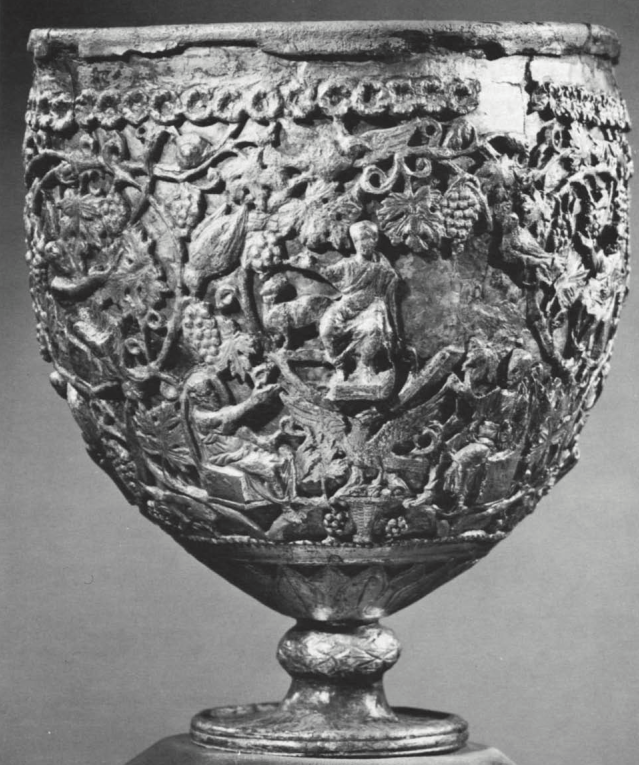
The chalice has been frequently published, but its iconography and date are still under discussion. The figures who acclaim Christ are most likely his apostles, although even Peter and Paul cannot be clearly distinguished. It has been generally agreed that Christ with the lamb and eagle is the resurrected Lord (Jerphanion, 1926, pp. 102-111). The other scene has been identified as Christ giving the law or the keys to Peter and Paul (Jerphanion, 1926, pp. 84-102; Elbern, 1963, pp. 119-120) or a Christ teaching (Stuhlfauth, 1918; Filson, 1942, pp. 9-10). Since many characteristics of Christ giving the law or the keys (e.g., the scroll and the keys) are absent, the identification as Christ teaching is the most convincing (cf. no. 472; fig. 86).
Like an ancient philosopher, he instructs his apostles, who acclaim him, while, on the other side, he is represented as the resurrected ruler, in heaven, perhaps, considering the apocalyptic lamb, at the Last Judgment. The vine scroll, the basket of grapes on which the eagle stands, and the basket of bread shown close to the lower border to the right refer to the subjects of Christ's teaching, his incarnation, and his sacrifice on the cross, which the Eucharist reenacts (see Elbern, 1963, pp. 119— 128).
Eisen's (1923,1) first-century date for the chalice has long been disproved, but a fifth- or sixth- century date is still debated (see Arnason, 1941; Arnason, 1942; Ostoia, 1969). The figural style of the chalice resembles most closely, however, that of the mid-sixth-century ivory Maximianus cathedra at Ravenna (figs. 60, 65), whose provenance is still disputed. Particularly in the Joseph scenes (fig. 60) the proportions and drapery of the figures and the modeling of the faces, which can best be judged on the protected side of the figures near the inner cup, are closely allied (Volbach, 1958, pis. 234, 235). Similarly, the vine scroll resembles more the scrolls on the cathedra than those of the fifth-century column drums in Istanbul, to which the chalice is also often compared. The chalice, therefore, was probably made in the first half or middle of the sixth century.
Reportedly found with other silver liturgical objects near Antioch-on-the-Orontes in 1910 (see nos. 554, 555), the chalice was acquired from Kouchakji Freres in 1950.
BIBLIOGRAPHY: Eisen, 1923,1; II; Jerphanion, 1926; Arnason, 1941; Arnason, 1942; Rorimer, 1934; Ostoia, 1969, no. 6.
Date added: 2026-07-14; views: 252;