
Ashburnham Pentateuch. Color plate XIII
North Africa, late 6th-early 7th century. Parchment. V + 142 + IV fols.; 39.5 x 33.5 cm. Paris, Bibliotheque Nationale, nouv. acq. lat. 2334
In its present condition, the manuscript lacks Deuteronomy. Only 129 of its 142 folios are from the original manuscript, which comprised 208 leaves to the beginning of Deuteronomy. Thirteen folios are CaroHngian or Gothic additions. The thick parchment was gathered in twenty-six regular quires of eight leaves. The text, written in uncials, is basically Vulgate with many variations.
The decoration consists of a full-page frontispiece and eighteen full-page miniatures. The original manuscript contained sixty-eight miniatures up to the end of Numbers, as well as painted framing arcades to all tables of titles.
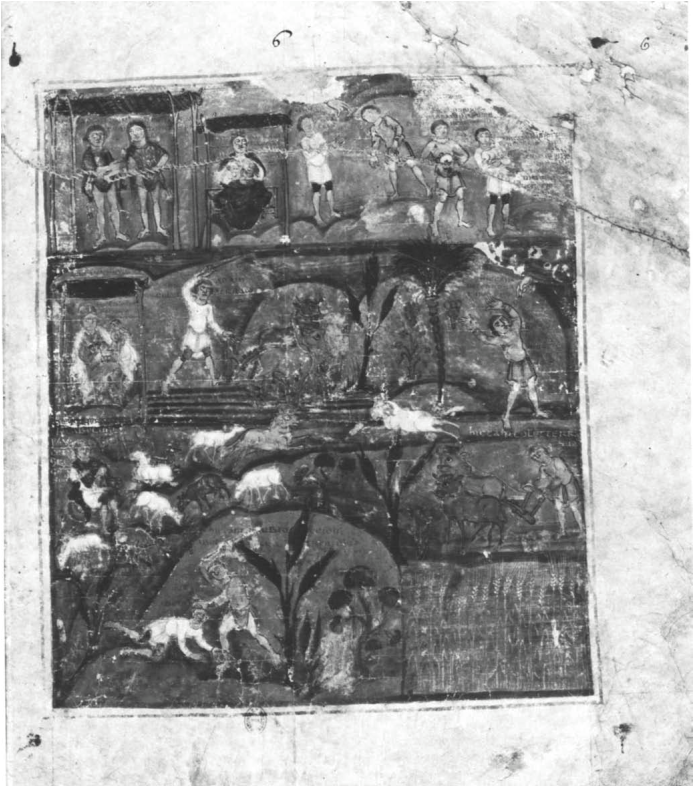
The frontispiece (fol. 2) lists the names of books in Latin and Latin transliterations of Hebrew displayed under a curtained arch, somewhat like antique representations of the Torah ark. Among the miniatures are: 1, the story of Adam and Eve after the expulsion and of Cain and Abel (fol. 6r), which includes the extrabiblical scene of the repentant couple in a bower; 2, a full-page miniature of the Deluge (fol. 9r), which depicts drowned giants, an element based on the Midrash; 3, Rebecca sought in marriage (fol. 21r), which includes a wealth of local details, including camels and black servants that may confirm a North African provenance for the manuscript; and 4, a three-part portrayal of Moses receiving the laws, delivering them to the Israelites, and preparing the tabernacle (fol. 76r).
The painting is in heavy gouache over pen drawings and Latin inscriptions, most of which are rewritten on the paint. Most of the miniatures are arranged in registers, but the episodes seldom correspond to the chronological sequence (see especially fol. 6r). The iconography of the scenes is unusual. Certain elements derive from mid- rashic sources, though others, such as the agent of creation shown as two men (fol. 1), are yet unexplained.
The rarity of illuminated manuscripts in this period allows little comparison of style. А сощ- parison of the very dense compositions, the heavy figure style, and the architectural framework with floor mosaics points to an origin in North Africa during the late sixth or early seventh century.
The manuscript was in Tours during the Caro- lingian period, when one of the figures of each dual creator was overpainted. In Tours the manuscript was probably used as a model for other illuminated manuscripts and wall paintings. In 1843, G. В. T. Libri stole the manuscript and, in 1846, sold it to the London bookseller Rodd. The Duke of Ashburnham acquired it in 1847, and, in 1888, it was purchased by the Bibliotheque Nationale.
bibliography: von Gebhardt, 1883; Lowe, 1930, V, p. 49; Gutmann, 1953-1954; Hempel, 1957; Narkiss, 1969; Narkiss, 1972.
Date added: 2026-07-14; views: 179;