
Old Testament panel from Sta. Maria Maggiore
Rome, 432-440. Glass mosaic. 119.3 X 203.1 cm. New York, The Metropolitan Museum of Art, Johnston Fund, 1924, 24.144.1
The mosaics of Sta. Maria Maggiore constitute the earliest surviving decoration of a Christian basilica. Although the apse mosaic was destroyed in 1288- 1292, the scenes from Christ's infancy on the triumphal arch are well preserved; twenty-seven of the original forty-two panels depicting Old Testament episodes in the nave are more or less intact.
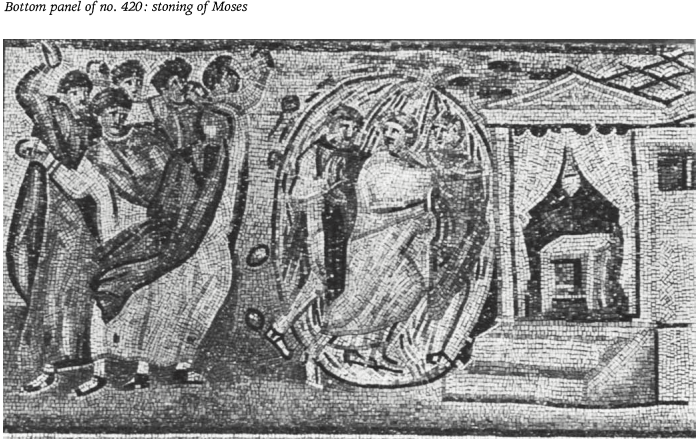
Two events from Numbers are portrayed in this panel from the middle of the right wall. At the top, either the return of the spies from Canaan (Num. 13:25-33) or, less likely, Korah's revolt (Num. 16:1-11) is depicted; the bottom presents the stoning of Moses (Num. 14:10). The generally close correspondence between the mosaic cycle and the Bible text suggests that the mosaicist copied an illustrated manuscript, but all attempts to connect the Roman cycle with extant Old Testament manuscripts have proven inconclusive. Parallels in later Western manuscripts—the ninth- century Bibles and the eleventh-century Aelfric Paraphrase—are more convincing than the correspondences often cited in Byzantine miniatures. One important element of the Sta. Maria Maggiore panel is not explained by the Bible text: the cloud that shields Moses, Joshua, and Caleb from the stoning. To explain this unusual iconography, Nordstrom (1959) adduced a passage in the Midrash Numeri Rabbah, “All the congregation bade stone them with stones. When the glory of the Lord appeared. This teaches that they cast stones but the cloud received them." The influence of a rabbinical text on mosaics in a Roman church indicates that the presumed manuscript model may have been a Jewish paraphrase of the Old Testament.
Although the Liber Pontificalis (1.232) indicates that Pope Liberius (352—366) built the church, modern excavations have shown that Sta. Maria Maggiore was constructed in a single campaign, mainly under Pope Sixtus III (432-440). An inscription on the triumphal arch proves that the mosaics date from the same time. In style and technique, the nearly contemporary mosaics in S. Giovanni in Fonte, Naples, and S. Aquilino, Milan, present striking similarities; but the closest parallels to the figures, compositions, and illusionistic settings are found in two Roman manuscripts, the Vatican Vergil (no. 203) and the Quedlinburg Itala fragments (no. 424). Not only do these parallels reinforce the connections to manuscript illumination, they help to place the mosaics within the context of the renewed classicism in Roman art during the first half of the fifth century, a period of artistic revitalization under papal patronage, following the sack of Rome in 410.
The vigorous, suggestive style of the Old Testament mosaics contrasts with the hieratic forms on the triumphal arch. Until it was demonstrated that both groups of mosaics were produced at the same time, the differences were attributed to different campaigns. Scholars now view the style of the triumphal arch as a reflection of the solemn, imperial mode and the nave panels as belonging to the Roman epic tradition. Brenk (1975) has also attributed some of the stylistic variation to five different mosaicists.
bibliography: Nordstrom, 1959, p. 32; Karpp, 1966, figs. 118-124; Brenk, 1975, pp. 91-94. 421 Pyxis with Moses and Daniel
Date added: 2026-07-14; views: 168;