
The Riha paten. Color plate XVI
Constantinople (?), 565-578. Silver with gilding and niello. Diam. 35 cm. Washington, D.C., Dumbarton Oaks Collection, 24.5. A generally fine state of preservation and the restoration, through careful cleaning, of the surface's rich luster to its original gleaming state make the Riha paten one of the most splendid early Byzantine objects yet to have been recovered archaeologically. Several breaks have occurred in the rim; cracks have developed along the edge of the bottom, in the architrave of the chancel barrier, and in the faces of both figures of Christ; some denting and crimping of the flat surfaces have taken place. Some of the niello is missing from the inscription, but most of the original gilding is preserved.
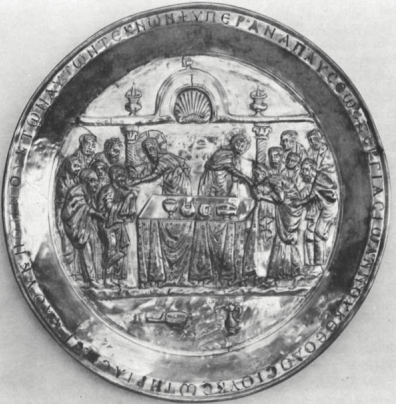
The nielloed dedicatory inscription on the rim corresponds to a formula commonly employed
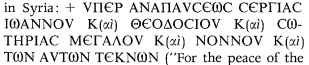
soul of Sergia, daughter of Johannes, and of Theodosios, and for the salvation of Megalos and Non- nous and their children").
Represented is the Communion of the Apostles, the sacrament for which such a paten is used in the church. Behind the draped altar two cross- nimbed figures of Christ administer the wine on the left and the bread on the right. On the altar are represented the implements; below, in the exergue, are a patera and a ewer. A ciborium in the form of an arched epistyle on two twisted columns with capitals, with a conch shell in the arch, and two standing, urn-shaped lamps, is placed behind the altar.
The Riha paten is similar to another silver, partly gilded paten from Stuma (fig. 82). Both bear control stamps of the emperor Justin II, but the stamps differ; therefore, it is reasonable to assume that the patens were made some years apart. Related to both patens is the double-page miniature of the Communion of the Apostles in the sixth- century Rossano Gospels (no. 443), and all three representations must share the same ultimate prototype. Jerphanion (1942) recognized the common denominator among the three and advanced the hypothesis that the prototype almost certainly was an apse decoration in the destroyed fourth- century Church of the Last Supper on Mt. Sion in Jerusalem, while Loerke (1975) assumed it to have been a cupola.
The representation of two Christ figures during the Communion of the Apostles occurs only in the Eastern Church but is thought to reflect the universal liturgical practice, originally of two deacons—and, later, of a priest and a deacon— administering the sacrament.
For some, the Riha paten has been the focus of discussions concerning style and place of origin. Formerly, the Riha and Stuma patens were localized to Syria, not only because they were found there, but because they seemed to follow the style known as "Syrian expressionism." Later, the stamps were introduced to show that the patens were made in Constantinople; and many scholars reevaluated them in the light of evidence that there coexisted in sixth-century Constantinople two different styles. Recently, Wessel (1969) has promoted the idea of a Syrian workshop in Constantinople.
Both the Riha and Stuma patens were discovered at or near sites of those names southeast of Antioch, in Syria. Together with the Riha paten were found a chalice and a rhipidion (no. 553), both of silver. A matching rhipidion from Stuma with control stamps identical to those on the Riha rhipidion has been adduced as evidence that the Riha and Stuma finds were originally one treasure.
bibliography: Jerphanion, 1942, pp. 418, 446; Ross, 1962, I, no. 10, pp. 12-15, ill.; Elbern (1), 1964, p. 134, ill. p. 131, fig. 116; Wessel, 1964, pp. 9—18; Wessel, 1969, pp. 367-369.
Date added: 2026-07-14; views: 313;