
Pair of book covers with Peter and Paul
Syria, 2nd half 6th century Silver with traces of gilding 27.3 x 21.6 cm.; 27 X 21.6 cm. New York, The Metropolitan Museum of Art, Fletcher Fund, 1950, 50.5.1,2. The two covers are in quite good condition, although the surface has dulled with corrosion. Fragments of the frame and background are missing from both panels. A recent analysis of the silver revealed traces of mercury from gilding on the figures and the peacocks. The covers, thin sheets of silver repousse, probably originally covered wooden cores. Holes on the sides may have served to secure the covers to the book by straps or chains.
On one cover, St. Peter holds a processional cross and raises his right hand in speech; on the other, St. Paul holds an open book. Each saint stands under an elaborate arch supported by spiral columns. Peacocks fill the spandrels. Each composition is framed by vine scrolls, which grow from a vase and meet on either side of a cross at center top.
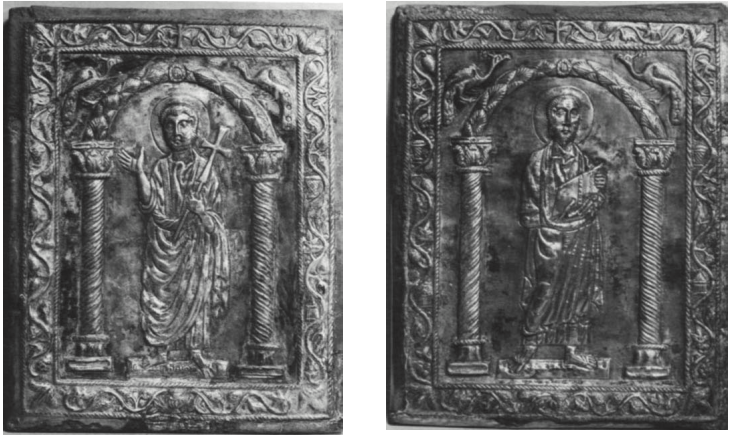
left, St. Peter; right, St. Paul
Evangelists, apostles, and saints are often placed in architectural frames in Early Christian art, a composition deriving ultimately from imperial sources (cf. no. 64). Paul is depicted in his role as teacher; Peter, with the cross-staff, symbol of Christ's Resurrection, as active preacher (cf. no. 509). The vine scroll, with its grape clusters, baskets of bread (?), birds, and birdcages (see Grabar [2], 1966; Hjort, 1968) clearly refers to the Eucharist and the revelation of divine truth.
The covers were probably made in Syria in the second half of the sixth century. The smooth, mannered folds of the saints' draperies resemble those of the silver plaque of St. Symeon Stylites in the Louvre (no. 529) and of figures in the Rabbula Gospels (no. 445, fols. 7a, 13b) and the Syriac Bible (no. 437, fol. 6b). The two panels are treated differently, reflecting the hands of two artists. Peter has more panache than Paul, if less anatomical integrity. The vine scroll on the Peter cover has fewer elements, and the vine scroll and the arch are higher and bolder in relief. Paul's panel is more linear, detailed, and subdued. Since Paul turns to the right he may have decorated the front cover (cf. Baltimore, 1957, no. 3).
These covers are the only surviving examples with Peter and Paul, and they probably enclosed a book of the Epistles. Although not as accomplished as the Riha paten (no. 547), they must have been impressive when gilded. They reportedly were found in an underground chamber in An- tioch-on-the-Orontes in 1911 (Eisen, 1916; Eisen, 1923, I, p. 3; cf. nos. 555, 542).
bibliography: Baltimore, 1957, nos. 3, 4; Kitzinger, 1958, pp. 33-34.
Date added: 2026-07-14; views: 247;