
Statuette of St. Peter. Rome, late 4th-early 3th century
Bronze. 9.3 cm. Berlin, Staatliche Museen Preussischer Kulturbesitz, Friihchristlich-Byzantinische Sammlung, 1. This statuette is complete and in good repair. Its identification as St. Peter is assumed from the hairstyle and physiognomy and by the attribute of the cross. Peter stands in contrapposto, wearing a short-sleeved tunic and pallium and holding a monogrammed cross (fashioned to suggest the first two Greek letters in XPICTOC ). He makes a speaking gesture with his right hand.
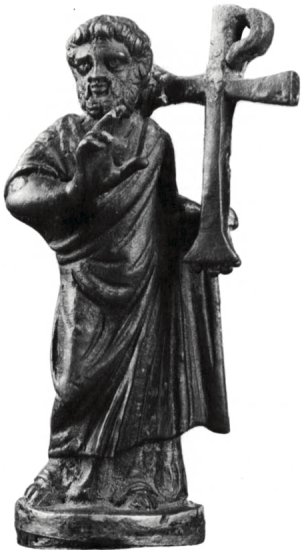
The iconography of Peter holding a cross typically appears in Dominus legem dat scenes, where Christ invests Peter with the responsibility of his ministry (cf. nos. 502, 503). The gem-encrusted or Chi-Rho-monogrammed cross held by Peter in such scenes is the triumphal cross of Christ's Resurrection and not the instrument of Peter's own martyrdom. Peter is thus singled out as the primary witness of the triumph over death and as Christ's earthly representative (Schumacher [2], 1959, pp. 15-18). This idea appears also to have motivated this representation, where Peter, making a speaking gesture often characteristic of Christ representations, displays the enlarged symbol of Christ's triumph.
The origin of this iconography is unclear. It is found on very few other monuments (cf. a terracotta lamp from Athens [Thompson, 1959, pi. 5, 7] and Grifflng, 1938, pp. 269-270), and no monumental prototype has been preserved. The dependence of Early Christian bronze sculptures on monumental art, however, can be demonstrated (cf. a lamp fragment with a Dominus legem dat scene, Verona [Franzoni, 1973, no. 186]). But whether the bronze records a lost Peter image from a holy site or is more simply a small iconic representation of the foremost prince of the apostles is difficult to determine (cf. an ivory diptych leaf with Peter and cross fVolbach, 1976, no. 135]).
Stylistically, this statuette is to be dated to the late fourth to early fifth century. Its similarity to the Verona lamp fragment, dated to the same period, all but assures an Italian origin. Although it has been suggested that the Berlin bronze also originally served as part of a lamp, it more likely follows the Roman tradition of small bronze deity statuettes. A representation of St. Paul could, theoretically, have been a companion piece to this statuette (see no. 554).
The Berlin bronze was said to have been found in a Roman catacomb in the early eighteenth century and was formerly in the Bellori collection, Rome.
bibliography: Schlunk, 1939, no. 129, pi. 41; Cecchelli, 1954, p. 140, fig. 64; Maccarrone, 1968, p. 66, fig. 1; Grabar (1), 1968, p. 70, fig. 169; Testini, 1969, no. 40.
Date added: 2026-07-14; views: 274;