
Apse with the Transfiguration
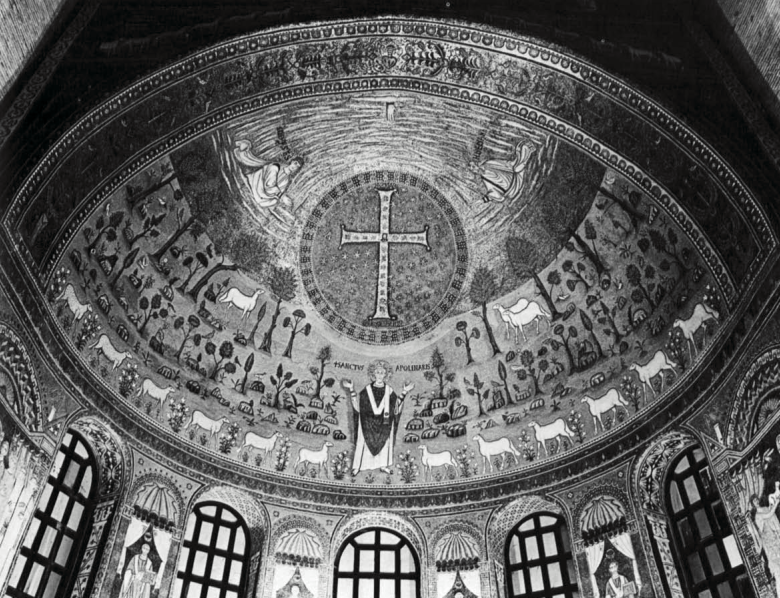
Ravenna, dedicated in 549. Mosaic. Apse diam. about 11.7 m. Ravenna, S. Apollinare in Classe. The apse at S. Apollinare in Classe is decorated with mosaics from several periods. The Transfiguration in the conch is depicted in symbolic form: half figures of Moses and Elijah emerge from a cloud-filled sky, flanking a jeweled cross with a bust of Christ at its crossing, enclosed in a star- studded blue circle. The hand of God issues from the heavens; below, three lambs, emblematic of James, Peter, and John, look up at the vision from a verdant garden. In the lower register, still within the garden, twelve lambs approach St. Apollinaris, orant, dressed in bishop's robes. Between the windows of the apse four bishops of Ravenna— Ecclesius, Severus, Ursus, and Ursicinus (533- 536), the founder of the church—hold books and stand in curtained niches beneath suspended crowns.
The archangels Michael and Gabriel, each holding a labarum, stand on the sides of the triumphal arch. This program dates from the midsixth century. Two panels from the seventh, one with Melchisedek, Abraham, and Abel, the other with Constantine IV granting a privilege to Archbishop Reparatus, flank the panels with the bishops. The other mosaics on the triumphal arch date from the ninth and eleventh to twelfth centuries. (For Renaissance and modern restorations, see Pela, 1970, pp. 53-98.)
The symbolic depiction is unique among the few known Early Christian examples of the Transfiguration, such as the apse decorations at the Ecclesia Stephania in Naples (535—555 [Thm, 1960, p. 176]) and at Mt. Sinai (548—565 [Dinkier, 1964, pp. 26-45]). Unlike the mosaic at Mt. Sinai, where the leading idea is the dogma of the Two Natures of Christ (Weitzmann, in Forsyth and Weitzmann [1973], p. 14), an eschatological interpretation of the feast predominates. The triumphal cross signals the Second Coming of the Lord from out of the heavens. The medallion bust of Christ, the inscriptions IX0VC (“Jesus Christ, Son of God, Savior") and salus mundi ("the salvation of the world"), and the archangels guarding the entrance to the sanctuary—paradise—emphasize the promise of Christ's coming again in judgment as described in early interpretations of the Transfiguration (St. John Chrysostom In Mattaeum Homilia 56 [Deichmann, 1969, I, pp. 262-263]).
In the lower zone, the sinopia under the mosaic depicts a frieze with garlands above a central cross flanked by plants, birds, and baskets of grapes (Bovini, 1972—1973). When the mosaic was laid, this traditional paradisiac subject was replaced with the figure of the church's martyr St. Apollinaris interceding for the faithful, represented by the lambs, His prayers for their salvation are reinforced by the blessings of the bishops below.
Although made only a few years after the mosaics at S. Vitale (nos. 65, 66, 593), the style of the mosaics at S. Apollinare is far more schematic in presentation of the landscape, the animals, and the human figures. Contours are thick, anatomical elements more isolated. Even the plants are more regimented in their balanced placement of stems, leaves, and flowers.
bibliography: Dinkier, 1964; Deichmann, 1969, I, pp. 256-277; Pela, 1970; Bovini, 1972-1973.
Date added: 2026-07-14; views: 318;