
Tomb relief with traditio legis
Rome, 4th quarter 4th century. Marble. 48.6 x 133.4 x 14.6. New York, The Metropolitan Museum of Art, Gift of Ernest and Beata Brummer in memory of Joseph Brummer, 1948, 48.76.2
The relief shows Christ in the central right niche, his face missing, his right hand raised in proclamation. He unfurls the scroll of the law toward Peter to his left. Paul, on Christ's right, looks up at him, probably acclaiming him with his missing right hand. Two young apostles also acclaiming, but not facing, Christ stand behind Peter and Paul. Two more apostles occupy the left-most niche. The bottom half of the relief is missing; the surface is considerably worn. Traces of arcades at the edges of the relief indicate that it had at least six, but most likely seven, niches with Christ in the center.
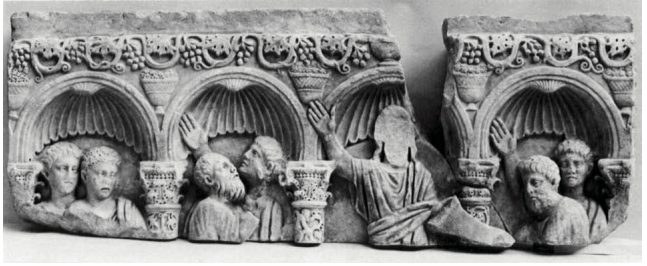
Three more pairs of apostles, therefore, may have flanked the scene of the traditio legis, although the missing niches may also have shown scenes from the life of Christ, as in the Lateran sarcophagus 174 (Bovini and Brandenburg, 1967, I, no. 677). The niches are decorated with shell conches and the horseshoe-shaped arches are supported on columns with elaborately carved vine scrolls and composite capitals. Another vine scroll grows from a vase over Christ's niche. It fills the frieze above the baskets of grapes in the spandrels of the arches.
The relief, first thought to be a forgery, has since been recognized as an important Roman sculpture of the Theodosian period (Brenk, 1970, pp. 43-44, 49). It is one of the earliest surviving examples of the traditio legis, Christ giving the law to Peter. In pose and dress, Christ resembles the Christ on the fragmentary front of a sarcophagus at S. Sebastiano in Rome, about 370 (Bovini and Brandenburg, 1967, I, no. 200), while the distribution of the apostles and the decoration of the columns parallel those of the Lateran sarcophagus 174 (see Sotomayor, 1961, pp. 225-230; Brenk, 1970, pp. 47-49). The traditio legis is here combined with the theme of Christ acclaimed by his apostles, both themes deriving from apse compositions (Ihm, 1960, pp. 33-39; Davis-Weyer, 1961, pp. 10 ff.).
The relief is a finely carved example of Roman work produced under strong Eastern influence in the late fourth century (Brenk, 1970, pp. 46-47, 50). The figural style is clearly Theodosian in the strong and subtly modeled, well-rounded bodies, the carving of the faces, and the delicate and intricate architectural decoration (cf. Kollwitz, 1941, pp. 132 ff.).
By analogy with several recently excavated reliefs in Istanbul (Firatli, 1960), the Metropolitan Museum's relief is thought to have once faced a wall grave. It was previously identified as the front of a sarcophagus.
Formerly in the collection of the Counts Picedi Benettini di Sarzana, Liguria, Italy.
bibliography: Brenk, 1970.
Date added: 2026-07-14; views: 299;