
Book cover with cross and saints
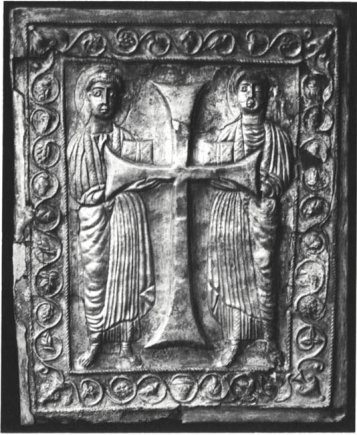
Syria, 2nd half 6th century Silver, originally partially gilt 28.2 x 23.2 cm. New York, The Metropolitan Museum of Art, Fletcher Fund, 1947, 47.100.36. The book cover is slightly more damaged than the covers of no. 554, especially around the frame. Like them, it is made of thin silver sheets, worked in repousse and probably once mounted on a wooden backing; the figures were originally gilt.
Two youthful saints, one with a short beard, hold books and support between them a large cross with flaring terminals. The frame is decorated with vine scrolls that grow from four amphorae at the corners of the plaque and harbor birds and a basket in their branches. A fragmentary relief in the Louvre (Coche de la Ferte, 1958, no. 42), with a bearded saint holding part of a cross, is probably part of the companion cover.
The figures on the Metropolitan Museum and Louvre panels cannot be surely identified as either apostles or evangelists, although evangelists do occur on covers of Gospel books, such as the sixth-century ivory covers in Milan (fig. 64) and the seventh- and eighth-century wooden covers in Washington (Morey, 1914, pp. 63-81). Similarly posed evangelists hold a monumental cross on the alabaster throne-reliquary in Venice (Grabar, 1954).
Although the composition is simpler on the Metropolitan book cover than on any of these, the symbolism is much the same. The figures hold forth the cross of salvation, the tree of life in paradise; the grapevine border with basket of bread (?) evokes the Eucharist—representing the Crucifixion, which opened paradise again to man. The subject is closely allied to the theme of the apostles guarding the cross (Ihm, 1960, pp. 88-89), found on the Prince's sarcophagus in Istanbul, a glass chalice in Washington (no. 545), and a gem in Vienna (no. 525; cf. also fig. 77). Angels hold a monumental cross on gems in Paris and Moscow (Ostoia, 1969) and adorn a jeweled cross in paradise on a paten in Leningrad (no. 482). The cover surely enclosed a Gospel book, which rested on the altar table not only during the Eucharist but permanently.
The figure style is allied to that of the covers with Peter and Paul (no. 554), but it is more abstract, characterized by rigidly repeated folds encasing the body, simplification and enlargement of the facial features, and a linear treatment of the hair, while the vine scroll is less organic. Although these stylistic differences show that a less adept artist executed this plaque, the treatment of the decorative bands on the tunic and especially the similar format of the covers indicate common working practices.
This cover was part of a group of liturgical objects reportedly found in Antioch (see nos. 542, 554). bibliography: Kitzinger, 1958, pp. 33-34; Ostoia, 1969, no. 9.
Date added: 2026-07-14; views: 289;