
Interactions Between Plants and Animals (Contribution by H. M. Schaefer)
Plants and animals interact in a myriad of ways (Figs. 19.17 and 19.18), resulting in complex interaction webs at the community or ecosystem level. For example, animals need particular species of plants for their food supply, and many flowering plants depend on animals for pollination, and especially woody plants in tropical forests depend on animals to disperse their seeds.
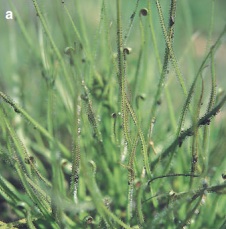
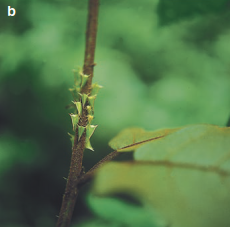
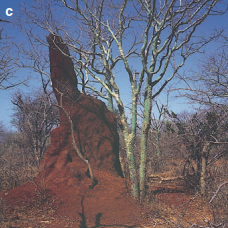
Fig. 19.17. Examples of manifold plant–animal interactions. Carnivory: The Mediterranean Portugese sundown (Drosophyllum lusitanicum) captures insects to complement nutrient uptake a. Commensalism: Thorn bugs use the stems of a Solanaceae in the montane forests of Ecuador as a mating place b. Termites can play an important role in nutrient cycling and thereby affect plant species composition as in the example of termite savannas in Africa c. (Photos: K. Müller-Hohenstein)
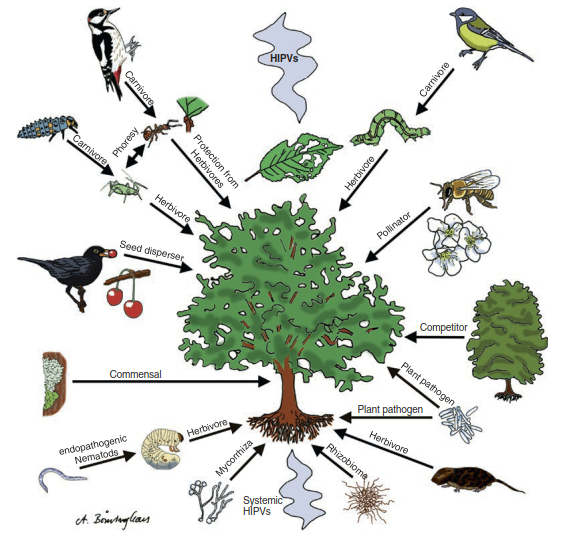
Fig. 19.18. Biological interactions between plants and other organisms (HIPVs: herbivore-induced plant volatiles)
The far-reaching effects of animals on plant communities become obvious in terms like “termite savanna” and “beaver meadow” or if we regard the transport of large amounts of nutrients from the sea to the mainland, for example, the Guano deposits in the North Chilean coastal regions. Animals not only sometimes depend on specific plant species but also on the structure of single plants or plant communities. For example, canopy height and layering of plant communities are key variables affecting the availability of resting and nesting sites—and thus habitat quality— for bird species, such as the Capercaillie (Tetrao urogallus), for example (Fig. 19.19). Numerous invertebrates find shelter under the leaves or bark of trees.
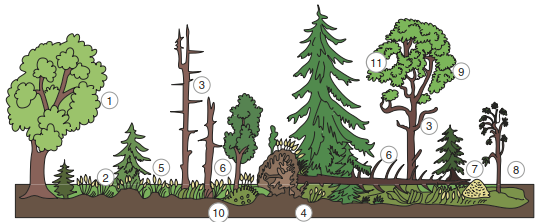
Fig. 19.19. Schematic of capercaillie (Tetrao urogallus) habitat requierements. A variety of different plant species, vegetation structures and environmental conditions are needed to fulfil habitat requirements for this bird species. 1: forage for beech buds in spring 2: protected nesting site 3: mating tree 4: grit uptake at root plates of fallen trees 5: forage for blueberries in summer 6: forage for xylobiontic insects on deadwood 7: forage for ants 8: mating site on the ground 9: forage for pine needles in winter 10: dusting sites 11: protected roosting site. (After von Hessberg 1998)
Thus, many characteristics of plants and plant communities have a considerable influence on animals, via:
- Food supply (e.g. leaf mass, fruits, wood, nectar, pollen).
- Carnivory
- Availability of physical structures (e.g. horizontal branches, closed canopy, dead wood).
Conversely, animals influence plants and plant communities in different ways, which can be partly understood as a response to the use of resources provided by plants, such as
- Herbivory (e.g. eating whole plants or only leaves, fruits).
- Pollination.
- Dispersal of seeds (and other propagules).
- Change of soil properties (e.g. bioturba- tion, degradation of organic matter by invertebrates).
Some of these interactions have long been the focus of ecologists and evolutionary biologists alike because they represent the backbone of structuring terrestrial biodiversity. However, plant and animal communities differ in some ways. Animal communities are usually richer in species. Animals use different resources in time and space, which obliges them to move between sites. Table 19.3 shows the temporal turnover in the population of ground-dwelling beetles (Coleoptera) in a semidesert species poor plant community. Therefore, for animal ecologists it is practically impossible to take a complete inventory of all animal species at one time, and recording of this diversity is a very time-consuming task requiring the cooperation of several taxonomic specialists.
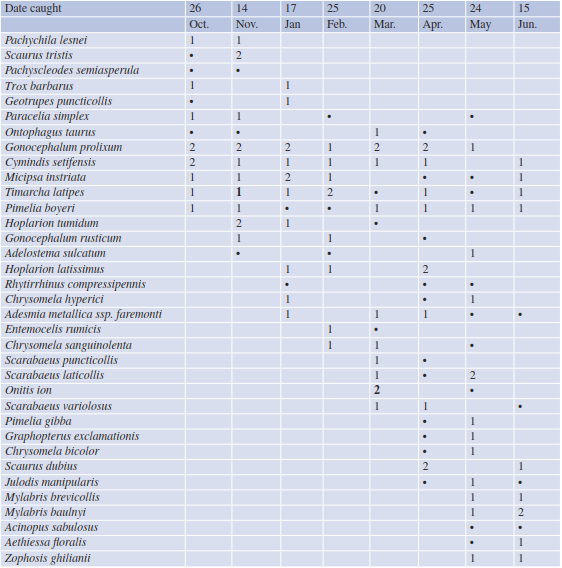
Table 19.3. Temporal dynamics of beetle species in a Stipa tenacissima community on high plateau of eastern Morocco (Müller-Hohenstein 1978). Beetles were caught in the same area at approximately monthly intervals between October 1973 and June 1974 (• = Only one, 1 = Several, 2 = Many)
Classification of Plant-Animal Interactions.The interactions between plants and animals can best be understood by looking at their evolutionary effects on both groups. A classification of these interactions must consider two different directions: the influence of plants on animals and, conversely, that of animals on plants. The interactions can be beneficial for both groups, beneficial for one group only and either neutral (commensalism) or detrimental to the other group, or neutral to both sides. Mutually beneficial interactions are termed mutualism; they occur predominantly in pollination and seed dispersal where animals typically obtain a nutritional reward for dispersing the genes of plants. However, mutualisms occur also in mycorrhizal symbiosis where plants provide carbohydrates to the mycorrhizal fungi, which supply minerals in exchange. Well known are also mutualistic interactions between ants and several Acacia species, for example, Acacia drepanolobium. The ants use nectar from glands produced by the tree and defend the tree from herbivores (Fig. 19.20).
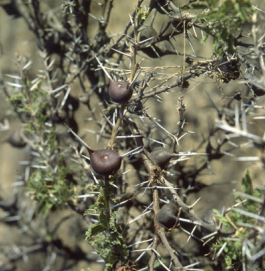
Fig. 19.20. Acacia drepanolobium is an important partner for mutualistic interactions with different ant species in semiarid tropical woodlands. (Photo: K. Müller-Hohenstein)
Mutualisms can be viewed as biological markets (Werner et al. 2014; Stournaras et al. 2015). In general, reciprocal rewards stabilise mutualisms, which occur if both partners can exert control over the interaction, for example, by directing resources to reward partners. Herbivory and carnivory are examples of interactions that are beneficial to only one group, the consumer, and detrimental to the other. Such interactions are termed antagonisms. Herbivory occurs if animals consume plants or parts of them, whereas carnivory occurs if plants consume animals. Neutral interactions are those that do not affect the fitness of interacting partners. An example of a neutralism is if a bird uses a plant as a lookout or to broadcast its song but does not interact with the plant in other ways, for example, by consuming herbivorous insects on it. This would be an example of commensalism. Considering the fitness effects of plant-animal interactions allows us thus to trace the evolutionary history that has shaped these interactions and the traits of both the plants and animals involved.
Date added: 2026-04-26; views: 257;