
Sarcophagus of Junius Bassus
Rome, 359 Marble. Sarcophagus: 141 x 243 x 144 cm. lid: 40 x 240 x 137 cm. Vatican City, Reverenda Fabbrica di S. Pietro in Vaticano. The lid is broken away except for a few centimeters at the base molding (Himmelmann, 1973). The figures in the ten niches are well preserved. Missing is the head of the servant on the upper right. Below, the originally naked Daniel has been replaced by a modern palliatus. The inscription on the upper edge reads: iun-bassus-v-c-qui vixit
ANNIS-XLII MENTITN IPSA PRAEFECTURA URBI NEOFI- TUS IIT AD DEUM-VIII-KAL-SEPT-EUSEBIO ET YPATIO coss. ("Junius Bassus, vir clarissimus, forty-two years and two months old, performing the duties of city prefect went newly baptized to God on 25 August during the consulate of Eusebius and Hypatius [= in the year a.d. 359]"). On the tabula of the lid a fragmentary inscription honors, originally in eight distiches, the official functions of Bassus and records the dignified funeral.
The sarcophagus is laid out in two registers of five niches, each separated by columns, six on each register; the two columns on the outside are spirally fluted; the two central ones are decorated with grapevines and in them climbing Erotes. The upper niches are covered by richly adorned architraves; below, shells and gables alternate.
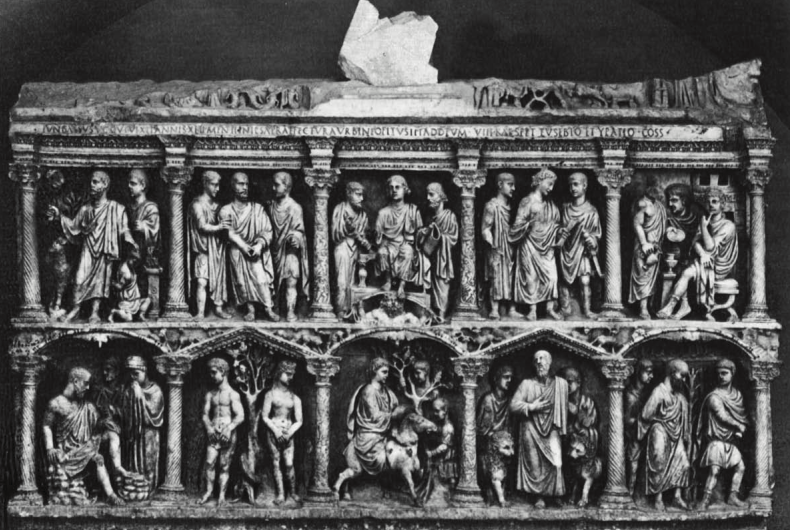
The almost fully plastic groups in the niches illustrate scenes of the Old and New Testaments. Upper zone: in the middle the youthful Christ, flanked by two apostles, a scroll in his left hand, is enthroned above the bearded personification of Caelus with the cloth of heaven. To the right follows the presentation of Christ by two soldiers before the pensive Pilate, who is seated on the sella curulis; at the left are the arrest of Peter and Abraham sacrificing Isaac, who kneels in tunica exomis in front of an altar; behind it is an accompanying servant; on the upper left is the hand of God (broken off); on the lower left, the ram looking up. Lower zone: in the middle, Christ's Entry into Jerusalem on a horselike donkey, with a small figure spreading out a robe and a man cutting branches in the fork of the tree (Matt. 21:1—11); at the right is Daniel, as noted, between the lions and the scene of Paul led to his martyrdom; a clump of reeds in the rear indicates its place by the Tiber; at the left is the Fall of Man, the progenitors flanking the tree with the serpent, and Job sitting on a pile of stones, with his wife and a friend, who are standing.
Noteworthy in the spandrels are the allegorical lambs, from the left to the right: Three Hebrews in the Fiery Furnace; Peter Striking the Rock; the Multiplication of the Loaves and Fishes; Baptism of Christ; Moses receiving the law; Raising of Lazarus. On the left short side: above, four Erotes harvesting grapes; below, ox cart with two baskets of grapes and wine-pressing Erotes. On right short side: three Erotes cutting, binding, and carrying sheaves of grain; below, six Erotes representing seasons: Winter, Autumn, and Spring (Hanfmann, 1951, II, p. 184, no. 540). For the fragmentary representations on the lid, see Himmelmann, 1973, pp. 13—28.
The sarcophagus belongs to the class of Passion sarcophagi; its upper zone has an accurate icono- graphical parallel in a Lateran sarcophagus (Bovini and Brandenburg, 1967, I, no. 677), in which the scenes are distributed over seven niches, with the Sacrifice of Isaac in the left corner, a scene that since Melito of Sardes (about a.d. 190) has been interpreted typologically as representing the Crucifixion of Christ. The scenes in the middle expand the heavenly majestas into an earthly majestas: the entry of the Messiah into Jerusalem. The gay representations on the short sides of the seasons passing from spring to winter are typical for third- and fourth-century monuments (Hanfmann, 1951, I, p. 59; II, p. 184, no. 540).
The Bassus sarcophagus belongs to the so-called beautiful style (between 340 and 360), to which belong also the sarcophagus of the Two Brothers and the Lot sarcophagus (Bovini and Brandenburg, 1967, I, nos. 45, 188). All of them show almost fully plastic figures.
Found in 1597 or 1595 (Bovini and Brandenburg, 1967, I, p. 279) under the confessio of St. Peter's. Additional fragments with inscriptions were unearthed in 1940-1943 during the excavations under St. Peter's. An engraving of 1632 (Bosio, fig. 45) shows the sarcophagus before the restoration of the Daniel scene.
bibliography: Gerke, 1936; Bovini and Brandenburg, 1967, I, no. 680; Himmelmann, 1973, pp. 13-28.
Date added: 2026-07-14; views: 170;