
Caesar’s First Invasions of Britain: Strategic Analysis and Politics
Logistical Preparations and Naval Mobilization for the British Expedition. Late in the summer of 55 BC, Julius Caesar made the decision to initiate a reconnaissance-in-force across the English Channel into Britain. Although the operation could be little more than a rapid, hastily organized raid with the explicit expectation of returning to winter quarters in Gaul, it marked a major expansion of Roman military reach. Caesar assembled his naval forces along the coast of the Morini territory (near modern Pas de Calais), requisitioning the specialized fleet previously built to fight the Veneti, alongside captured vessels and ships supplied by Gallic allies. The arrival of Caesar’s legions prompted the previously hostile Morini to offer their submission to Rome.
The invasion force was intentionally streamlined to maximize speed and minimize logistical overhead. The proconsul gathered just under 100 sailing ships to serve as transports, compelling the expeditionary force to carry minimal baggage and rely on field foraging from local British grain crops. Caesar allocated 80 transport vessels to two core legions—the Seventh (Legio VII) and Tenth (Legio X)—which at this stage fielded approximately 4,000 men apiece, yielding an average density of 100 legionaries per transport. An additional 18 transport vessels were assigned to the auxiliary cavalry, while senior military officers and administrative staff were accommodated within the cramped quarters of the oared war galleys. The main body of the Roman army remained on the continent under legates tasked with subduing the Menapii and remaining rebellious factions of the Morini, as well as guarding the primary embarkation harbor near modern Boulogne.
Intelligence Constraints and Pre-Invasion Reconnaissance. Prior to setting sail in late August, Caesar attempted to gather tactical and geographic intelligence concerning Britain. However, interviews with regional merchants yielded minimal actionable data. Maritime trade routes across the Channel were dominated by Gallic traders—many belonging to coastal tribes recently suppressed by Roman armies—who were reluctant to assist Roman expansion that threatened their trade monopolies. Furthermore, commercial traffic focused primarily on trade hubs farther west, such as Hengistbury Head, whereas Caesar targeted the south-eastern coast.
To bridge this intelligence gap, Caesar dispatched a warship commanded by Caius Volusenus on a 5-day reconnaissance patrol along the British coastline. Volusenus surveyed the coast without risking a beach landing, observing key features such as the Wantsum Channel and the island of Thanet. In response to news of the impending invasion, several British tribal representatives arrived at Caesar’s camp offering hostages and peace alliances. Caesar sent them back accompanied by Commius, a Gallic chieftain of the Atrebates appointed as a client king by Rome, who possessed cultural connections in Britain. However, upon landing in Britain, Commius was seized and imprisoned by local tribes, cutting off Caesar’s internal diplomatic channel.
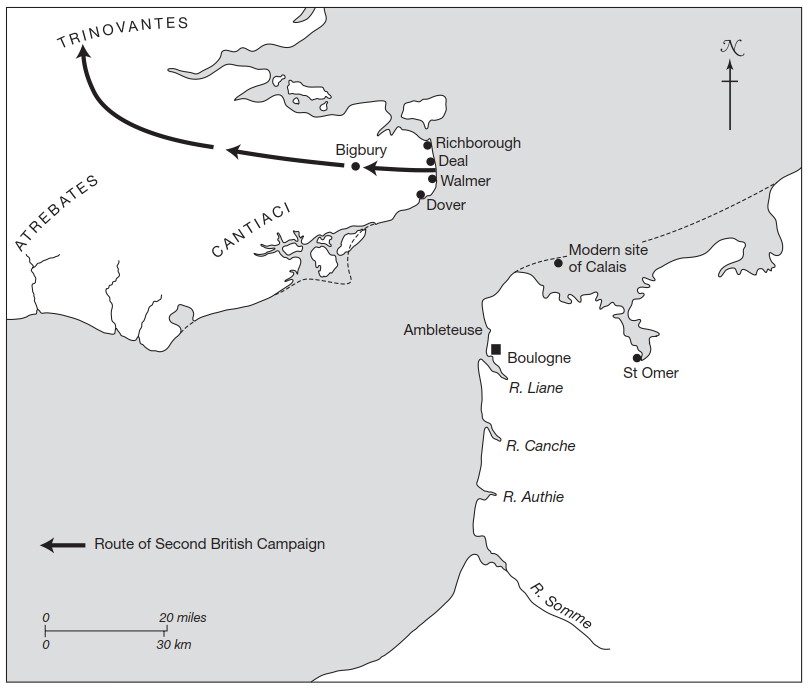
Fig. 1. The probable coastline of Britain and Gaul in 55 BC.
Amphibious Assault at Dover and Beachhead Tactics. The expedition encountered critical disruptions from its inception. The 18 cavalry transports failed to depart simultaneously due to adverse weather shifts, leaving the main infantry convoy to cross the Channel alone before dawn. The leading Roman warships reached the British coast near modern Dover by late morning, where Caesar encountered high chalk cliffs heavily defended by massed British forces. Recognizing that the landing zone was tactically untenable against missile fire from the heights, Caesar held his ships at anchor until late afternoon to assemble his scattered fleet.
Following a brief council of war with his senior staff, Caesar ordered the fleet to advance 7 miles along the coast to a flat, open shore near Deal or Walmer. The British forces shadowed the fleet’s movement along the coastline, deploying cavalry and war chariots to contest the landing site.
Combat Engagements during Disembarkation. The amphibious landing presented severe tactical challenges for the Roman infantry. Deep drafts prevented the heavy transport ships from beaching in shallow water, forcing the legionaries to disembark into deep water while laden with armor and weapons. Heavily encumbered, the soldiers struggled to maintain formation while coming under missile fire from mobile British defenders.
To suppress the enemy, Caesar directed his oared warships—equipped with slings, archers, and deck-mounted bolt-shooting artillery (catapultae)—to deploy on the exposed flank of the British forces. The artillery barrage provided suppressive fire, forcing the defenders to pull back. Rallying the troops, the standard-bearer (aquilifer) of the Tenth Legion leaped into the sea with the legionary eagle standard, calling on his comrades to advance. Inspired by his action, the legionaries jumped from the transports to establish a organized fighting line in the surf.
"Jump down, soldiers, unless you want to give up your eagle to the enemy; everyone will know that I at least did my duty to the Republic and my commander!"
Using rowing boats and light reconnaissance vessels as mobile tactical reserves, Caesar directed reinforcements to vulnerable points along the landing line. After sustained hand-to-hand fighting, the legionaries secured the beachhead and routed the British forces. However, the absence of Roman cavalry prevented any effective pursuit of the retreating enemy.
British Resistance, Chariot Warfare, and Coastal Clashes. Following the successful landing, the Roman army established a fortified camp near the beachhead. Nearby British chieftains sued for peace, returned Commius with a small mounted escort of 30 retainers, and surrendered hostages. However, 4 days after the landing, a sudden storm dispersed the incoming 18 cavalry transports as they approached the British coast, driving them back toward Gaul. The storm also severely damaged the Roman fleet anchored off the open beachhead, destroying 12 ships and damaging the remaining vessels.
Recognizing that the Romans were short on supplies and lacked cavalry, the British leaders renewed hostilities. They quietly withdrew from the Roman camp and organized an ambush targeting Roman foraging parties.
Tactical Operations and British Chariot Mechanics. While Roman engineering details worked to repair the damaged fleet, foraging detachments from the Seventh Legion were ambushed while harvesting wheat in nearby fields. The British forces deployed light cavalry and traditional war chariots (esseda). In contrast to continental tactics where chariots had been phased out, British commanders used two-horse chariots driven by an unarmed driver while an aristocratic warrior engaged enemies with thrown javelins before dismounting to fight on foot.
"This is how they fight from chariots – to start off with they drive all over the field and throw javelins... when they have charged forward between the troops of their own cavalry, they jump down from the chariot cars and fight on foot."
Alerted by a large dust cloud raised near the fields, Caesar personally led the camp's outposts to relieve the encircled foragers. Deploying two cohorts to stabilize the line, Caesar checked the British assault and escorted the Seventh Legion back to the main camp. Encouraged by their initial success, the British assembled a larger force to attack the Roman camp directly. Caesar drew up his legions on the plain outside the ramparts alongside Commius’s small cavalry unit. In open infantry battle, the Roman legions defeated the British forces, routing their ranks and burning the surrounding settlements.
Strategic Outcomes and Political Impact in Rome. Following their defeat, the British chieftains again sought terms. Caesar doubled the required hostage count, demanding that they be delivered directly to Gaul to avoid delaying his departure. Utilizing 68 repaired transport vessels alongside the surviving warships, the entire army embarked near the September equinox, making a nighttime crossing back to the Gaulish coast.
Upon landing, two transport ships were blown off course into the territory of the Morini. Local warriors attacked the stranded legionaries, but Caesar dispatched his full cavalry force to rescue them without suffering a single fatality. The following day, Titus Labienus led a punitive campaign with the Seventh and Tenth legions, forcing the Morini to surrender. Meanwhile, legates operating in the north successfully concluded the campaign against the Menapii.
Historiographical Assessment and Political Consequences. From a tactical and strategic perspective, the initial expedition of 55 BC achieved limited military objectives. The Roman army remained confined to a narrow coastal strip, gathered minimal geographic intelligence, and suffered major naval damage due to adverse Channel weather. Nevertheless, in terms of political impact and domestic prestige, the campaign proved highly successful. News that Roman legions had crossed the Ocean to an unknown island generated widespread enthusiasm in Rome.
The Roman Senate voted a 20-day public thanksgiving (supplicatio) in honor of Caesar’s achievements—a period 5 days longer than the thanksgiving awarded for his previous Gallic campaigns. This formal recognition effectively countered political attacks led by Cato the Younger in the Senate. Having demonstrated Roman military power across both the Rhine and the English Channel within a single campaigning season, Caesar returned to winter quarters, already planning a larger second expedition to Britain for the following summer.
Date added: 2026-09-24; views: 1;