
The Campaign of Ilerda: Military Strategy in the Roman Civil War
Strategic Antecedents and Disposition of Forces in the Spanish Campaign. Julius Caesar famous described the Pompeian forces in Hispania as "an army without a general." Seven legions of the Pompeian army were stationed in the Spanish Peninsula under the command of three legates who lacked operational cohesion: Marcus Terentius Varro, Lucius Afranius, and Marcus Petreius. Varro, a celebrated polymath and author of broad scholarly works, had maintained a long political association with Pompey (notably writing a senatorial manual for him in 70 BC), but possessed limited tactical acumen. Commanding Further Spain (Hispania Ulterior) in 49 BC, Varro’s army operated independently and failed to unite with the primary Pompeian force, rendering his division military ineffective during the opening phases of the campaign.
Tactical Structure of the Pompeian Forces. The bulk of active resistance was led by Lucius Afranius and Marcus Petreius, who concentrated five legions alongside substantial auxiliary troops near the strategic settlement of Ilerda (modern Lérida). Petreius was a seasoned veteran who had commanded the army that defeated Catiline in 63 BC, bringing over thirty years of military experience, though primarily in subordinate roles. Afranius, consul for 60 BC, was technically senior in rank, creating an ambiguous command structure between joint authority and formal seniority. Their forces were bolstered by 10,000 cavalry and eighty cohorts of Iberian infantry—predominantly heavy infantry (scutati) and light-armed skirmishers (caetrati) equipped with javelins and small circular shields.
Strategic Manoeuvres and the Siege of Massilia. Caesar initiated his counter-campaign by instructing his legate Caius Fabius to advance three legions from Narbo to secure the Pyrenean passes and engage Afranius and Petreius. As three additional legions were directed to reinforce Fabius, Caesar marched south but was delayed outside Massilia (modern Marseille). Although Massilia held long-standing historical ties to Caesar as proconsul of Gaul, its oligarchic leadership maintained ancestral client ties to Pompey dating to the Sertorian War. Attempting neutral diplomatic posturing, Massilia nevertheless admitted Lucius Domitius Ahenobarbus, who assumed command of the city's defense. Caesar left three legions under Caius Trebonius to conduct the naval and land siege of Massilia, supported by a naval squadron under Decimus Brutus, before pressing forward to Spain with a bodyguard of 900 Germanic cavalry.
Tactical Engagements and Engineering Challenges at the River Sicoris. Upon joining Fabius at Ilerda in June 49 BC, Caesar consolidated six legions—likely the Sixth, Seventh, Ninth, Tenth, Eleventh, and Fourteenth—alongside allied auxiliary contingents. To secure financial backing and bolster army morale, Caesar borrowed capital from his military tribunes and centurions, distributing the cash directly to the legionaries. This fiscal maneuver served a dual purpose: securing the material loyalty of his officer corps while incentivizing rank-and-file enthusiasm. The opposing armies initially faced each other across the River Sicoris (modern Segre), where Fabius had constructed two wooden pontoon bridges located four miles apart to maintain foraging communications on the eastern bank.
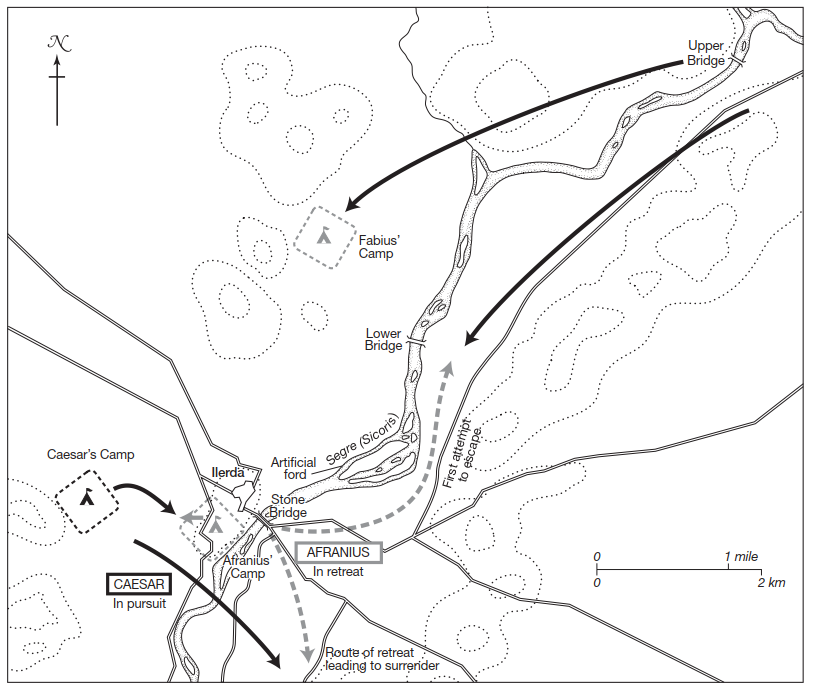
Fig. 1. Map of the military maneuvers, troop deployments, and lines of retreat during the Battle of Ilerda.
Logistical Crisis and the Battle for the Hillock. Seasonal rainstorms triggered sudden flooding that swept away both of Fabius’ bridges, stranding Caesarean foraging parties and severe logisitical distress. Caesar overcame the river barrier by introducing lightweight, timber-framed boats covered in hides—a design adopted during his military expeditions in Britain. Transported 22 Roman miles upstream under darkness, these vessels enabled his legions to cross undetected, establish a bridgehead, and erect a new bridge in two days. Concurrently, Caesar ordered the construction of artificial canals to divert the Sicoris, creating a usable ford. During subsequent tactical movements aimed at occupying a key hillock between the Pompeian camp and Ilerda, Caesarean forces faced fierce resistance from Afranian troops utilizing loose, irregular tactics adapted from native Spanish tribes. The engagement resulted in heavy losses, including 70 dead and 600 wounded for Caesar, and approximately 200 casualties for the Pompeians.
Operational Encirclement, Surrender, and Strategic Fallout. Sensing a shift in strategic momentum and threatened by Caesarean cavalry dominance, Afranius and Petreius initiated a withdrawal toward Octogesa on the River Ebro. Caesar’s legions successfully waded the artificial ford across the Sicoris and executed an aggressive marching maneuver through rugged terrain, successfully outracing the Pompeian column to secure the mountain passes and block their line of retreat.
Capitulation at Ilerda and Northern Hispania. Refusing his soldiers' demands for an immediate bloodbath, Caesar opted for an operational blockade, systematically cutting off the Pompeian army from its water and supply lines to force a surrender without unnecessary loss of life. Fraternization between the opposing Roman troops grew rapidly, despite an attempt by Petreius to execute Caesarean soldiers found within his lines. Bound by lack of supplies and morale exhaustion, Afranius and Petreius formally capitulated. Caesar pardoned both legates and disbanded their legions without reprisal.
Complete Pacification of the Iberian Peninsula. Following the surrender at Ilerda, Caesar marched into Further Spain, where Marcus Terentius Varro, abandoned by his troops and surrounded by a pro-Caesarean populace, yielded his remaining forces without resistance. By late summer 49 BC, Massilia surrendered following the flight of Domitius Ahenobarbus. Through combined tactical flexibility, engineering ingenuity, and strategic clemency, Caesar neutralized seven Pompeian legions and secured full control of the Spanish provinces, liquidating the Western theater before turning his focus to the East.
Date added: 2026-09-24; views: 2;