
The Siege of Dyrrhachium: Strategic Maneuvering in the Roman Civil War
Strategic Maneuvering and the Encirclement at Dyrrhachium. Eventually, on 10 April, Mark Antony successfully transported the bulk of the Caesarean troops across the Adriatic from Brundisium to Greece. Landing near Lissus in the north with four legions and 800 cavalry, this vital reinforcement bypassed Pompey the Great, who was too slow to prevent the convergence of the two forces. With a more powerful army at his disposal, Julius Caesar still faced numerical inferiority, particularly in cavalry, but relied on the superior quality of his veteran legionaries to counterbalance this tactical disadvantage. The sudden influx of troops exacerbated supply issues, prompting Caesar to dispatch large detachments away from the main army to protect allies in Thessaly and Macedonia. When Pompey refused offers of battle in hopes of wearing down the Caesareans through starvation, Caesar moved swiftly to capture his opponent's main supply base at Dyrrhachium, pitching camp between the town and the enemy army after arriving just too late to seize the supplies directly.
Fortification and Logistical Warfare. The Pompeian forces took up a defensive position on a hill called Petra, which overlooked a natural harbour, granting them easy sea communication and allowing grain convoys to arrive from as far afield as Asia. Positioned on higher inland ground, Caesar ordered the construction of extensive fortifications to protect his foraging parties and to restrict the Pompeians, who possessed significantly more cavalry mounts and supply animals. By enveloping his rival, Caesar aimed to diminish Pompey's prestige (auctoritas) among foreign nations by portraying him as besieged and terrified of fighting a decisive battle. Forced to respond, Pompey commanded his own men to build a counter-fortified line; this defensive perimeter eventually stretched 15 Roman miles and was strengthened by twenty-four distinct forts. Because Caesar was on the outside attempting a complete circumvallation, his siegeworks inevitably had to be larger and eventually extended for approximately 17 miles.
Resource Deprivation and the War of Attrition. Although the calendar indicated spring, seasonal winter conditions kept food scarce for the Caesareans, who often relied on barley and a root plant called charax, which they mixed with milk and baked into a crude loaf. Upon seeing this survival bread, Pompey ruefully remarked that he was fighting beasts rather than men. To intensify the blockade's pressure, Caesar ordered his troops to divert or dam the streams flowing into the enemy camp, severely depriving them of fresh water. While the Pompeians had ample food delivered via sea shipments, they lacked water, forcing them to dig new wells with limited success while disease, potentially typhus, broke out in their crowded camps. Unbroken in spirit, Caesarean sentries reportedly vowed to eat tree bark before letting the enemy escape, occasionally hurling charax loaves into the Pompeian trenches to demonstrate their unyielding determination.
Tactical Engagements and the Heroism of the Ninth Legion. Skirmishes intensified as the siege persisted, with Pompeian archers targeting Caesarean campfires at night, forcing soldiers to sleep away from the flames in the cold to avoid the deadly missile fire. Pompey launched a series of major probing attacks to test the strength of the fortifications, one of which was successfully repelled by Publius Cornelius Sulla, who prudently chose not to overextend his counter-attack with his two reinforcing legions. During another fierce engagement, three cohorts of the Ninth Legion defended a key sector against an entire Pompeian legion supported by large numbers of allied archers and slingers. Over 30,000 arrows were later recovered from the fort, and virtually every defender suffered wounds during the day of bitter fighting. Centurion Scaeva displayed extraordinary bravery; despite losing an eye and taking hits to his thigh and shoulder, he held his ground after his shield was pierced by 120 missiles.
The Map of the Blockade and Scaeva's Reward. The strategic layout of these massive circumvallation lines is clearly depicted, as shown in Fig. 1.
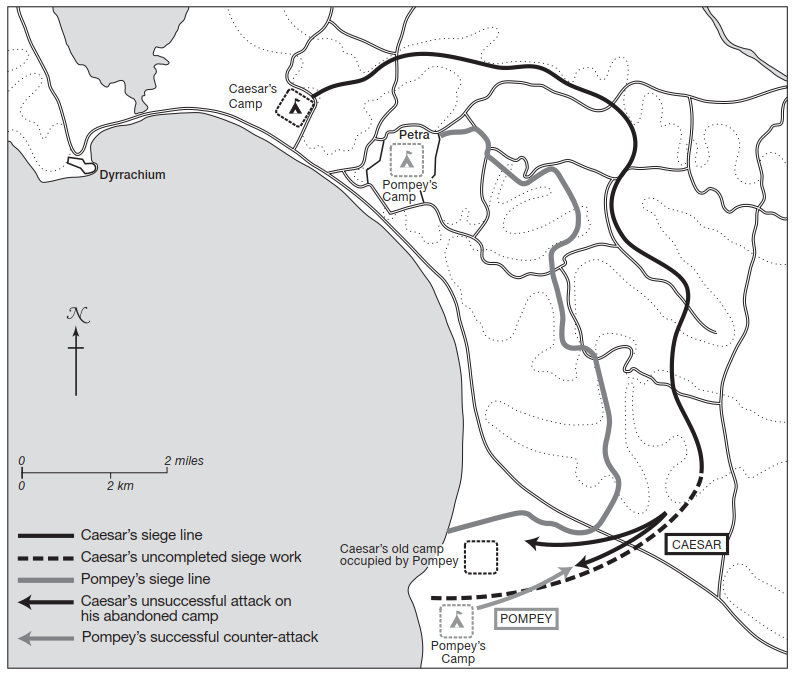
Fig. 1. The lines at Dyrrhachium
During his defensive stand, Scaeva feigned a willingness to surrender to lure the enemy, subsequently killing one and severing the arm of another, intimidating the attackers into halting their advance. For this astonishing display of martial prowess, Caesar lavishly rewarded the entire cohort with extra grain, decorations, and double pay, while Scaeva received a 200,000-sestertii bounty and a promotion to primus pilus before later leading an auxiliary cavalry unit named the ala Scaevae. Overall, Caesar reported losing only twenty dead in these assaults, while claiming the Pompeians suffered around 2,000 casualties, including a former praetor's son. Following this burst of fighting, Pompey's men fortified their vulnerabilities by raising ramparts to 15 feet, while Caesar repeatedly offered battle on unfavourable, rough ground, which Pompey continually declined in favor of starvation tactics.
Treachery, Intelligence, and the Breaking of the Blockade. The stalemate broke following the desertion of two Gaulish noblemen, the brothers Roucillus and Egus, who had commanded tribal cavalry for Caesar with distinction and had even been elevated to senatorial rank. Facing impending punishment for embezzling their men's pay and falsifying troop returns, the brothers defected to Pompey, bringing invaluable intelligence regarding the exact layout and routine of the Caesarean fortifications. Armed with this tactical blueprint, Pompey planned a major midnight assault on the southernmost sector of the lines, where the defenses were incomplete and closest to the sea. Pompeian legionaries crafted wicker coverings for their helmets to prevent bronze glints from revealing their position in the dark and to dampen the concussive force of sling stones. Attacking with a main force of sixty cohorts, the Pompeians outflanked the defenses from the sea and quickly drove off the two cohorts of the Ninth Legion on duty, successfully seizing control of the sector despite the swift arrival of Mark Antony and Caesar with reserves.
The Failed Counter-Attack and the Caesarean Rout. Seeking to neutralize this breakthrough, Caesar identified a vulnerable Pompeian legion occupying an old, abandoned fort nearby and launched a deception maneuver with thirty-three cohorts. The Caesareans successfully stormed the outer walls by hacking apart the defensive barrier of stakes, but internal resistance from a smaller garrison enclosure halted their momentum. Confusion struck the right wing, which mistakenly followed a rampart away from their objective, leading to a catastrophic breakdown in unit cohesion just as Pompey launched a massive counter-attack with five legions and a large body of cavalry. The Caesarean cavalry dissolved into panic, sparking a full-scale rout where terrified men were trapped in the ditches and abandoned their military standards. When Caesar attempted to physically halt the fleeing standard-bearers, the panic was so absolute that one man even tried to stab the commander with the standard's butt spike, forcing a bodyguard to slice off the attacker's arm to save Caesar's life.
Strategic Withdrawal and the Aftermath of the Siege. The disastrous counter-attack cost Caesar 960 soldiers, 32 officers, and 32 standards, yet Pompey failed to exploit the momentum with a full assault—a hesitation Caesar noted by stating the enemy would have won had they been commanded by a victor. Following the skirmish, Pompeian commander Labienus mockingly executed captured legionaries in plain view of the Caesarean lines. Recognizing that the attempt to blockade the Pompeians had definitively failed and lacking resources to construct new lines, Caesar paraded and mildly reprimanded his demoralized troops, demoted several standard-bearers, and prepared to withdraw. Under the cover of darkness, he sent his one-legion escort, baggage train, and wounded towards Apollonia, followed by the main army just before dawn. Two rearguard legions remained to sound the normal morning trumpet calls to deceive the enemy before slipping away, and despite a delayed pursuit by Pompeian cavalry, Caesar's tactical retreat successfully broke contact, formally ending the siege of Dyrrhachium.
Date added: 2026-09-24; views: 2;