
The Campaign of Pharsalus: Tactical Analysis
Strategic Maneuvers and Rations Following the Reversal at Dyrrachium. As Julius Caesar’s army marched away from the enemy, it moved into unexploited regions that had not yet been visited by foraging parties from either belligerent force. By this time, it was summer, and the new grain crops had ripened sufficiently to be harvested by the hungry legionaries. Caesar was also rejoined by several detached troops, which helped to replace a portion of his military losses. However, as news spread of his setback at Dyrrachium, some regional communities concluded that aiding a commander who appeared likely to lose the civil war would be a strategic error. At Gomphi, the city’s magistrates closed the gates and refused to admit his men.
Caesar refused to tolerate this open defiance. His army stormed the town, which was subsequently sacked; soldiers committed acts of plunder, killing, and sexual violence at will, while the magistrates committed suicide. When the army departed on the following day, historical accounts note that its progress resembled a chaotic revel more than a disciplined military march. Curiously, ancient sources claim that this debauchery significantly improved the physical health of many soldiers who had suffered from severe food shortages and strenuous labor in the siege lines outside Dyrrachium. It marked the first instance since the outbreak of the Roman Civil War that Caesar permitted his troops to mistreat the population of a captured city, serving as a deliberate display of military ruthless cruelty. The fear of suffering a similar fate ensured that all other towns in the region promptly welcomed Caesar’s forces.
Political Factionalism and Command Dynamics in the Pompeian Camp. The engagement at Dyrrachium was an undeniable victory for the Pompeians, generating widespread elation throughout their military camp, as it represented the first major operational reverse suffered by Caesar since the beginning of the war. Senior officers demonstrated the highest degree of overconfidence, asserting that decisive action alone was required to conclude the conflict immediately. Lucius Afranius urged Gnaeus Pompeius Magnus (Pompey the Great) to utilize his maritime superiority to transport the army back to Italy, reoccupy Rome, and strip Caesar of any political pretense that he represented the legitimate Roman Republic. Other commanders, notably Lucius Domitius Ahenobarbus, argued that Caesar was at their mercy and should be engaged in a decisive pitched battle immediately.
Strategic Hesitation and Factional Intrigues. Pompey maintained a far more cautious posture, holding immense respect for the tactical effectiveness of Caesar’s veteran legions. Although Pompey had envisioned returning to Italy, he expressed concern that a sea voyage might be interpreted as another forced retreat under pressure while Caesar remained operational in the field. Crucially, such a redeployment would leave his father-in-law, Quintus Caecilius Metellus Pius Scipio, whose Syrian legions had not yet joined the primary force, vulnerable to Caesar’s superior concentration of troops. Pompey preferred remaining in Greece, believing that engaging in an immediate pitched battle was tactically unwise and unnecessary, favoring instead a strategy of attrition designed to wear down the enemy by cutting off supply lines.
This strategy of caution generated severe discontent among his aristocratic allies. Domitius Ahenobarbus mockingly referred to Pompey as "Agamemnon" or "King of Kings," implying that he was intentionally protracting the war to prolong his own supreme command. Even Marcus Tullius Cicero, who harbored affection for Pompey, remarked that the Civil War had devolved into a personal conflict over whether Pompey or Caesar would hold autocratic power. Expecting an imminent victory, many senatorial leaders began dividing the spoils of war beforehand; agents were dispatched to Rome to purchase prominent real estate near the Forum, while Domitius Ahenobarbus, Metellus Scipio, and Publius Cornelius Lentulus Spinther actively disputed who would succeed Caesar in the religious office of Pontifex Maximus.
Cicero observed this factional greed with profound disgust, later uttering a grim pun regarding Marcus Porcius Cato and his aristocratic faction—the self-proclaimed boni ("good men")—stating that there was "nothing good about them, apart from their cause." Cato himself had been left in command of the garrison securing Dyrrachium, giving rise to malicious rumors that Pompey had intentionally sidelined him to prevent his political interference following Caesar’s defeat. Intracamp factionalism escalated: Afranius was accused of treachery during the earlier Spanish campaign, while others squabbled over future consular elections. Domitius Ahenobarbus advocated for harsh punitive measures not only against Caesar’s partisans but also against neutral Italian citizens. Unlike Caesar, Pompey lacked absolute, unquestioned command over his subordinates.
Psychological Pressures on Pompeian Command. Following Dyrrachium, the psychological climate among the senior Pompeian officers deteriorated into a volatile mixture of hubris, greed, jealousy, and mutual distrust. The political pressure on Pompey to force a final battle grew overwhelming. Having historically struggled when facing direct hostility from political allies, Pompey was deeply concerned with maintaining his standing in post-war Roman society. Since his third consulship, he had aligned himself closely with the senatorial aristocracy and could not afford to alienate them. Consequently, Pompey grew indecisive and increasingly susceptible to external influence; Cicero famously remarked that after his initial success, Pompey "was no longer a general."
Operational Deployment and Pre-Battle Maneuvers at Pharsalus. Pompey delayed major operations until Metellus Scipio’s forces joined him before advancing into Thessaly to locate the enemy. By early August, both armies performed tactical maneuvers in close proximity on terrain favorable to traditional Roman warfare. Caesar observed that his legionaries had recovered their physical health and morale, prompting him to offer battle on multiple occasions. Pompey repeatedly declined, demonstrating that he retained sufficient operational authority to avoid fighting under disadvantageous conditions while awaiting a superior tactical opportunity.
Cavalry skirmishes occurred regularly, during which Caesar’s numerically inferior horsemen effectively held their ground through the integrated support of specialized light infantrymen. The Pompeians established their camp on elevated terrain and deployed along the slopes, inviting Caesar to attack uphill at a distinct disadvantage. Although his supply network had improved, Caesar sought to avoid an extended stalemate in a single locality. On the morning of August 9, Caesar issued orders to break camp and march away, intending to maneuver into a more advantageous position elsewhere.
The Sudden Transition to Pitched Battle. As Caesar’s marching columns began their movement, the Pompeian army was observed descending from the heights onto the open plain below. Caesar immediately halted the redeployment, declaring to his officers that the opportunity for a decisive battle had arrived. The legionaries shed their heavy pack gear, retaining only their armor and personal weaponry, and formed lines for immediate combat. Ancient historian Appian notes that Caesar spent the preceding night conducting religious sacrifices to Mars and his legendary ancestor Venus, vowing to construct a grand temple in Rome upon achieving victory, though Caesar’s own Commentarii omit these religious details in favor of pragmatic military logistics.
Tactical Order of Battle on the Plain of Pharsalus. The plain of Pharsalus presented a broad, open battlefield bounded on one side by the Enipeus River. Pompey deployed his forces with his right flank anchored securely against the riverbank. This right wing was supported by a small cavalry detachment of 600 horsemen alongside allied light infantry. The primary infantry line consisted of 11 legions arranged in the standard triplex acies formation. His strongest legions were stationed on the flanks and in the center; specifically, the Legio I and Legio III—units that had previously served under Caesar—were positioned on the left wing.
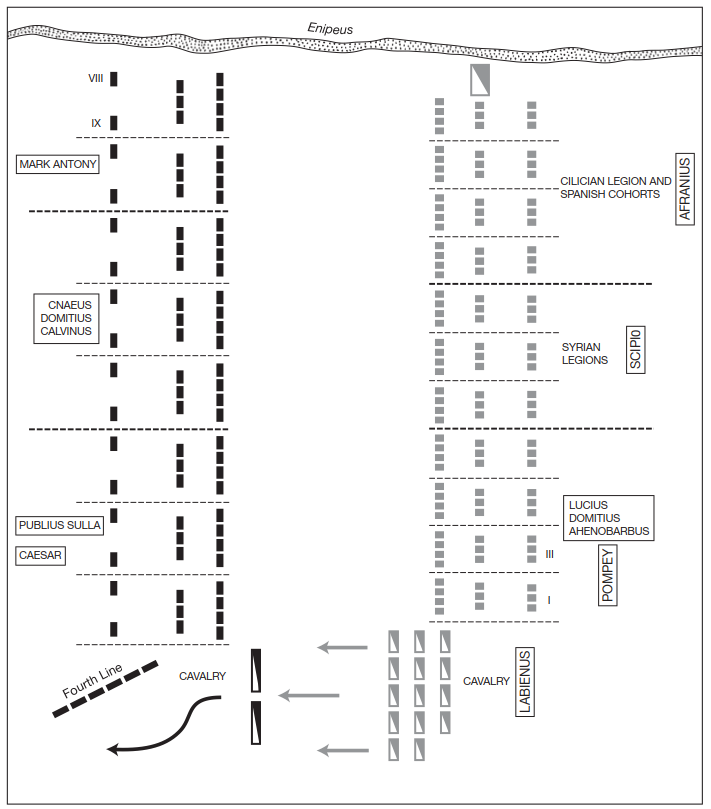
Fig. 1. Initial tactical deployment of Pompeian and Caesarean armies prior to the cavalry engagement at the Battle of Pharsalus.
Each Pompeian cohort was deployed 10 ranks deep—a formation far denser than standard Roman tactical doctrine. This deep formation aimed to prevent inexperienced troops in the front ranks from breaking, forcing them to maintain cohesion under severe combat stress. However, its primary tactical drawback was that only the front ranks could actively engage the enemy, making it difficult for rear ranks to throw their pila (heavy javelins) effectively. Pompey fielded approximately 110 cohorts, totaling roughly 45,000 legionaries according to Caesar’s account, though rival contemporary sources suggest a somewhat lower total.
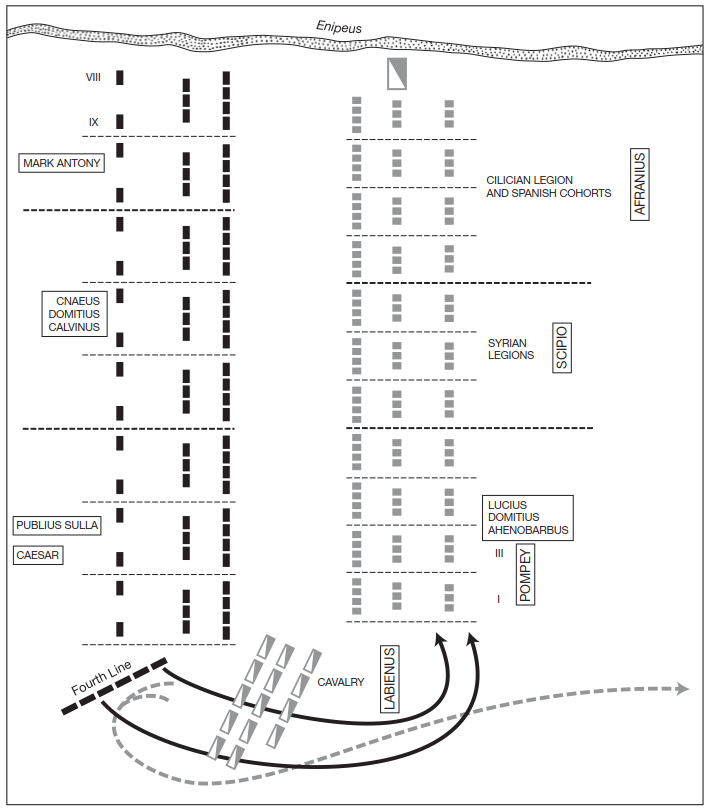
Fig. 2. Tactical execution of Caesar’s Fourth Line counter-attack against Labienus' cavalry unit.
Distribution of Command and Tactical Objectives. The Pompeian right wing was commanded by Lucius Afranius (or Lentulus according to Appian), the center by Metellus Scipio, and the left wing by Lucius Domitius Ahenobarbus. Pompey ordered his main infantry line to remain static and hold their ground rather than charge, intending to absorb the impact of the enemy charge and pin down Caesar’s infantry. His primary operational objective relied on his massive cavalry force of approximately 6,400 horsemen, massed on the left flank under the command of Titus Labienus, supported by large bodies of light-armed skirmishers. This cavalry strike was designed to sweep aside Caesar’s weaker horsemen and envelop his exposed flank and rear.
Caesarean Deployment and Counter-Tactics. Caesar deployed his force of 80 depleted cohorts, totaling no more than 22,000 men, anchoring his left flank against the Enipeus River. Seven cohorts were detached to guard the primary camp. His legions were also organized in a triplex acies, but out of necessity were arrayed in shallower formations—approximately four to six ranks deep. Mark Antony commanded the left wing, Cnaeus Domitius Calvinus held the center, and Publius Cornelius Sulla was assigned nominal command of the right wing, where Caesar personally stationed himself alongside his favored Legio X.
Recognizing that Pompey’s massed cavalry on the left wing intended an immediate offensive strike, Caesar executed a crucial tactical adjustment: he detached six cohorts from his third line reserve and arrayed them obliquely behind his right flank, forming an hidden fourth line. Obscured behind his 1,000 cavalrymen and the dust clouds generated on the plain, this redeployment remained completely undetected by the Pompeian command structure.
The Battle of Pharsalus: Execution and Collapse. Both commanders issued passwords to avoid friendly fire in the chaos of civil conflict; Caesar selected "Venus Victrix" (Venus the Bringer of Victory), while the Pompeians chose "Hercules Invictus" (Hercules the Unconquered). Prior to the advance, a decorated veteran named Crastinus, a former primus pilus of the Legio X, led a force of 120 volunteer soldiers in an aggressive opening charge against the enemy line, performing notable heroics before being killed by a sword wound to the throat.
The Main Infantry Contact. Caesar’s main infantry line advanced at a measured pace to preserve tactical formation. When they closed to within effective missile range (approximately 15 yards), they expected the Pompeian line to advance to meet them. Realizing that Pompey’s troops remained stationary, Caesar’s centurions halted the charge mid-stride, reorganized their ranks in an impressive display of discipline, and then re-accelerated forward. They launched their pila, drew their swords (gladii), and engaged the enemy line. Pompey’s dense formation absorbed the impact, and intense hand-to-hand fighting ensued along the entire line.
Failure of the Pompeian Cavalry Charge. Concurrently, Titus Labienus launched the massed Pompeian cavalry charge against Caesar’s weak horsemen on the right wing. Caesar’s cavalry gave ground systematically, drawing the enemy horsemen out of formation. The Pompeian cavalry, consisting largely of raw recruits and inexperienced young aristocrats, quickly lost cohesion and devolved into a disorganized mass. At that critical moment, Caesar ordered his concealed fourth line into action.
The infantrymen of the fourth line charged forward, using their pila as thrusting pikes targeted directly at the faces and bodies of the horsemen. Taken entirely by surprise and lacking operational momentum, the Pompeian cavalry broke in panic and fled the battlefield, leaving their supporting light infantry to be cut down.
The Tactical Flanking and Defeat of Pompey. Maintaining rigid discipline, Caesar’s fourth line did not engage in pursuit; instead, they wheeled left and struck the exposed flank of the Pompeian main infantry. Simultaneously, Caesar ordered his fresh third line reserve into combat along the primary front. Caught between a frontal assault by fresh troops and a flank attack, the Pompeian infantry line collapsed into total rout.
Caesar subsequently ordered the assault on the enemy camp. While he instructed his legionaries to spare fleeing Roman citizens, orders were given to cut down foreign auxiliary forces. Caesar reported 15,000 enemy casualties and 24,000 prisoners, whereas historian Asinius Pollio recorded a lower, likely more accurate figure of 6,000 Pompeian dead. Caesar lost approximately 200 legionaries and 30 centurions. Lucius Domitius Ahenobarbus was killed during the retreat, while Marcus Junius Brutus surrendered and was granted clemency by Caesar.
Aftermath and the Death of Pompey the Great. Upon witnessing the rout of his cavalry and the collapse of his main infantry line, Pompey abandoned his tactical command, retired to his tent, stripped off his general's insignia, and fled the field in disguise. Rather than attempting to rally his remaining forces in Greece, Pompey fled to Egypt, accompanied by his wife Cornelia and a small retinue, seeking refuge and political support from the young king Ptolemy XIII.
Upon arriving off the shore of Alexandria, Pompey was invited aboard a small boat by Egyptian officials and two Roman military officers (Achillas and Lucius Septimius) who had previously served under him. As his family watched from their vessel, Pompey was stabbed to death on the boat on the day before his fifty-ninth birthday. His head was severed to be presented to Caesar, while his remaining torso was left on the beach, where it was later cremated and buried by one of his freedmen.
Date added: 2026-09-24; views: 2;