
Ptolemaic Dynasty and Roman Hegemony in Egypt
Historical Foundations of Ptolemaic Egypt and Roman Intervention. The geopolitical trajectory of Hellenistic Egypt began in 331 BC when Alexander the Great wrested control of the region from the Achaemenid Persian Empire and established the capital city of Alexandria. Following his death, his empire was partitioned among his leading generals, known as the Diadochi. Ptolemy I Soter (son of Lagos) secured Egypt, diverting Alexander's funeral cortege to Alexandria to establish political legitimacy and founding the Ptolemaic Dynasty, which would endure for nearly three centuries. At its zenith, the kingdom projected authority over Cyrenaica, Palestine, Cyprus, and portions of Asia Minor, engaging in persistent tri-polar rivalries against Antigonid Macedonia and the Seleucid Empire. By 48 BC, both major Hellenistic rivals had fallen to Roman expansion: Macedonia was annexed as a Roman province in 146 BC, and Pompey the Great deposed the last Seleucid monarch in 64 BC. Unlike their contemporary rival states that engaged in direct armed conflict with the Roman Republic, the Ptolemies adopted a diplomatic strategy of formal alliance. While this policy ensured state survival, it did not protect the kingdom from steady decline throughout the second century BC, exacerbated by continuous, severe intra-dynastic conflict.
Dynastic Endogamy, Succession Instability, and Roman Arbitrage. To prevent native or foreign aristocratic lineages from establishing competing claims to the royal lineage, Ptolemy II initiated a systematic practice of endogamous incestuous marriages—including sibling, avuncular, and aunt-nephew unions—that persisted until the end of the dynasty. These internal unions generated highly ambiguous succession lines, fostering competing political factions centered around different members of the royal family. The resulting frequent civil wars increasingly compelled the Egyptian court to rely on the Roman Senate to act as an external political arbiter. Formal diplomatic recognition by Rome became an essential requirement to legitimate a monarch's sovereignty, which progressively eroded the kingdom's geopolitical independence.
Economic Systems and Agrarian Wealth of the Nile Delta. Despite political volatility, Egypt remained extraordinarily wealthy, driven by global trade through Alexandria and an exceptionally productive agrarian economy dependent on the annual flooding of the Nile River. The predictable inundation deposited nutrient-rich silt across the valley, yielding massive grain surpluses that sustained both domestic stability and international commerce. The Ptolemaic administrative state systematically exploited this agricultural productivity through a centralized bureaucratic apparatus inherited from earlier Pharaonic periods. Indigenous Egyptian temples functioned as crucial economic institutions; they served as major landowners, manufacturing centers for crafts and textiles, and spiritual hubs that preserved native religious rites free from excessive Hellenistic integration. These temple institutions enjoyed significant tax exemptions and held elevated legal status, exciting both the admiration and geopolitical appetite of Roman officials who viewed the kingdom's vast economic resources as a target for extraction.
Political Turbulence, Financial Dependence, and the Rise of Cleopatra VII. The career of Ptolemy XII Auletes ("the Flute Player," also styled Neos Dionysus) demonstrates the extreme vulnerability of the late Ptolemaic state to Roman financial and political influence. Following a succession of dynastic murders, depositions, and short-lived reigns involving Ptolemy IX, Ptolemy X, and Ptolemy XI, Ptolemy XII secured throne recognition in 80 BC through the political intervention of the Roman dictator Sulla. Facing constant internal opposition and factional challenges in Rome—such as Marcus Licinius Crassus’s 65 BC effort to annex Egypt based on an alleged bequest in the will of Ptolemy X—Auletes spent immense financial sums securing formal recognition. In 59 BC, he pledged a massive bribe of 6,000 talents to Julius Caesar and Pompey the Great to obtain formal status as a "friend and ally of the Roman people" (amicus et socius populi Romani).
Expulsion, Restoration, and Foreign Debt Burden. The extreme taxation required to raise the 6,000-talent sum sparked an Alexandrian uprising in 58 BC, driving Ptolemy XII to flee to Rome alongside his young daughter, Cleopatra VII. During his exile, his daughter Berenice IV assumed power, co-ruling briefly with Cleopatra VI before marrying a prince of Pontus, an alignment that alarmed Roman strategic interests. In 55 BC, the Roman governor of Syria, Aulus Gabinius, reinstated Auletes by military force in exchange for a promised payment of 10,000 talents. Upon his restoration, Ptolemy XII executed Berenice IV, but the state's financial collapse prevented full payment of the debt, leading to severe civil unrest, anti-Roman riots in Alexandria, and complete economic subservience to Roman creditors.
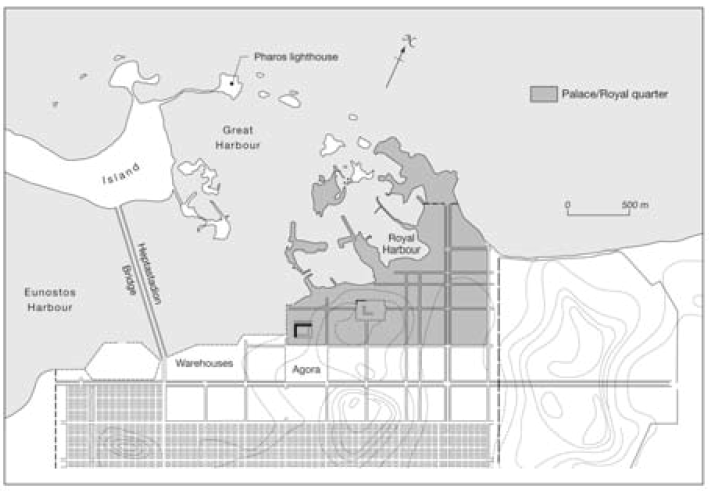
Fig. 1. Topographical map of ancient Alexandria illustrating the Royal Harbor, the Palace quarter, the Pharos Lighthouse, and key urban infrastructure.
Dynastic Co-Rule and the Outbreak of Civil War. Upon his death in 51 BC, Ptolemy XII left a will—copies of which were deposited in Rome—designating his seventeen-year-old daughter Cleopatra VII and his ten-year-old son Ptolemy XIII as joint monarchs, bound by sibling marriage. Cleopatra VII immediately asserted administrative dominance, issuing official state decrees that omitted her brother’s name. However, a palace faction led by the court eunuch Pothinus, the general Achillas, and the tutor Theodotus of Chios mobilized the royal army against her. Complicated by severe economic hardship and low Nile floods in 49–48 BC, the regents drove Cleopatra out of Alexandria. She withdrew to Arabia and Syria, securing the support of the garrison at Ascalon to assemble an army. By the summer of 48 BC, Cleopatra’s forces faced her brother's army near Pelusium in the eastern Nile Delta, just as the Roman civil war between Julius Caesar and Pompey reached Egypt.
Historiographical Evaluation, Intellectual Attributes, and Urban Morphology. Modern historiographical analysis of Cleopatra VII requires disentangling verified ancient evidence from later Augustan political propaganda and modern literary dramatizations. Inheriting a fragile state at age twenty, she was thoroughly educated in the Hellenistic royal tradition and was credited with authoring technical treatises on science, medicine, and cosmetics. As recorded by Plutarch, Cleopatra was a polyglot who spoke numerous languages without an interpreter and was the only Ptolemaic monarch to master the native Egyptian language. Politically, she bridged the gap between the Greek ruling class and native Egyptian subjects by actively participating in traditional religious ceremonies and identifying herself directly as the "New Isis" (Nea Isis).
Physical Iconography and Numismatic Analysis. Numismatic evidence from contemporary coins minted at Alexandria and Ascalon, alongside classical literary descriptions, offers an objective perspective on her physical features. Coins depict a ruler with a prominent, high-bridged nose, strong jawline, and hair styled in the traditional Hellenistic royal bun (melonenfrisur) secured by a royal diadem. While later Roman historians like Cassius Dio emphasized her unmatched visual beauty, Plutarch noted that her primary impact lay in her persuasive rhetoric, charismatic presence, musical voice, and intellectual charm. Genetic analysis of her lineage reveals predominantly Macedonian Greek ancestry with minor Persian and Seleucid branches; assertions regarding alternative racial backgrounds remain unsupported by direct contemporary documentation.
Urban Structure and Intellectual Supremacy of Alexandria. At the time of Caesar's arrival, Alexandria was the primary intellectual and commercial metropolis of the Mediterranean, housing a population estimated at approximately 500,000 residents. Designed on a grid layout by the architect Dinocrates of Rhodes, the city featured wide avenues up to 100 feet across, a massive harbor complex anchored by the Pharos Lighthouse, and an extensive royal quarter composed of palaces constructed by successive monarchs. As an international trade hub handling luxury goods from India, Arabia, and Sub-Saharan Africa, the city maintained a cosmopolitan population that included the largest Jewish diaspora community in the ancient world. Above all, Alexandria remained the premier center of Hellenistic scholarship; its famous Great Library and Mouseion housed vast collections of texts, scientific inventions, and research institutions that attracted leading philosophers, mathematicians, and scholars across the classical world.
Date added: 2026-09-24; views: 2;