
Strategic and Political Dynamics of Caesar’s Italian Campaign in 49 BC
Initial Political Shock and Military Mobilization. The unexpected news that Julius Caesar had crossed the Rubicon stunned his political opponents in Rome. Conducting military operations in January posed severe logistical challenges, as keeping an army adequately supplied in the field was remarkably difficult. In spite of earlier rumors, the Senate and Pompeian factions were likely aware that the main strength of Caesar’s forces remained north of the Alps. This lack of immediate force concentration indicated that even after passing the senatus consultum ultimum and initiating military mobilization, many Roman elites expected Caesar to back down when confronted by their united front and apparent strategic advantage.
Pre-War Negotiations and Command Allocations. Senate members operated under the assumption that Caesar would wait for the spring campaigning season to carefully mass his forces before initiating hostilites, or perhaps remain on the defensive in hopes of achieving a negotiated political compromise. In the days following January 7, the Senate convened repeatedly outside the sacred boundary (pomerium) of Rome to allow Pompey the Great to participate and reassure senators. During these meetings, Metellus Scipio, Pompey's father-in-law, was appointed to command Syria, while Domitius Ahenobarbus was designated proconsul of Transalpine Gaul. As Caesar recorded in his Commentaries, these provincial assignments were made without ratification by the Popular Assembly (Comitia Centuriata or Comitia Tributa), violating traditional constitutional procedures. Nevertheless, both magistrates performed the customary rituals before departing rapidly for their respective provinces, alongside propraetors assigned to other regions, including Cisalpine Gaul.
Initial Troop Movements and Strategic Surprises. While Caesar’s opponents had openly committed to using force against him, their operational readiness was severely lacking. Although troop levies were underway and arms were being collected throughout the peninsula, Italy was fundamentally unprepared to resist an invasion. Conversely, Caesar was also militarily vulnerable, lacking sufficient forces for a full-scale campaign. Orders had been dispatched to additional legions north of the Alps to reinforce him, but their arrival would take considerable time. Recognizing that delay would allow the Senate to consolidate its resources, Caesar opted for speed and operational initiative, advancing southward with only the Thirteenth Legion (Legio XIII).
Occupation of Strategic Centers and Senate Evacuation. Moving quickly, Caesar secured Ariminum (modern Rimini), which had already been infiltrated by his operatives, without encountering military resistance. From this forward operational base, he dispatched Mark Antony with five cohorts to occupy Arretium (modern Arezzo), while sending three additional cohorts to secure Pisaurum, Fanum (modern Fano), and Ancona. News of the crossing of the Rubicon reached Rome around January 17, triggering widespread panic. Realizing he lacked the immediate military strength to defend the capital against an active invasion, Pompey and his allied magistrates evacuated Rome.
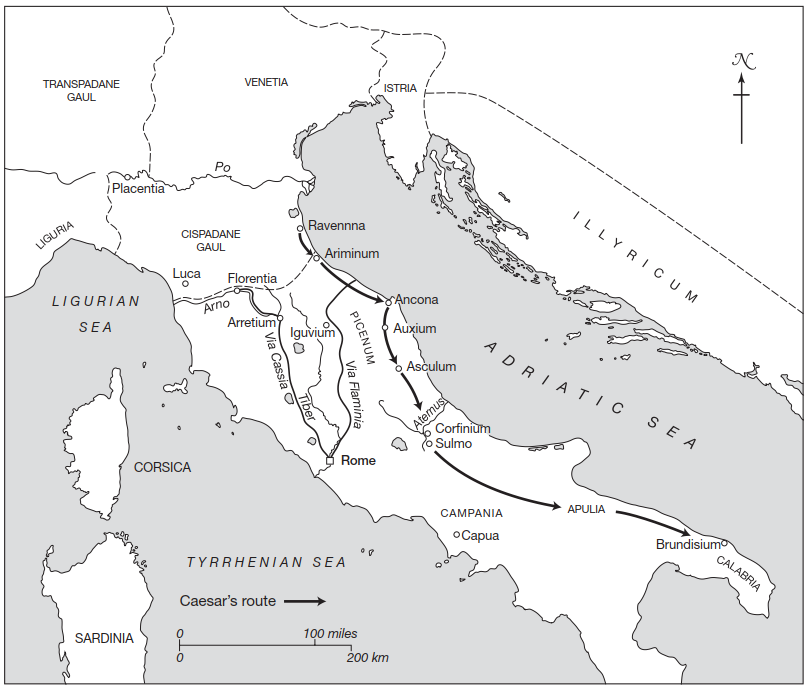
Fig. 1. Map of Caesar’s route through Italy during the campaign of 49 BC.
Constitutional Disruption and Diplomatic Overtures. The abrupt departure of the senior magistrates left Rome without functioning governance, halting normal constitutional operations and public life in the Republic. Uncommitted senators were forced to choose between fleeing with Pompey—haunted by memories of the violent purges of Marius and Sulla—or retreating to their private estates to remain neutral. During this period of political uncertainty, several unofficial emissaries arrived at Caesar’s headquarters in Ariminum. Among them was Lucius Julius Caesar, son of the former consul who had served as Caesar's legate, carrying a personal communication from Pompey.
Rejection of Terms and Mutual Distrust. Pompey's message insisted that his actions were driven by duty to the Republic rather than personal hostility, urging Caesar to lay down his command to prevent civil war. A similar proposal was delivered by the praetor Lucius Roscius. In response, Caesar affirmed that he sought only to exercise his legal rights as granted by the Roman people, demanding that Pompey depart for his assigned province in Spain so both leaders could simultaneously disband their armies. By January 23, Lucius Caesar the Younger delivered these terms to Pompey at Teanum in Apulia. As recorded by Cicero, the Pompeian faction agreed to the terms on the condition that Caesar first withdraw his garrisons from all occupied towns outside his province before discussions could resume in the Senate.
Failure of Peace Negotiations and Psychological Factors. Caesar rejected these conditions as an unfair arrangement, noting that no firm date had been established for Pompey's military demobilization or departure to Spain. Conceding his forward positions would mean surrendering the strategic momentum gained by his rapid movement, leaving him at the mercy of an unforgiving Senate. Mutual distrust prevented either faction from making the initial concession. Caesar's frustration was heightened by Pompey's consistent refusal to participate in a face-to-face conference. Pompey's reluctance to meet directly stemmed from concerns over Caesar’s persuasive ability, fear of political assassination, and pressure from hardline allies like Cato the Younger, who insisted on the absolute defeat of the rebellious proconsul.
The Advance Through Picenum and Clemency Policy. Resuming his advance southward, Caesar learned that Iguvium was held by five cohorts under propraetor Quintus Minucius Thermus. Caesar dispatched Curio with three cohorts to secure the city; upon their approach, Thermus's raw recruits deserted, and the local population welcomed the Caesarean forces. Expanding his control, Caesar entered Picenum—traditionally considered the client base and ancestral stronghold of Pompey's family. Despite this local connection, the populace showed little enthusiasm for resisting Caesar, whose troops maintained strict military discipline, refrained from plundering, and were viewed favorably due to past financial distributions sourced from the conquest of Gaul.
The Siege and Surrender of Corfinium. By February, Caesar united the Thirteenth Legion with the incoming Twelfth Legion (Legio XII) and pressed forward to Corfinium, where Domitius Ahenobarbus had gathered over thirty cohorts of newly levied troops. Although Pompey repeatedly urged Ahenobarbus to retreat southward to join his main army in Apulia, Ahenobarbus refused and remained fortified inside Corfinium. Caesar quickly invested the town, beginning lines of circumvallation reinforced by redoubts. When Ahenobarbus realized Pompey would not march to his relief, he attempted to organize a private escape. Discovering his betrayal, his own officers and troops arrested him and surrendered the city to Caesar after a seven-day siege.
Political Impact of Clemency at Corfinium. Following the capitulation of Corfinium, Caesar executed a calculated policy of clemency (clementia). Rather than executing his opponents, he released prominent leaders, including Domitius Ahenobarbus and Publius Cornelius Lentulus Spinther, and returned six million sesterces of public funds brought by Ahenobarbus. This policy starkly contrasted with the historical precedents of military proscriptions set by Sulla, winning over public opinion throughout Italy. Caesar incorporated the surrendered garrison cohorts into his own army, later sending them under Curio's command to secure Sicily and North Africa.
The Evacuation of Brundisium and Aftermath. Realizing that Italy could not be held against Caesar's disciplined forces, Pompey consolidated his remaining military units at the port city of Brundisium (modern Brindisi) to execute a strategic evacuation across the Adriatic Sea into Greece. Caesar arrived outside Brundisium on March 9 with six legions, including the Eighth (Legio VIII), Twelfth, and Thirteenth, alongside newly formed units like the Fifth Alaudae (Legio V Alaudae). Despite Caesar's efforts to block the harbor mouth with engineered earthworks and boom structures, Pompey successfully evacuated the remainder of his army by ship on the night of March 17. By securing his forces intact, Pompey set the stage for a prolonged global civil war, mirroring the strategic trajectory previously taken by Sulla.
Date added: 2026-09-24; views: 1;