
Caesar’s African Campaign: Logistics, Tactics, and the Battle of Thapsus
Strategic Logistics and Staging at Lilybaeum. Julius Caesar remained in Rome only as long as was necessary to restore administrative stability before initiating immediate preparations for a major offensive against Optimate forces in North Africa. Troops and logistical supplies were ordered to concentrate at the strategic port of Lilybaeum in Sicily, which served as the primary staging area for the operational invasion fleet. The expedition faced severe material constraints, notably an acute shortage of transport vessels, making it impossible to convey the entire army across the Mediterranean in a single wave. Winter weather further complicated maritime transportation, bringing severe supply chain disruptions reminiscent of the earlier Macedonian campaign. Despite unfavorable omens reported by accompanying religious augurs, Caesar disregarded traditional divinations in favor of military urgency, arriving at Lilybaeum on December 17, 47 BC.
Force Composition and Embarkation Protocols. Upon reaching the Sicilian coast, Caesar pitched his command tent directly on the beach to project operational immediacy, instructing his troops to be prepared to embark at any moment. His initial force comprised a single legion, but five additional legions arrived within the week. Among these units, only the Fifth Alaudae (Legio V Alaudae)—raised in Transalpine Gaul and granted full Roman citizenship—was composed of seasoned combat veterans. The remaining five formations (the Twenty-Fifth, Twenty-Sixth, Twenty-Eighth, Twenty-Ninth, and Thirtieth legions) were recently levied units consisting largely of personnel originally conscripted by Pompeian recruiters. Each unit was crammed into transport ships under strict weight restrictions that prohibited non-essential baggage or personal equipment. The initial force included 2,000 cavalrymen and their mounts, but capacity limits prevented the transport of substantial food or draft animals, forcing reliance on immediate field foraging upon arrival.
Amphibious Operations and the Landings at Hadrumentum and Ruspina. On December 25, 47 BC, Caesar set sail without issuing sealed orders containing landing coordinates, departing from his standard operational protocol due to insufficient intelligence regarding coastal defenses. Adverse winter winds scattered the fleet, leaving Caesar with only a fraction of his total force when land was sighted on December 28. Navigating parallel to the coast in search of a suitable landing zone, he disembarked near the enemy-held port of Hadrumentum with approximately 3,500 legionaries and 150 cavalry. Upon disembarking, Caesar stumbled on the beach; he quickly reinterpreted the bad omen by grasping the shingle and declaring, "I have hold of you, Africa!" Following an unsuccessful attempt to negotiate the surrender of the garrison at Hadrumentum, he declined to initiate a formal siege due to numerical inferiority and established a main base at Ruspina.
Comparative Order of Battle and Strategic Constraints. The Optimate forces arrayed against Caesar held overwhelming numerical superiority. Intelligence indicated that Quintus Caecilius Metellus Pius Scipio led ten legions—though understrength and inexperienced—supported by heavy cavalry and royal troops under King Juba I of Numidia. King Juba contributed four Roman-trained infantry legions, numerous light cavalry, infantry skirmishers, and 120 war elephants. To mitigate the chaos caused by war elephants, Metellus Scipio instituted specialized training regimes to condition his animals against battle noise. Facing these numbers, Caesar dispatched warship squadrons to locate his scattered transport fleet, at one point personally searching for lost ships. While he retained the element of strategic surprise by striking in winter, local food supplies had been largely depleted or buried by the enemy, and agricultural labor was disrupted by mass conscription, forcing Caesar to issue urgent grain requisitions to adjacent provinces like Sardinia.
Tactical Analysis of the Battle of Ruspina (46 BC). On January 1, 46 BC, Caesar secured the town of Leptis, posting guards to prevent looting before returning to Ruspina. On January 4, he led thirty cohorts on a major foraging expedition, ordering his reserve of 400 cavalry and 150 archers to follow when an enemy force was spotted three miles out. The Optimate force, commanded by Titus Labienus, comprised 8,000 Numidian cavalry, 1,600 Gallic and German horsemen, and large bodies of light infantry. Labienus deployed his cavalry in an unusually dense line, which Caesar misidentified from a distance as close-order infantry. Acting on this assumption, Caesar arranged his understrength troops into a single extended line of cohorts to match the enemy’s frontage and avoid encirclement.
Tactical Encirclement and Cohort Restructuring. Labienus quickly extended his wings, encircling the single Roman line while light infantry swarmed forward to launch javelins at the unshielded right flank of the legionaries. When Roman cohorts attempted to counter-attack, the Numidian cavalry feigned retreat and turned back to attack as soon as the legionaries separated from the main line. To maintain cohesion, Caesar issued strict orders prohibiting any soldier from advancing more than four paces from their cohort’s line. As panic mounted among the recruits, Caesar intervened directly, physically grabbing a fleeing standard-bearer and redirecting him toward the enemy. Eyewitness accounts in the Bellum Africum record tactical exchanges during the battle, including an incident where a veteran of the Tenth Legion (Legio X Equestris) threw his heavy javelin (pilum) at Labienus, mortally wounding his horse. To break the encirclement, Caesar ordered the line to extend and instructed every second cohort to face about 180 degrees, creating a two-fronted battle formation. A simultaneous volley of pila followed by a charge temporarily drove the enemy back, enabling a tactical withdrawal toward the fortified camp at Ruspina.
Retreat and Strategic Counter-Measures. The retreating column was continuously harassed by Optimate reinforcements led by Marcus Petreius, who arrived with 1,600 fresh cavalry. Exhausted Caesarian troops executed a final counter-attack over elevated terrain, wounding both Petreius and Labienus and allowing Caesar to complete his withdrawal. Although the Battle of Ruspina was a tactical setback that failed to secure foraging goals, Caesar prevented the complete destruction of his army. In the aftermath, he heavily fortified his camp at Ruspina, mounted siege artillery on the ramparts, and converted fleet sailors into light infantry while workshops produced sling bullets and javelins. Fodder shortages were managed by washing and drying seaweed to feed the cavalry horses. Strategic pressure on Caesar eased when King Bocchus II of Mauretania and Roman mercenary Publius Sittius invaded Numidia, forcing King Juba to divert forces to defend his home territory.
The Uzitta Campaign and Psychological Warfare. Reinforcements subsequently arrived from Sicily, delivering the Thirteenth and Fourteenth legions, 800 Gallic cavalry, 1,000 light infantry, and grain supplies. Metellus Scipio was also reinforced when King Juba returned with three legions, 800 heavy cavalry, light infantry, and war elephants. Rumors of Juba's approaching force caused widespread anxiety in the Caesarian camp. According to Suetonius, Caesar addressed his troops directly to restore order, deliberately exaggerating enemy numbers to eliminate rumors:
"Let me tell you that in a couple of days the king will be here with ten legions, 30,000 horsemen, 100,000 skirmishers, plus 300 elephants. Right then, some of you can now stop asking questions or guessing and can believe me, because I know all about it. If not, then you can be sure that I will order them put on some old hulk of a ship and blown away to whichever land the wind takes them."
Maneuvers Around Uzitta. Extended operational maneuvering occurred around Uzitta, where both sides contested key high ground. An ambush planned by Labienus failed due to poor discipline among his troops, allowing the Caesareans to route the force and fortify the position. Shortly thereafter, the Ninth and Tenth legions arrived at Ruspina. Caesar used this opportunity to discipline officers involved in the earlier Italian mutinies; Tribune Avienus was publicly dismissed and disgraced for filling an entire transport vessel with personal household goods and baggage instead of troops and supplies. With ten legions now under his command (half of them veteran units), Caesar persuaded Gaetulian leaders to rebel against King Juba, further dividing the Optimate coalition.
Supply Tactics and Relocation to Aggar. To relieve persistent supply shortages, Caesar led troops on expeditions to locate subterranean grain pits used by local populations. Learning through deserters that Labienus was organizing another ambush, Caesar sent out decoy foraging parties for several days before launching a pre-dawn strike with three veteran legions, successfully checking the Optimate forces. Despite this tactical success, supply constraints persisted. Unable to force Metellus Scipio into a decisive engagement on favorable terrain, Caesar burned his camp near Uzitta in the early morning hours and marched to Aggar, where his foraging parties secured substantial stores of barley and grain.
Operational Maneuvers Preceding the Battle of Thapsus. During the march toward Aggar, Optimate cavalry continuously harassed Caesar’s column, restricting progress to as little as 100 paces in four hours. To counter these tactics, Caesar repositioned his cavalry behind the heavy infantry and instituted specialized combined-arms drills, detailing 300 active legionaries per legion to move in constant battle order alongside the horsemen. On March 21, the army performed a formal lustratio (a ritual purification ceremony), and on March 22, Caesar offered battle, which the enemy declined. Caesar then stormed the town of Sarsura, capturing stored enemy grain before marching 16 miles on April 4 to invest the coastal town of Thapsus.
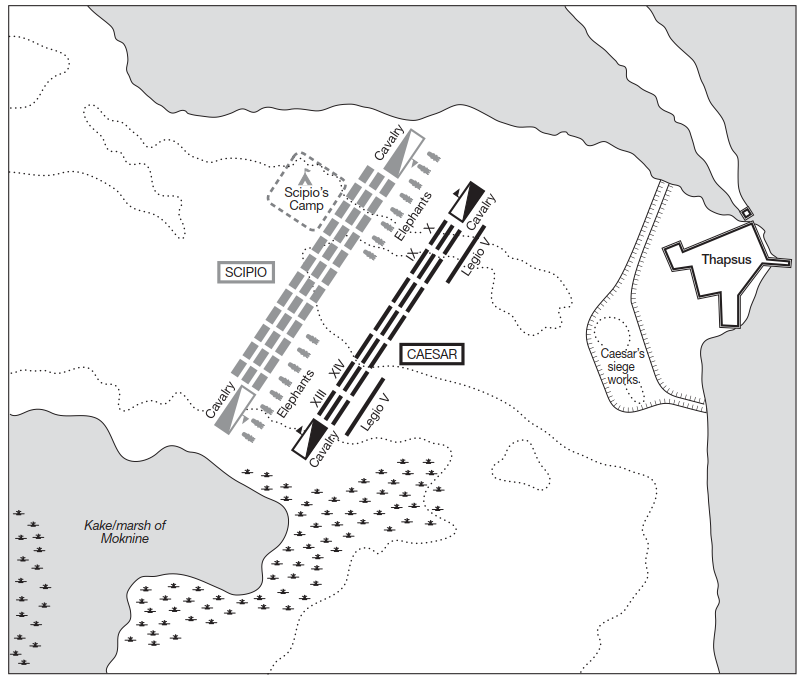
Fig. 1. Tactical deployment of Caesarian and Optimate forces at the Battle of Thapsus.
The Topography of Thapsus. Thapsus was geographically constrained, bordered by the Mediterranean Sea on one side and a large saltwater lagoon (the Marsh of Moknine) on the other. Metellus Scipio advanced to relieve the city, dividing his forces between two camps eight miles away. Finding the main land approach blocked by a fort constructed by Caesar, Metellus Scipio led his army on a night march around the lagoon, establishing a position on a narrow spit of land less than a mile and a half wide. King Juba and Lucius Afranius remained behind in camp with a containment force, leaving Scipio’s main body constrained on narrow terrain that restricted cavalry maneuvers.
The Decisive Battle of Thapsus (6 April 46 BC). Caesar left two legions of recruits to maintain the siege lines at Thapsus and deployed the remainder of his army in a standard triplex acies formation facing Metellus Scipio. Veteran formations anchored the flanks: the Tenth and Ninth legions on the right, and the Thirteenth and Fourteenth legions on the left, flanked by archers, slingers, and cavalry. To counter Scipio’s war elephants, Caesar split the Fifth Alaudae, placing five cohorts behind each wing to form a specialized fourth line. Three less experienced legions formed the center, while warships were instructed to threaten the enemy's rear from the coastline.
Unsanctioned Attack and Collapse of the Optimate Line. Caesar attempted to restrain his enthusiastic soldiers, preferring a controlled engagement. However, on the right wing, a trumpeter (tubicen) sounded the charge without orders, supported by the legionaries. Centurions were unable to hold back the line, prompting Caesar to give the watchword "Good Luck" (Felicitas) and ride into battle. An alternative account by Plutarch claims Caesar suffered an epileptic seizure as the battle opened and was removed to shelter, though this remains the only historical account suggesting his illness disrupted operational command.
Massacre and Collapse of the Optimate Forces. Missile fire from Caesarian archers and slingers panicked the Optimate war elephants on the left flank, causing them to stampede back through their own lines. The entire Optimate left wing collapsed, and the retreat turned into a general rout. Driven by exhaustion and frustration over the prolonged conflict, Caesar’s legionaries refused to give quarter, killing surrendering troops and striking down several of their own officers who attempted to stop the carnage. Approximately 10,000 Optimate troops were killed, compared to roughly fifty casualties on the Caesarian side.
Political and Historical Aftermath. Following the defeat at Thapsus, the primary Optimate leaders were killed or committed suicide. Lucius Afranius and Faustus Cornelius Sulla were captured by Publius Sittius and executed. Marcus Petreius and King Juba I entered into a suicide pact, engaging in a fatal duel in which Petreius killed Juba before ending his own life with the assistance of a slave. Metellus Scipio escaped by sea, but committed suicide when his vessel was intercepted by a Caesarian squadron. Titus Labienus escaped to Spain to join Pompey's sons, Cnaeus Pompeius and Sextus Pompeius.
The Death of Cato the Younger at Utica. Marcus Porcius Cato (Cato the Younger) held command of the garrison at Utica throughout the campaign. Upon receiving news of the disaster at Thapsus, Cato met with his local council of 300 Romans but concluded that further resistance was impossible. After dining while seated—a habit he adopted following the defeat at Pharsalus—he retired to his quarters and read Plato's Phaedo. Realizing his sword had been removed by his son and servants, he demanded its return. Once alone, the 48-year-old Cato stabbed himself in the abdomen. Attendants discovered him and a physician attempted to bind the wound, but Cato tore open the stitches, dying before he could be restrained. Upon learning of his death, Caesar remarked that he begrudged Cato the opportunity to grant him a pardon.
Conclusion of the African Campaign. Less than three and a half years after crossing the Rubicon, Caesar had eliminated the primary Optimate leadership. Communities that supported the Pompeians were subjected to punitive financial levies, while allied towns were rewarded. During this period, Caesar engaged in a political and personal alliance with Eunoe, wife of King Bogud of Mauretania. Caesar departed North Africa in June 46 BC, five and a half months after his initial disembarkation, having secured control over the province prior to his final campaign in Spain.
Date added: 2026-09-24; views: 2;