
Military Strategy and Political Consolidation in Late Republican Rome
Administrative Mismanagement in Further Spain and the Resurgence of Pompeian Resistance. The final phase of the Roman Civil War was directly precipitated by the administrative failures of Quintus Cassius Longinus, who had been appointed governor of Further Spain (Hispania Ulterior) following the defeat of Afranius and Petreius. Cassius’s personal avarice and tyrannical temperament alienated both the local provincial populations and the legionary units under his command, culminating in widespread mutiny, rebellion, and open defections to the Pompeian faction. Although Cassius survived an assassination attempt, he eventually fled the province and drowned when his vessel, burdened with confiscated plunder, sank. Before his death, Julius Caesar had learned of his misconduct and dispatched a replacement governor, but the political destabilization of the Iberian peninsula was already irreversible. Exploiting this unrest, Pompey’s sons, Cnaeus Pompeius and Sextus Pompeius, arrived in Spain to leverage their family’s extensive client networks and mobilize resistance. Following the Caesarean victory at Thapsus, surviving Republican officers, including Titus Labienus, joined the Pompeian forces in Spain, rapidly transforming a regional disturbance into a major threat to Caesar’s hegemony.
The Strategic March and Administrative Delegation in Rome. Initially underestimating the crisis, Caesar expected his legates to resolve the rebellion without his direct intervention. By late November 46 BC, recognizing the scale of the threat, he personally assumed command of the Iberian campaign. In the absence of elected magistrates, Caesar entrusted the administration of Rome to Marcus Aemilius Lepidus, who served as Master of Horse alongside eight appointed prefects, while day-to-day governance remained largely overseen by his confidential agents Gaius Oppius and Lucius Cornelius Balbus. Rapidly deploying across the Mediterranean theater, Caesar reached Further Spain in under four weeks (spanning 24 to 27 days according to primary historical accounts), utilizing the journey to conduct administrative correspondence and compose his poem, The Journey (Iter). Upon arrival, Caesar faced a formidable force led by Cnaeus Pompeius, who commanded thirteen legions alongside extensive auxiliary forces. Conversely, Caesar mustered only eight legions, of which only two—the Fifth Alaudae and the Tenth (the latter reduced in strength due to the discharge of time-expired veterans)—were experienced veteran units.
Anxiety Among the Senatorial Elite and the Campaign of Attrition. The disparity in force strength and Cnaeus Pompeius’s reputation for ruthlessness caused profound anxiety among former Pompeians who had reconciled with Caesar. In January 45 BC, Gaius Cassius Longinus (the future conspirator and brother-in-law of Brutus) expressed his apprehension in a letter to Marcus Tullius Cicero, stating a clear preference for Caesar’s established clemency over the unpredictable cruelty of Cnaeus. The subsequent military operations, recorded in the Spanish War (Bellum Hispaniense)—the least satisfactory volume of Caesar’s Commentaries—began with Caesar relieving the siege of Ulia, the sole major regional community retaining loyalty to his cause. To draw the Pompeian army away from Ulia, Caesar executed a diversionary strike against Corduba, defended by Sextus Pompeius. Cnaeus shadowed the Caesarean army, engaging in skirmishes but refusing pitched battle. Recognizing the strength of Corduba's defenses, Caesar shifted his operations to besiege Ategua. The campaign degenerated into extreme savagery; when the garrison at Ategua attempted to surrender, the Pompeian commander executed all suspected sympathizers and their families on the city walls. Despite these measures, Ategua capitulated on February 19, 45 BC, initiating a wave of defections to Caesar and widespread desertions from Pompeian ranks. Cnaeus retaliated with executions of suspected partisans, while Caesar ordered the execution of captured enemy scouts according to status—crucifying three who were enslaved and beheading one who held Roman citizenship.
Tactical Decoupling and the Battle of Munda. As Cnaeus Pompeius retreated toward Urso (modern Osuna), he established a defensive encampment on a ridge near Munda, approximately six miles distant. On the morning of March 17, 45 BC, Cnaeus deployed his forces in battle array along the high ground, prompting Caesar to accept battle on the plain below. Although Caesar anticipated that the Pompeians would descend to level terrain, Cnaeus maintained his commanding position on the slope, forcing Caesar to order an uphill assault against superior numbers and entrenched lines.
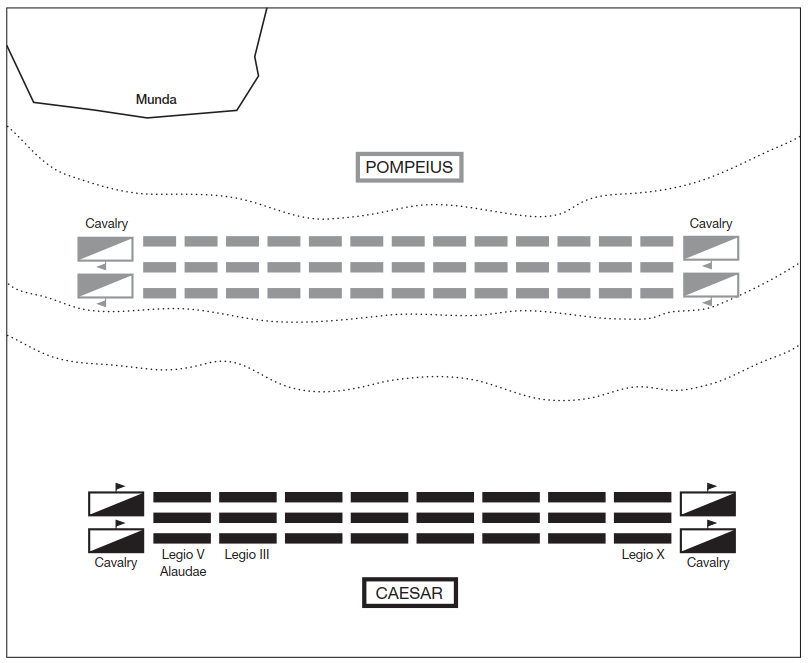
Fig. 1. Figure title. Battle of Munda line of battle schematic showing the tactical arrangement of Legio V Alaudae, Legio III, Legio X, and supporting cavalry cohorts.
Tactical Realignment and Escalation at Munda. To offset the uphill elevation, Caesar relied on his superior cavalry complement and the combat discipline of his core legions. In his tactical alignment, Legio X anchored the right flank, while Legio V Alaudae and Legio III held the left flank, with five less experienced legions forming the center. The Pompeian forces launched an aggressive counter-assault as the Caesareans advanced, resulting in intense hand-to-hand combat. As the Caesarean center began to waver, Caesar personally intervened, exposing himself to direct missile fire within ten paces of the enemy line to rally his soldiers and stabilize the tactical line. The battle reached its turning point when Legio X shattered the Pompeian left flank. When Cnaeus ordered Titus Labienus to redeploy a legion from the right flank to plug the breach, Caesar’s cavalry immediately exploited the movement to execute an enveloping maneuver on the exposed Pompeian flank, causing the complete collapse of Cnaeus's army.
Casualties, Decisive Outcome, and the End of Civil War. The tactical severity of Munda resulted in approximately 1,000 Caesarean casualties, representing a higher loss threshold than that incurred at Pharsalus from an army of 25,000–30,000 men. Pompeian casualties exceeded 33,000, including Titus Labienus, who was killed on the field. Cnaeus Pompeius escaped the initial rout but was wounded, captured several weeks later, and executed. Sextus Pompeius escaped with a small naval squadron, ceasing to pose an immediate strategic threat. Munda effectively concluded the active military phase of the Roman Civil War.
Administrative Settlement, Civic Honors, and Political Hegemony. Following news of the victory at Munda, the Senate decreed fifty days of thanksgiving, awarded Caesar the title of Liberator, authorized the construction of a Temple of Liberty, and permanently conferred upon him the title of Imperator. Remaining in Spain for several months, Caesar reorganized the province by re-founding multiple communities as veteran colonies, rewarding loyal provincial and citizen populations. During his return journey through Transalpine Gaul, he assessed veteran colonization projects at Narbo (Narbonne) and Arelate (Arles), while granting Latin status (ius Latii) to local Gallic towns, enabling their magistrates to automatically acquire full Roman citizenship upon completion of their term.
Honors, Autocracy, and Senatorial Resentment. Returning to Rome in late summer 45 BC, Caesar celebrated a controversial triumph over fellow Roman citizens and permitted two of his legates, Quintus Pedius and Quintus Fabius Maximus, to celebrate triumphs for the Spanish campaign—a deviation from traditional Republican precedent that drew severe criticism from the senatorial class. Caesar's growing autocratic authority was formalized through unprecedented constitutional extraordinary powers: he was appointed dictator for ten years, granted the right to hold the consulship continuously for ten years, assumed control of the Republic’s Treasury (aerarium), held command of all military forces, and reportedly received powers equivalent to a tribune of the plebs (tribunicia potestas). Statues of Caesar were erected on the Capitol alongside the ancient kings of Rome and inside the Temple of Quirinus, evoking sharp political satire from Cicero. Although Caesar avoided the overt terror tactics of Lucius Cornelius Sulla, senatorial elites expressed profound discontent over the marginalization of traditional senatorial authority and the concentration of executive decision-making within Caesar’s private circle of advisors, notably Oppius and Balbus.
Ideological Warfare: The Cato Debates and Public Opinion. The ideological struggle between Caesar and the Republican opposition persisted in literary and philosophical discourse. Following the suicide of Marcus Porcius Cato (Cato the Younger) at Utica, Marcus Junius Brutus published a glowing eulogy entitled Cato. Cicero subsequently authored his own treatise on Cato, focusing on his personal virtue rather than his political career. In response, Caesar directed Aulus Hirtius to compile critical materials, which Caesar subsequently expanded into a two-volume polemic entitled Anticato. The work launched severe personal attacks against Cato's private conduct, including allegations regarding the handling of his brother's estate and his unusual marital arrangements involving Hortensius. Despite Caesar's literary counter-offensive, Cato became an enduring martyr for Republican liberty, demonstrating the limits of Caesar's ideological control.
The Final Settlement and the Dilemma of Autocracy. Ultimately, Caesar’s political regime did not rely on mass proscriptions or systemic repression. He employed executive clemency (clementia) and political patronage to integrate former opponents and maintain civic stability. However, because his supreme position rested on military force rather than consensus, Caesar faced the complex challenge of persuading the senatorial aristocracy to accept long-term autocratic rule in exchange for peace and stability—a political dynamic that remained fundamentally unresolved prior to the Ides of March.
Date added: 2026-09-24; views: 3;