
Institutional Foundations and Political Dynamics of the Roman Republic
Historiographical Origins and Constitutional Mechanics of Early Rome. Roman historiographical tradition asserted that Rome was founded in 753 BC, establishing this date as Year One from which subsequent events were calculated ab urbe condita ("from the foundation of the city"). Archaeological evidence regarding the city's precise origin remains less definitive, as determining the exact period when separate communities scattered across the Roman hills coalesced into a unified urban entity presents significant methodological challenges. Very few written records survived from the earliest epochs, leaving even second-century BC Roman historians with incomplete factual knowledge. While early traditions likely preserve underlying historical truths, verifying specific individuals or events remains difficult. Monarchical rule governed Rome initially—though the historical reality of all seven traditional kings cannot be independently confirmed—until internal political upheavals around the end of the sixth century BC (traditionally 509 BC) led to the establishment of the Republican regime.
Constitutional Flexibility and Institutional Equilibrium. The political architecture of the Roman Republic evolved gradually over centuries rather than through a single codified document, functioning as an unwritten, flexible body of precedent, customary law, and legislative enactments. The Latin term res publica literally translates to "the public thing," reflecting the conceptual framework of the State or body politic. Julius Caesar later dismissed this designation as an "empty phrase," yet the elasticity of the unwritten constitution historically served as a primary source of political resilience, even as new precedents continually redefined legal norms. At the core of the Republican system lay an intense institutional prohibition against the concentration of permanent individual power, rooted in a deep-seated aristocratic fear of monarchical revival. Governance was consequently partitioned among three principal organs: executive magistrates, the Senate, and the Popular Assemblies.
Executive Magisterial Power and Imperium. Executive authority was vested in annual magistrates, the most senior of whom held imperium—the legal command over military forces and judicial administration. To prevent autocratic overreach, magisterial power was strictly temporary (limited to a twelve-month tenure) and bound by the principle of collegiality, granting colleagues equal veto power within the same office. The chief executive college comprised two consuls, followed in seniority by six praetors. Candidates for the praetorship were required to reach thirty-nine years of age, while the consulship required a minimum age of forty-two, with a mandatory ten-year statutory interval before re-election to the same office. Civil and military duties were fully integrated without separation. During their term or immediately following it, senior magistrates governed Roman provinces as pro-magistrates (proconsul or propraetor) through Senate-approved extensions of imperium, usually limited to one or two additional years to preserve the temporary nature of executive command.
Senatorial Authority and Voting Assemblies in Republican Governance. In contrast to the annual rotation of executive magistrates, the institutional influence of the Senate rested upon its permanent status and collective prestige. Composed of approximately 300 members, the Senate met only when summoned by a presiding magistrate, typically a consul. Senators were not directly elected by public vote; instead, every five years, the censors conducted a census of citizens and enrolled qualified individuals into the senatorial order. These inductees were drawn from those who had won election to a magistracy since the previous census, though censors possessed the formal authority to expel members for moral or financial infractions.
Social Composition, Auctoritas, and Advisory Roles of the Senate. Membership in the Senate required belonging to the equestrian order (equites or "knights"), the highest property-holding census class whose origins stemmed from early Roman cavalry service. Because the majority of equestrians abstained from active political careers, the Senate was effectively drawn from an informal inner elite within this class—men with a strong vested interest in maintaining the Republican status quo. Senatorial debates were hierarchically structured, with presiding officers soliciting opinions first from former consuls, followed by former praetors, and down through junior ranks. Prominent elder statesmen possessed immense political influence, known as auctoritas—a complex blend of authority, social standing, and reputation that persisted long after a magistrate stepped down from formal office. Although the Senate lacked direct legislative authority, its decrees (senatus consulta) carried overwhelming weight when submitted to voting assemblies, while its administrative duties included managing provincial allocations, granting pro-magisterial imperium, directing foreign policy, and receiving foreign embassies.
The Democratic Element and Assembly Dynamics. Voting assemblies of the Roman populace held vital constitutional responsibilities, including electing magistrates, enacting statutes, and ratifying treaties of war and peace. However, these bodies possessed no capacity for independent initiative or legislative debate. Assemblies were summoned and directed by a presiding magistrate, with citizens voting strictly yes or no on submitted proposals or choosing from an established candidate slate. In the Comitia Centuriata—which elected consuls and praetors—citizens voted within centuries organized by property ownership, reflecting the archaic military structure where wealthier citizens equipped themselves for senior combat roles. Because the wealthy were divided into a higher number of smaller voting centuries and voted first, a majority decision was frequently reached before the poorest centuries cast their ballots. Similarly, in tribal assemblies (Comitia Tributa and Concilium Plebis), rural tribes dominated by wealthy landowners held disproportionate influence over densely populated urban tribes.
Magisterial Competition, Political Culture, and Urban Topography. Political advancement within the Roman Republic was fiercely competitive and driven by individual aristocratic ambition rather than organized political parties. Eligible candidates from the equestrian class competed as individuals, rarely campaigning on specific policy platforms but relying instead on personal character, past military achievements, and family lineage. Roman political culture operated on the assumption that lineage transmitted personal virtue; thus, candidates highlighted the heroic deeds of ancestors to secure electoral favor. Wealth and family fame allowed a small cluster of noble families to dominate the consulship, though exceptional individuals could rise as "new men" (novus homo)—first-generation senators who attained senior office, as exemplified by Caius Marius. Because the number of available magistracies decreased higher up the political ladder (with only two consuls selected annually from six praetors), rivalry intensified significantly at senior levels.
Auctoritas, Triumphant Honors, and Political Mechanics. The pursuit of office was intrinsically linked to the accumulation of auctoritas, which dictated a senator's precedence and weight during deliberations. A striking example of auctoritas occurred in 90 BC, when the senior senator (princeps senatus) Marcus Aemilius Scaurus was accused of accepting foreign bribes by Quintus Varius Severus, a Roman citizen born in Sucro, Spain. Scaurus successfully dismissed the charges simply by appealing to his reputation, asking the assembly whether they preferred to believe an unknown provincial or a decorated leader of the Senate. The ultimate validation of a commander's military achievement was the award of a triumph—a ritual procession along the Sacra Via to the Temple of Jupiter Optimus Maximus, where the victorious general wore divine regalia while a public slave stood behind him whispering reminders of his mortality.
The Urban Topography of the Forum Romanum. While the Republic expanded across the Mediterranean basin, all legislative, judicial, and electoral mechanisms remained concentrated strictly within the city of Rome. By 100 BC, the urban population numbered several hundred thousand citizens, reaching nearly one million by the end of the first century BC. Urban housing was densely built, centered around the open space of the Forum Romanum. The Forum served as the commercial, judicial, and political core of the Roman world, housing the Senate House (Curia), the Comitium, the Tabularium, the tribunal courts, and the speakers' platform known as the Rostra. It was from the Rostra that magistrates addressed public gatherings (contiones) and summoned assemblies to pass statutes, making the Forum the physical heart of Republican political life.
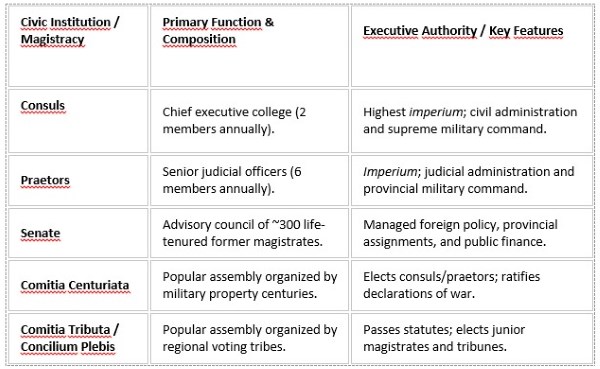
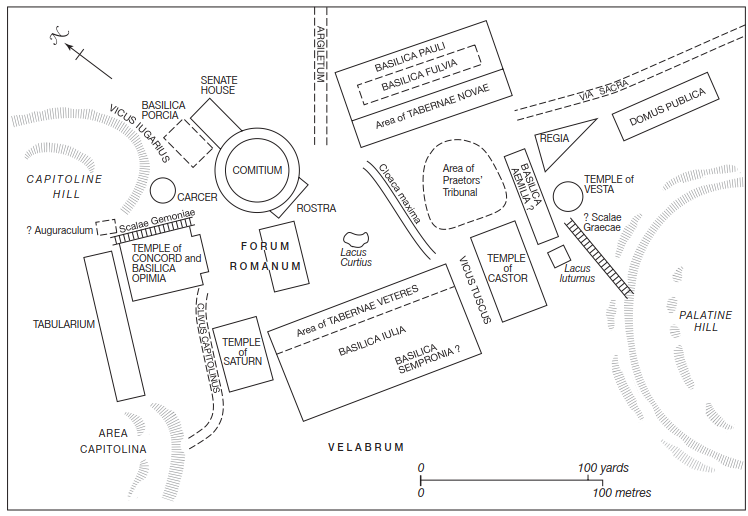
Fig. 1. The City of Rome – central area, Forum etc. (after CAH² ix (1994) p.370). Some of the details are conjectural.
Date added: 2026-09-24; views: 3;