
The Operational Dynamics and Structural Decline of the Roman Republic
Theoretical Foundations of Roman Hegemony and Constitutional Equilibrium. Rome's rapid elevation from a regional Italian power to a dominant Mediterranean superpower was viewed with profound shock across the Greek-speaking world, which had historically disregarded western populations as non-Hellenic barbarians. While the conflict with Carthage spanned more than a century and inflicted catastrophic human and material losses, the subsequent subjugation of the Hellenistic kingdoms transpired in half the time at a fraction of the cost. A generation prior to the birth of Julius Caesar, the Greek historian Polybius authored his monumental work, Universal History, specifically to analyze the mechanisms underlying Roman supremacy. Having fought against Roman forces in the Third Macedonian War (172–167 BC), Polybius was subsequently brought to Rome as a high-status hostage. During his exile, he resided within the household of prominent Roman aristocrats, accompanying them on military campaigns and personally witnessing the systematic destruction of Carthage.
Hellenistic Historiography and the Polybian Balanced Constitution. Although Polybius acknowledged the technical efficacy of the Roman military apparatus, he asserted that Rome's unprecedented success stemmed primarily from its institutional governance model. In his historiographical framework, the Republican constitution represented a perfectly balanced mixed constitution, integrating elements of monarchy (the Consuls), aristocracy (the Senate), and democracy (the Popular Assemblies). This equilibrium prevented any single faction or individual from achieving absolute political authority, thereby shielding the State from the cyclical internal strife (stasis) and violent revolutions that chronically unstable Greek city-states experienced. Characterized by internal systemic stability, the Roman Republic possessed the unique structural capability to wage large-scale, persistent warfare with absolute commitment. This resilience was demonstrated by the State's capacity to withstand the devastating defeat inflicted by Hannibal during the Second Punic War and ultimately secure decisive victory.
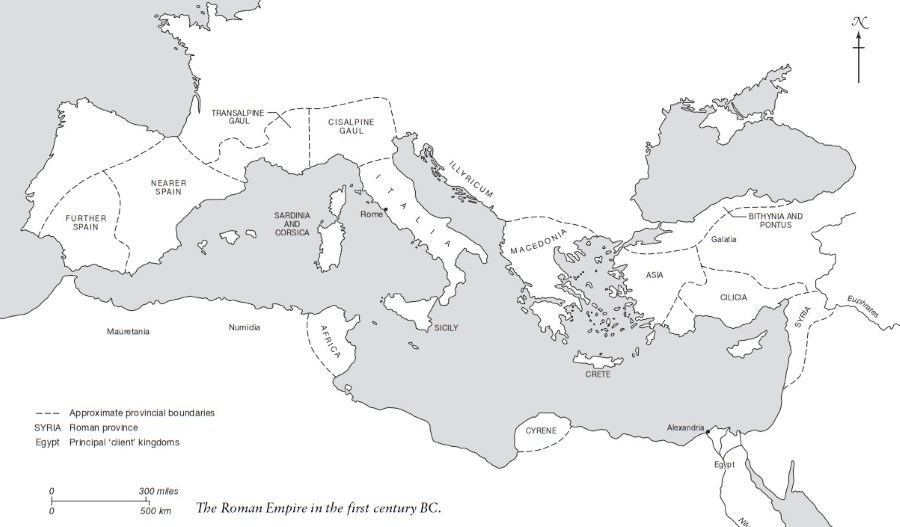
Fig. 1. The Roman Empire in the first century BC.
Signs of Structural Crisis and the Germanic Threat at the Close of the Second Century BC. The political environment into which Julius Caesar was born had functioned effectively for nearly four centuries, yet by the late second century BC, clear manifestations of systemic distress began to emerge. Though Rome continued its territorial expansion, the traditional Republican machinery was approaching an irreversible crisis. During his lifetime, Caesar would witness the complete destabilization of the Republic through catastrophic civil conflicts—wars in which he played a central role. Contemporaries noted that the institutional framework could not survive his dictatorship, with many regarding him as its ultimate destroyer. By the time his adopted heir, Augustus, established himself as the first Roman emperor, the Republican constitution existed merely as a historic memory.
The Northern Incursions and Strategic Disasters. A major external shock occurred in 105 BC, when migrating Germanic tribes, specifically the Cimbri and the Teutones, annihilated a massive Roman army at the Battle of Arausio (located near modern Orange in southern France). The losses sustained at Arausio rivaled the catastrophic casualties of the Battle of Cannae in 216 BC, where nearly 50,000 Roman and allied soldiers perished in a single day. This defeat represented the culmination of a series of severe military reversals caused by Germanic and Celtic incursions, which had begun when Roman forces first engaged these tribes in 113 BC. Unlike organized military states, the Cimbri and Teutones operated as whole populations migrating in search of arable land; their fighters possessed immense individual physical bravery but lacked formal tactical discipline and centralized strategic objectives.
Socio-Political Panic and Institutional Rupture. Following their victory at Arausio, the Germanic tribes migrated toward Spain rather than immediately invading the Italian peninsula. Nevertheless, this temporary reprieve failed to quell widespread panic in Rome, where public anxieties were intensified by cultural memory regarding the historical sack of Rome by Gallic tribes in 390 BC. Deep-seated fear of northern invasion led to intense public criticism of the aristocratic senator-generals, whose perceived incompetence had precipitated recent military disasters. In response, the Roman electorate demanded that military command be entrusted to Caius Marius, a prominent general who had recently concluded the Jugurthine War in Numidia—a conflict previously marked by senatorial corruption and administrative inefficiency.
The Consulship of Caius Marius and the Escalation of Political Violence. Caius Marius, who was married to Caesar's aunt, was a novus homo ("new man"), representing the first generation of his family to enter the Roman Senate. After achieving the consulship for 107 BC, Marius introduced sweeping military and administrative adaptations. Under traditional Roman constitutional law, consuls served as the highest executive and military magistrates for a single 12-month term, with a mandatory ten-year statutory interval before an individual could seek reelection to the office. However, in response to the Germanic emergency, Marius was elected to five consecutive consulships from 104 to 100 BC. This continuous tenure was unprecedented and constitutionally dubious, yet it achieved its immediate military objective: Marius decisively destroyed the Teutones at Aquae Sextiae in 102 BC and the Cimbri at Vercellae in 101 BC.
The Degradation of Legal Norms and Mob Violence. While Marius's consecutive consulships were defended as necessary emergency measures to safeguard the State, they set a dangerous precedent by violating core principles of Republican governance. Concurrently, political disputes within the city of Rome grew increasingly violent. In the autumn of 100 BC, the consul-elect Memmius was beaten to death in the Roman Forum by partisans of Caius Servilius Glaucia, an unsuccessful consular candidate. Glaucia and his political ally, the tribune Lucius Appuleius Saturninus, had consistently used intimidation, political violence, and mob mobilization to pass radical legislation, having previously been implicated in the assassination of another political rival.
The Suspension of Law and Constitutional Breakdown. The public lynching of Memmius triggered an immediate institutional response. Marius, who had previously utilized Saturninus to advance his own political agenda, aligned himself with the Senate's emergency directive to restore order. Marius armed his supporters and blockaded the partisans of Saturninus and Glaucia on the Capitoline Hill, forcing their unconditional surrender. Although Marius attempted to guarantee the safety of the prisoners, public anger prevented judicial proceedings. A mob assembled around the Senate House (Curia), climbed onto the roof, removed the roof tiles, and hurled them down onto the captives inside until all were killed. To preserve the State, standard legal protections were suspended, and political violence was neutralized using state-sanctioned force. This civil breakdown stood in stark contrast to the harmonious constitution conceptualized by Polybius, signaling the onset of the structural crises that characterized the final decades of the Roman Republic.
Date added: 2026-09-24; views: 4;