
Soil Microorganisms: Beneficial Fungi, Bacteria, and Phytopathogen Management
The topsoil hosts a complex community of microorganisms, among which fungi and bacteria are particularly significant due to their prevalence and dual roles. Depending on the species, host plant, and environmental conditions, these organisms can be either beneficial or pathogenic. In native, undisturbed ecosystems, a diverse array of soil microbes exists in a state of dynamic equilibrium, where plant diseases are the exception rather than the rule. This biodiversity is fundamental to ecosystem resilience and plant health.
Beneficial soil fungi and bacteria support higher plants through several key mechanisms. First, they engage in direct symbiotic associations with roots, such as mycorrhizae and nodule-forming bacteria. Second, they facilitate the breakdown and mineralization of soil organic matter, releasing essential elements like nitrogen and phosphorus into plant-available forms. Third, they act as natural biocontrol agents by parasitizing phytopathogens, competing for nutrients, or producing inhibitory toxic metabolites.
Conventional agricultural practices often disrupt this delicate balance, suppressing microbial biodiversity and reducing the soil's innate suppressiveness. This loss of functional diversity diminishes the ecosystem's ability to withstand abiotic and biotic stress. In such stressed systems, the resident competitors and antagonists of plant pathogens are negatively impacted. Consequently, this can allow soil-borne phytopathogens to proliferate, leading to increased disease incidence and spread.
Soil-borne phytopathogens are pathogenic fungi or bacteria that infect the roots and lower stems of cultivated plants. They may complete their entire life cycle within the soil or spend part of it on phyllosphere surfaces. During parasitic phases, they grow within susceptible host tissues. Between hosts, they persist as saprophytes on organic debris or as resilient resting propagules, such as chlamydospores, sclerotia, or oospores, which can survive for weeks to years.
A plant disease manifests only when three critical conditions converge, known as the disease triangle. There must be a virulent pathogen, a susceptible host, and favorable environmental conditions. The absence of any single component prevents disease establishment. This principle underscores the importance of integrated management strategies that target one or more vertices of this triangle to reduce disease pressure effectively.
Globally, soil-borne phytopathogens cause economically significant diseases across many growing regions. Predominant fungal genera include Armillaria, Colletotrichum, Fusarium, Gaeumannomyces, Macrophomina, Phoma, Phytophthora, Pythium, Rhizoctonia, Sclerotinia, Sclerotium, Thielaviopsis, and Verticillium (Fig. 4.14). Common bacterial pathogens include Agrobacterium tumefaciens, Erwinia carotovora, and Plasmodiophora brassicae. These organisms primarily affect vegetables, cereals, and ornamental flowers, and can also damage orchard trees.
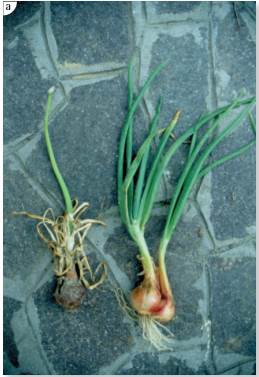
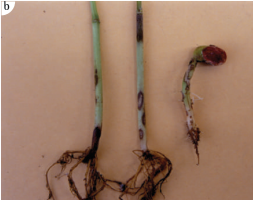
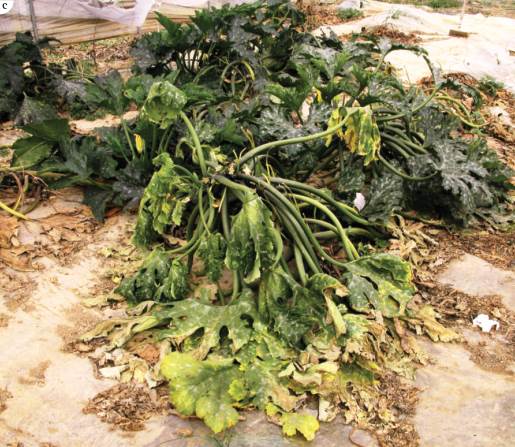
Fig. 4.14: (a) Onion plants with symptoms of fusarium wilt by Fusarium oxysporum f. sp. cepae, on the left, compared with a healthy plant on the right; (b) Symptoms of Rhizoctonia solani infection on bean plants; (c) Corgette plants with symptoms caused by Fusarium solani f. sp. cepae race 1. (RR)
The potential damage from these pathogens profoundly influences agricultural decision-making, impacting choices in cultivar and rootstock selection, crop rotation schemes, planting density, timing, seed treatments, and agrochemical use. Managing these diseases requires a holistic understanding of the soil ecosystem. Crucially, environmental conditions favoring disease can be moderated by the presence of other, suppressive microorganisms, highlighting the value of enhancing soil microbial health as a foundational disease management strategy.
Date added: 2025-12-15; views: 702;