
The Institutionalization of Science: State Academies and Societies in Early Modern Europe
The publication of Isaac Newton's seminal 1672 paper on light in the Philosophical Transactions of the Royal Society exemplifies the new era of organized science initiated by state-supported learned societies. This letter, addressed to Secretary Henry Oldenburg, appeared under the auspices of The Royal Society of London for Improving Natural Knowledge, an institution founded in 1660 and chartered by King Charles II in 1662. As a pioneering state scientific society sustained by member dues, it represented a fundamental shift in the organizational structure of scientific inquiry, moving beyond private patronage and university confines.
The Royal Society (1662) and the Paris Academy of Sciences (1666) served as flagships of a profound seventeenth-century organizational revolution. These institutions created a durable new base for scientific activity, establishing the academy model that would dominate the following century. This model proliferated across Europe and its colonies, with major national academies subsequently arising in Prussia, Russia, and Sweden. These societies coordinated diverse scientific activities, offering paid positions, sponsoring prizes and expeditions, maintaining vigorous publishing programs, and performing specialized functions for the state, thereby dominating organized science until the rise of specialized societies in the nineteenth century.
Evolving from Renaissance precedents, these seventeenth and eighteenth-century learned societies were deliberate creations of emerging nation-states and their governments. Unlike earlier informal circles, state-supported scientific societies possessed permanence, receiving official charters that incorporated them as legal institutions and permanent corporations. As government operations separated from royal households, these societies became integrated into state bureaucracies, with members acting increasingly as expert state functionaries rather than scientific courtiers. Crucially, these state academies and societies were dedicated specifically to the natural sciences, governed themselves, and engaged in research without the teaching mission of universities, signaling the deeper social assimilation of post-Scientific Revolution science.
The world of official science and learned societies remained predominantly male, in contrast to the literary salons often presided over by women. A notable exception was the French polymath Émilie du Châtelet (1706-49), a member of several academies, an original contributor to science, and Newton's profound French translator. In Italy, cities with strong academic traditions produced several female luminaries, such as the experimental Newtonian physicist Laura Bassi (1711-1778). These exceptional women brought credit to their gender and demonstrated that, albeit with immense difficulty, female intellectuals could participate in the republic of science.
Parallel to the academy movement, new patterns for organizing and communicating science emerged in the seventeenth century. While personal travel, private letters, and books had been the mainstays of communication, the periodical scientific journal arose in the second half of the century. The Philosophical Transactions of the Royal Society of London and France's Journal des Sçavans, both launched in 1666, pioneered this enduring form. Scientific journals enabled rapid dissemination of knowledge and formalized the scientific paper as the fundamental unit of research production, fundamentally reshaping the pace and structure of scientific dialogue.
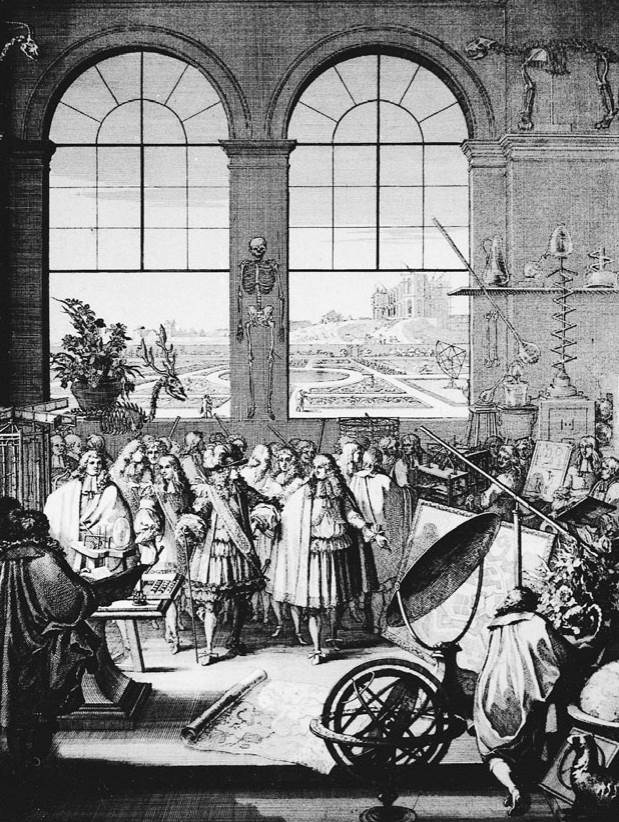
Fig. 13.1. Louis XIV visits the Paris Academy. This fanciful seventeenth-century engraving, showing King Louis XIV of France visiting the Paris Academy of Sciences, illustrates the growing role of state support for the sciences in seventeenth-century Europe.
European states also founded permanent astronomical observatories to better administer domestic and colonial commerce, following earlier Islamic precedents. Key institutions were established in France (1667), England (1675), Prussia (1700), Russia (1724), and Sweden (1747). Similarly, states sponsored national botanical gardens, such as Paris's Jardin du Roi (1635) and London's Royal Gardens at Kew (1753), often subsuming older university gardens. Under mercantilist policies, these gardens became centers of scientific study and hubs in global networks for the exchange of economically valuable plants, further tying scientific exploration to state economic interests.
From the sixteenth century onward, a process of mutual institutionalization occurred between European governments and science. Scientific specialists assisted states in botanical gardens, observatories, academies, and specialized posts within bureaucracies. For instance, Medici Florence's River Commission employed a technical staff, consulting Galileo Galilei on engineering, while Sir Isaac Newton later served the English Crown at the Royal Mint. Like experts in ancient hydraulic civilizations, European scientists increasingly became state functionaries, with institutions like the Paris Academy of Sciences administering patents and publishing official astronomical tables as an arm of the state.
A prevailing ideology of utility cemented the new relationship between science and government in early modern Europe. This established a reciprocal contract: the state provided recognition, support, and self-governance in exchange for useful services and technical expertise. Science actively promoted its utility to governments, which in turn began to systematically invest in scientific enterprise. The historical significance of this contract lies in European states beginning to emulate ancient civilizations in their structured employment of scientific experts, embedding science within the apparatus of governance.
However, one must not exaggerate the extent or prestige of government support for science at the close of the Scientific Revolution. Scientists and technical experts did not generally enjoy high social status; King Charles II famously mocked his own Royal Society for its seemingly frivolous air-pump experiments. Payment for services was often unreliable, and even the prestigious Paris Academy operated with meager funds, far less than its sister arts academies. Tellingly, Louis XIV visited his science academy only once. European governments insisted that state science be both cheap and useful—a condition largely enforced until the twentieth century—with only partial success achieved regarding its practical utility.
Date added: 2026-02-14; views: 449;