
Twentieth-Century Cosmology: From Island Universes to the Big Bang Theory and Modern Cosmic Mysteries
The Foundations of Modern Cosmology. The twentieth century witnessed profound conceptual innovations in cosmology, the scientific study of the universe's origin and evolution, which continue to underpin the field today. Building upon eighteenth-century ideas of the Milky Way as an "island universe" and nineteenth-century observations of nebulae, astronomers began to suspect the existence of external galaxies. Critical technological advances, such as the spectroscope, revealed a universal chemistry and, through the analysis of spectral line shifts, suggested stellar motion. This discovery, greatly aided by the advent of dry-plate photography in the 1870s, opened the possibility of an expanding universe. However, it was not until the 1920s, through the seminal work of American astronomer Edwin Hubble, that the extragalactic nature of nebulae, vast cosmic distances, and the universe's expansion became firmly established within the scientific community.
The Fusion of Relativity, Particle Physics, and Stellar Evolution. Beginning in the 1930s, the integration of relativity and particle physics dramatically transformed cosmological theory. Einstein’s equation of matter and energy, coupled with growing understanding of nuclear processes, provided the theoretical foundation for both thermonuclear weapons and the revelation that thermonuclear fusion powers stars. This theorizing led to the groundbreaking recognition that all chemical elements heavier than hydrogen and helium are synthesized within stellar furnaces and disseminated by stellar explosions, a process known as stellar nucleosynthesis. Furthermore, by replacing outdated combustion models, thermonuclear theory vastly extended the estimated age of the sun and solar system, effectively resolving Lord Kelvin's critique of Darwinism by providing the deep time necessary for biological evolution.
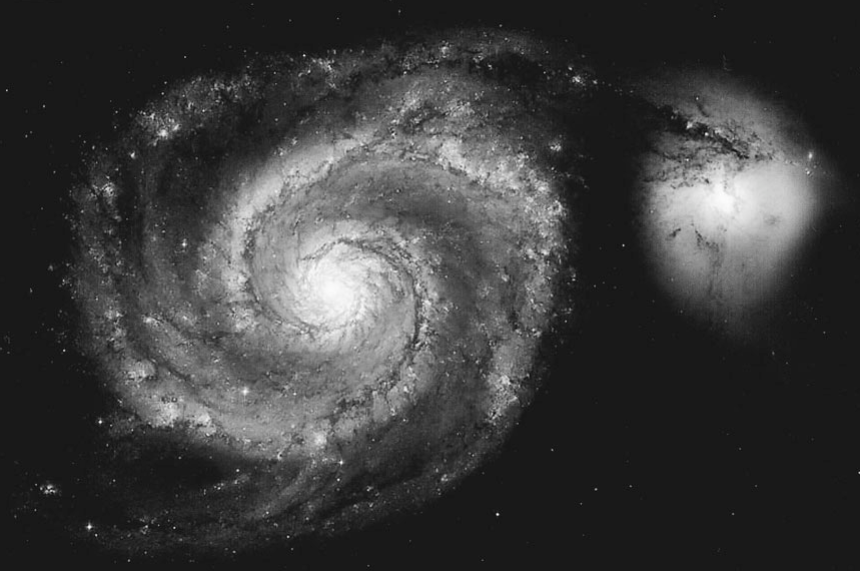
Fig. 18.2. Expanded horizons. The Whirlpool Galaxy (M51) and Companion Galaxy (NGC 5195) float through space 31 million light-years from Earth. Photograph taken by NASA’s Hubble Space Telescope in January 2005. Only in the last century did astronomers grasp the immense temporal and spatial scales of the universe.
The Great Cosmological Debate: Steady State vs. Big Bang. Explaining the universe's expansion spurred a major theoretical debate through the 1950s. Two competing models emerged. The "steady state" theory proposed a universe of constant density, with new matter continuously created during expansion. Its rival, first articulated by Belgian physicist Georges Lemaître and later developed by George Gamow and colleagues, posited a singular, hot, dense origin in a "Big Bang", followed by ongoing expansion. While the steady-state model held significant sway among mid-century cosmologists, the debate was conclusively settled after 1965 with the accidental discovery of the cosmic microwave background (CMB) radiation by Arno Penzias and Robert Wilson of Bell Laboratories. This omnipresent 3° Kelvin background radiation precisely matched predictions for the relic heat of a primordial fireball, earning its discoverers the Nobel Prize in 1979 and cementing the Big Bang theory as the dominant cosmological paradigm.
The Inflationary Universe and the Standard Model. The discovery of the CMB radiation showcased the immense theoretical power of unifying particle physics with cosmology. This synergy produced the coherent Standard Model of cosmology. Its widely accepted inflationary variant describes a universe originating approximately 13.8 billion years ago from an initial singularity. Following the Big Bang, a phase of exponential growth called cosmic inflation occurred, increasing the universe's size by over seventy-five orders of magnitude. As expansion and cooling continued, energy and matter decoupled after about 380,000 years, leading to the formation of the first atoms and the release of the CMB. Over billions of subsequent years, gravity sculpted the cosmic web of galaxies and stars, with our own solar system forming roughly 4.6 billion years ago.
Open Questions and Frontier Research in Modern Cosmology. Despite this robust framework, significant mysteries persist in cosmology. Determining the universe's precise age and fate depends on accurately measuring the Hubble constant and the universe's total mass-energy content. Current research seeks to identify dark matter, an elusive form of matter inferred from gravitational effects that helps bind galaxies. Intriguingly, studies since 1998 indicate that a repulsive dark energy is accelerating cosmic expansion, suggesting a potential fate of continued acceleration or even a "Big Rip". Furthermore, explaining the origin of cosmic structure—the transition from early uniformity to present-day galaxies—remains a key challenge. Investigations into quantum cosmology, virtual particles, and quantum tunneling explore how the universe may have arisen from a quantum vacuum. The study of black holes and their Hawking radiation also provides insights into extreme gravity and thermodynamics. Contemporary theorists even probe esoteric concepts like multiverse theories, demonstrating the field's enduring vitality. Ultimately, this pursuit of fundamental knowledge continues the venerable Hellenic tradition, driven by intellectual satisfaction and the profound human desire to comprehend our cosmic origins.
Date added: 2026-02-14; views: 350;