
The Historical Emergence and Modern Dynamics of Big Science and Technoscience
The concept of Big Science, characterized by research conducted with large-scale, costly instruments operated by specialized teams in industrial-scale installations, is not a uniquely modern phenomenon. Historical precedents include the Imperial Astronomical Bureau of classical China, the grand observatories of Tycho Brahe in the sixteenth century, and the international expeditions to observe the transits of Venus in the eighteenth century. However, these early examples are overshadowed by the extraordinary developments of the twentieth and twenty-first centuries, which represent the true industrialization of scientific research. This shift marked a fundamental transformation in the organization, scale, and cost of producing new knowledge.
Throughout the nineteenth century, the dominant mode of scientific investigation involved individual researchers or small groups working in modest laboratories. The advent of nuclear physics in the twentieth century irrevocably altered this paradigm. Research began to necessitate massive installations like particle accelerators, or "atom smashers," and other costly capital equipment far beyond the resources of individual scientists or even single institutions. Consequently, large, collaborative teams of specialized researchers began to replace the solitary investigator. Scientific publications from such endeavors now frequently list hundreds of authors, reflecting this collective effort.
A quintessential example of Big Science is the discovery of the "top quark" in 1995 at the Fermi National Accelerator Laboratory (Fermilab). This achievement required two separate teams, each comprising 450 scientists and technicians operating detectors costing $100 million each. This model continues with projects like the Large Hadron Collider (LHC) at the European Center for Nuclear Research (CERN), a $1.93 billion facility involving thousands of scientists worldwide. While small-group research persists in fields like botany or mathematics, Big Science has become a defining feature of disciplines such as particle physics, biomedicine, and space exploration.
The divergent fates of two major projects highlight the political and economic forces shaping Big Science. The Superconducting Supercollider (SSC), a monumental particle accelerator under construction in Texas, was canceled in 1994 when its public cost escalated to $11 billion, despite its profound value for natural philosophy. In stark contrast, the Human Genome Project, a multi-billion dollar endeavor, faced no such threat due to its clear promise of practical utility in medicine and agriculture. This contrast underscores the constant tension between the pursuit of fundamental knowledge and the demand for socially beneficial outcomes, especially for publicly funded research.
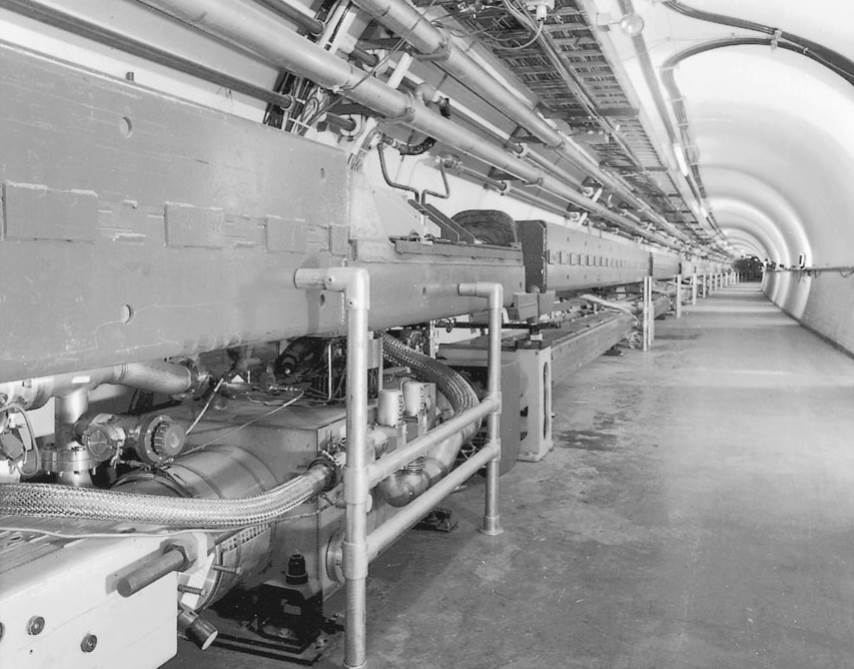
Fig. 20.6. Natural philosophy and big science. Today, discoveries in such fields as high-energy physics require large and expensive equipment and teams of scientists working together. Pictured is a portion of the four-mile main accelerator at the Fermi National Accelerator Laboratory in Illinois. The tunnel is 20 feet underground. The Tevatron accelerator (the lower ring) uses superconducting magnets to accelerate protons and antiprotons to very high energies. Sophisticated detectors display the results of particle collisions which are then “read” by technical experts.
Not all Big Science projects are judged solely by immediate utility, as evidenced by major space exploration efforts. Projects like the Hubble Space Telescope ($3 billion), the Mars Exploration Rover Mission ($820 million), and the Cassini-Huygens Mission to Saturn ($3.3 billion) offer incalculable scientific value but minimal direct practical application. These endeavors plainly reveal the tension between disinterested scientific inquiry and pressures for useful outcomes, a historical constant that is magnified in the context of massively expensive, publicly funded science. This dynamic remains a central theme in the social history of scientific research.
The equipment-intensive nature of Big Science relates directly to the concept of technoscience, a term denoting the deep interdependence of scientific research and advanced technology. Technoscience encompasses both the application of science to create new technologies and the reliance on stupendous, technologically complex instruments to conduct research. In this framework, sophisticated instrumentation is not merely a tool but a transformative agent that has altered the very nature of scientific practice. The laboratory has evolved from a simple workspace into a complex knowledge-production factory.
From Galileo's telescope to the James Webb Space Telescope, instrumental technology has always driven astronomical discovery. However, technoscience argues that a qualitative shift occurred when the quantity and complexity of instruments reached a critical threshold. Modern laboratories marshal virtual arsenals of equipment—confocal microscopes, mass spectrometers, lasers—each representing a highly specialized field of technical knowledge. Entire industries exist to supply this market, with instruments often costing hundreds of thousands of dollars and requiring dedicated specialists to operate them.
Scholars view scientific instruments as "inscription machines" that generate data outputs from specific inputs. These devices are "blackboxed," meaning their internal workings are accepted as reliable and are not routinely questioned by the research community. However, the operation of these instruments and the interpretation of their raw data involve elaborate social and technical processes. The outputs, whether squiggles on a graph or numerical readings, are meaningless without being contextualized, filtered, and interpreted by researchers within a shared theoretical framework.
This perspective reveals a revised understanding of laboratory dynamics, where the traditional image of the lone scientist is replaced by an industrialized, hierarchical division of labor. Scientific workers operate instruments and handle preliminary data, which is then analyzed and synthesized by senior scientists who direct further research and produce manuscripts and grant applications. The laboratory itself becomes the key functional unit—a physical and social entity with inputs (personnel, supplies, funding, ideas) and outputs (papers, applications, trained researchers).
Laboratories function as nodes within a vast network, interacting with other labs, "invisible colleges" of specialists, equipment manufacturers, journal publishers, and funding agencies. This systemic view of technoscience captures the complex, collaborative, and instrument-driven reality of modern scientific enterprise. It emphasizes that knowledge production is as much a social and technical process as it is an intellectual one, a defining characteristic of research in the age of Big Science. This model continues to evolve, pushing the frontiers of knowledge in fields from high-energy physics to genomics, forever intertwining the fate of discovery with the advancement of technology.
Date added: 2026-02-14; views: 348;