
Plant Resource Allocation and Life History Strategies
The Evolutionary Mechanics of Plant Resource Allocation. The optimal allocation of limited resources to growth, maintenance, and reproduction represents an interrelated suite of functional attributes that have evolved through natural selection. These physiological functions and their corresponding anatomical plant structures interact dynamically to determine evolutionary fitness, defined fundamentally as the number of viable descendants contributed to future generations. Natural selection systematically favors individuals that maximize offspring contribution. However, the internal partition of carbon, nitrogen, and other essential nutrients among organs involves severe physiological trade-offs, where fitness gains in one function are frequently offset by energy deficits in another.
Increasing resource partitioning toward reproduction does not automatically translate to enhanced evolutionary success. When plants divert excessive metabolic products toward seed formation, fewer carbon skeletons remain available for structural vegetative growth. Consequently, the plant may fail to compete against neighboring individuals for light interception, soil hydration, and mineral acquisition. Alternatively, an individual can optimize its fitness by suppressing early reproductive effort and reallocating assimilation products into height acquisition and root lateral extension. By usurping ambient solar radiation and soil moisture from adjacent flora, the plant secures long-term survival and enhances its cumulative lineage output.
Theoretical Frameworks of Resource Partitioning. Ecology and evolutionary biology establish that natural selection maximizes individual fitness by optimizing structural compromises, forming a balanced system of resource allocation across plant modular organs. Foundational theoretical and empirical contributions by Bloom et al. (1985), Tilman (1988), Chapin (1991), Bazzaz (1996), and Grace (1997) demonstrate that resource partition schemes govern plant functional types across diverse biomes. Resources are consistently directed in a manner that maximizes reproductive throughput over an individual's life cycle, though no single phenotypic allocation pattern suits all ecological niches.
Because abiotic factors—including photon flux density, soil volumetric water content, and bioavailable nitrate—fluctuate spatially and temporally, plants display varied morphological and life history traits. Diverse physiological strategies allow plants to grow, persist, and reproduce within specialized ecological microenvironments. While phenotypic plastic responses allow fine-tuning to immediate environmental shifts, allocation responses remain fundamentally constrained by the inherited genetic life history of the species.
Evolutionary Life History Strategies: Monocarpy vs. Polycarpy. A species' life history encapsulates its overarching schedule of growth, morphological development, reproductive timing, and longevity. Evolutionary success relies on maintaining a lineage across generations through distinct adaptive paradigms. One strategy involves remaining small while channeling all acquired energy reserves into a single, massive episode of seed production, a phenomenon known as monocarpy or semelparity. Monocarpic plants invest heavily in reproductive structures at the total expense of vegetative maintenance, culminating in programmed senescent death immediately following seed dispersal.
Conversely, an alternative strategy involves slow vegetative accumulation, prolonged lifespan, and repeated reproductive episodes spanning multiple years or centuries. Plants exhibiting this strategy are classified as polycarpic or iteroparous. The lifespan of iteroparous plants ranges from several years in herbaceous perennials to centuries in canopy tree species.
Environmental Drivers of Life History Trade-Offs. Environmental disturbance regimes determine which life history strategy achieves optimal fitness within a given habitat. Habitats subject to frequent, high-intensity disturbances that regularly expose bare substrate favor rapid colonizers that allocate massive biomass toward high seed output and wind-assisted dispersal. Monocarpic strategies are favored in ephemeral environments characterized by low juvenile mortality but extremely high adult mortality.
However, committing to a single reproductive bout carries significant evolutionary risk under fluctuating environmental conditions. A single unseasonal drought, late frost, or herbivore outbreak can destroy an entire age cohort, eliminating its genetic lineage entirely. In contrast, polycarpic strategies are favored in stable climax communities or uncertain environments where juvenile mortality is high while adult survival is relatively stable. By spreading reproductive effort over multiple growing seasons, iteroparous plants buffer their reproductive success against single-year environmental failures.
Functional Adaptations: Annuals versus Perennials. The differentiation between annual plants and perennial plants represents a classic model of alternative life histories shaped by longevity and age at first reproduction. Annual plants complete their entire lifecycle—from seed germination to vegetative expansion, anthesis, and seed maturation—within a single calendar year or growing season.
During early development, annuals allocate metabolic reserves strictly to photosynthetic foliage and anchor roots to capture solar radiation, water, and inorganic nutrients. As sexual maturity approaches, vegetative growth ceases, and assimilates are shifted toward fruit and seed formation.
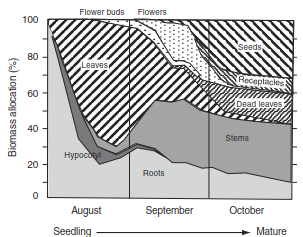
Fig. 18.6 Whole plant allocation for Senecio vulgaris, an annual. Adapted from Harper and Ogden (1970).
The life cycle of the herbaceous annual Senecio vulgaris (common groundsel) illustrates the phenological shift typical of short-lived ruderal species, as detailed in Fig. 18.6. The developmental continuum progresses through three main physiological phases:
1. Phase I (Establishment): Rapid tissue allocation to roots, hypocotyls, and early vegetative foliage to establish baseline photosynthetic capacity.
2. Phase II (Stem Elongation and Anthesis): Biomass shifts into vertical stem expansion and flower bud development, accompanied by a slowdown in new leaf organogenesis.
3. Phase III (Senescence and Seed Maturation): Structural reserves in stems and leaves are re-translocated into ripening seed structures, culminating in systemic plant death.
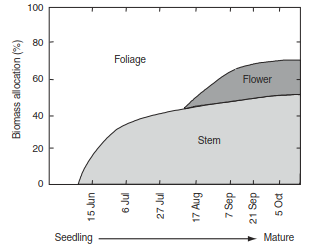
Fig. 18.7 Aboveground allocation to foliage, stems, and flowers in a herbaceous perennial (goldenrod, Solidago speciosa). Adapted from Abrahamson and Gadgil (1973).
In contrast, perennial plants follow an extended allocation schedule, exemplified by the goldenrod species Solidago speciosa shown in Fig. 18.7. Perennials maintain vegetative tissues across consecutive growing seasons, requiring continuous resource allocation to persistent perennating organs (e.g., overwintering buds) and storage tissue (e.g., specialized rhizomes, taproots).
Consequently, perennials allocate a smaller proportion of their seasonal energy budget to direct seed production compared to annuals. However, while annuals must restart development from small seeds each spring, established perennials initiate early spring growth using stored carbohydrate reserves and intact root networks. This storage investment grants perennials an early-season canopy advantage, enabling them to overtop and shade out developing annual competitors.
Allometric Scaling and Biomass Partitioning in Woody Plants. In woody perennial ecosystems, allocation trade-offs extend across multi-year developmental trajectories, governing structural investments in leaf area, branching systems, and main stem wood accretion. The quantitative study of these organ ratios is evaluated via allometric scaling laws, which model how structural organ biomass scales relative to primary stem diameter.
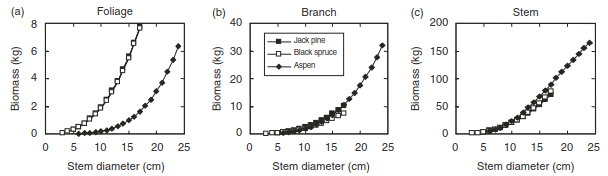
Fig. 18.8 Relationship between stem diameter and foliage, branch, and stem biomass for jack pine, black spruce, and quaking aspen trees growing in Canada. Data from Gower et al. (1997).
As documented by Gower et al. (1997) and illustrated in Fig. 18.8, biomass partitioning across Canadian forest tree species—specifically Jack pine (Pinus banksiana), Black spruce (Picea mariana), and Quaking aspen (Populus tremuloides)—demonstrates clear functional trade-offs driven by physiological design and shade tolerance mechanisms:
Foliage Biomass Accumulation. As stem diameter increases, foliage mass displays distinct non-linear trajectory curves across functional groups. Deciduous broadleaf species such as Quaking aspen maintain lower relative foliage biomass per unit stem diameter due to annual leaf shedding. Conversely, evergreen conifers like Black spruce retain multiple leaf cohorts, resulting in higher accumulated needle mass for an equivalent trunk diameter.
Branch Biomass Partitioning. Branch structural investment scales non-linearly with trunk radial growth to provide mechanical support for expanding photosynthetic canopies. Data across Jack pine, Black spruce, and Quaking aspen indicate consistent exponential scaling curves, reflecting uniform biomechanical requirements for canopy architecture across diverse taxa.
Main Stem Biomass Investment. Main stem trunk mass represents the largest long-term carbon sink in woody perennials. Structural stem accumulation curves show high consistency across both gymnosperm conifers and angiosperm broadleaf species. This persistent allocation to stem wood ensures vertical light capture dominance over decades, reinforcing the long-term survival strategy of perennial woody taxa.
Date added: 2026-09-24; views: 1;