
Diurnal Dynamics of Forest Ecosystem Surface Fluxes and Energy Exchange
Understanding the microclimatic dynamics and biophysical processes within terrestrial ecosystems requires a rigorous examination of surface fluxes and their response to the diurnal solar cycle. Energy transfer at the atmosphere-canopy interface is dictated by shifting radiative inputs that govern sensible heat, latent heat, and ecosystem carbon exchange. In forest environments, particularly boreal and temperate broadleaf ecosystems, these diurnal variations control water vapor transport, primary productivity, and local microclimate regulation.
Diurnal Dynamics of Surface Fluxes and Atmospheric Energy Exchange. Surface fluxes vary systematically over the course of a day in direct response to the diurnal cycle. As incoming solar radiation increases after sunrise, terrestrial surface temperatures rise, dissipating absorbed radiative energy primarily through sensible heat flux (H) and latent heat flux (λE). Concurrently, stomatal apertures enlarge to facilitate carbon dioxide (CO₂) uptake for photosynthesis, triggering transpirational water loss from the canopy.
In the early morning, forest ecosystems display a negative net radiation (Rₙ) balance due to nighttime longwave radiative cooling. Under these conditions, both sensible heat and latent heat fluxes remain minimal. Plant stomata remain closed, suppressing photosynthetic activity while physiological respiration continues. This results in a positive net flux of CO₂ directed from the canopy into the boundary layer.
As the sun ascends, the absorption of solar radiation creates a positive net radiation balance at the surface. The forest canopy warms, partitioning this absorbed energy into atmospheric warming via sensible heat and evapotranspiration via latent heat. The opening of stomata enables net CO₂ assimilation through photosynthesis. Flux magnitudes typically peak during early-to-mid afternoon and diminish in the late afternoon as incoming solar irradiance subsides.
Near-Surface Carbon Dioxide Concentration Dynamics. The concentration of CO₂ within the lower atmospheric boundary layer exhibits a pronounced diurnal oscillation driven by the opposing balance of diurnal photosynthetic uptake and nocturnal ecosystem respiration.
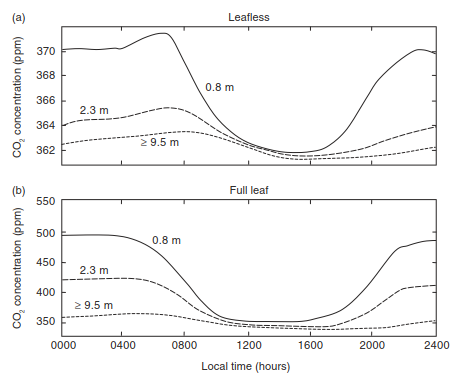
Fig. 17.15. Diurnal variation of near-surface atmospheric CO₂ concentration in a boreal aspen forest during dormant and growing seasons.
During the dormant season, when deciduous broadleaf species are defoliated, diurnal fluctuations in atmospheric CO₂ concentration remain negligible, and vertical concentration gradients are absent. Conversely, during the active growing season, vertical gradients emerge between sub-canopy heights (0.8 m and 2.3 m). Nighttime CO₂ concentrations accumulate within the range of 400 to 500 ppm, whereas daytime photosynthetic drawdowns reduce concentrations to approximately 350 ppm.
High nocturnal CO₂ levels stem from the combination of continuous autotrophic and heterotrophic respiration and the formation of a temperature inversion in the nocturnal boundary layer. This inversion suppresses vertical turbulent transport, trapping respired carbon beneath the canopy. The amplitude of this diurnal concentration cycle attenuates with vertical height, reaching relative stability at 9.5 m above the ground, where daytime and nighttime values converge.
Environmental Controls on Canopy Carbon Uptake. Canopy-scale carbon fluxes exhibit functional dependencies on microclimatic variables similar to those observed at the leaf scale. The net uptake of carbon by a forest canopy scales directly with photosynthetically active radiation (PPFD), reaching a light-saturation plateau under elevated radiation levels.
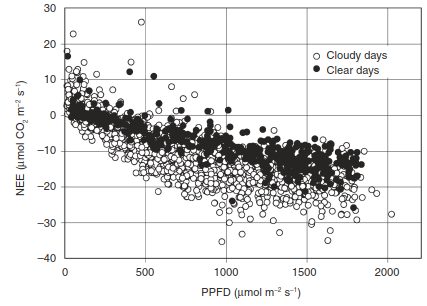
Fig. 17.16. Net ecosystem exchange of carbon (NEE) in relation to direct (clear days) and diffuse (cloudy days) photosynthetically active radiation (PPFD) for a boreal aspen forest. Negative fluxes indicate carbon uptake. Adapted from Law et al. (2002).
This relationship is mathematically parameterized by the non-rectangular hyperbolic model:
NEE = −(Aₘₐₓ · EF↓) / (EF↓ + Aₘₐₓ) + Rₑ
where the first term represents gross primary production (GPP) as a function of incoming photon flux density (EF↓) and maximum photosynthetic capacity (Aₘₐₓ), while the second term (Rₑ) accounts for total ecosystem respiration (Lasslop et al., 2010).
Canopy carbon assimilation is strongly governed by light quality, specifically the ratio of direct to diffuse radiation. Diffuse light penetrates deeper into multi-layered forest structures, illuminating lower canopy foliage without causing light saturation in upper leaves. Consequently, net carbon uptake (−NEE) is enhanced during cloudy conditions compared to clear sky conditions dominated by direct beam radiation—a phenomenon documented across diverse forest ecosystems (Hollinger et al., 1994; Goulden et al., 1997; Gu et al., 2002, 2003; Knohl and Baldocchi, 2008).
Water-Use Efficiency and Seasonal Energy Partitioning. Carbon uptake is intrinsically linked to canopy-scale evapotranspiration (ET). The ratio of gross primary production to evapotranspiration (GPP / ET) serves as a primary metric for water-use efficiency (WUE).
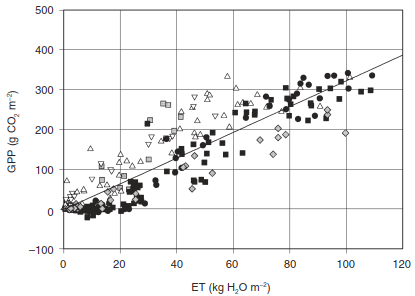
Fig. 17.17. Monthly gross primary production (GPP) in relation to monthly evapotranspiration (ET) for broadleaf deciduous forests. Adapted from Law et al. (2002).
When normalized by the vapor pressure deficit (VPD), the expression (GPP · VPD) / ET defines the intrinsic canopy water-use efficiency. Across global terrestrial biomes including forests, grasslands, and croplands, standard GPP / ET values span 1 to 6 g C kg⁻¹ H₂O, while VPD-scaled values range between 5 and 43 g C hPa kg⁻¹ H₂O (Beer et al., 2009).
Seasonal Energy Budget Modifications. In broadleaf deciduous forests, leaf phenology alters the surface radiation budget and the partitioning of net radiation (Rₙ) into sensible heat (H) and latent heat (λE).
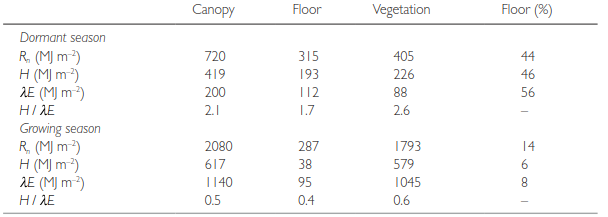
Table 17.3. Dormant season and growing season energy fluxes above the canopy, at the forest floor, and from vegetation (canopy – floor). Note: Data derived from Wilson et al. (2000). Fluxes are integrated over dormant (days 1–115, 305–365) and growing (days 116–304) periods.
Prior to budburst during the dormant season, the majority of net radiation is converted into sensible heat, yielding an above-canopy Bowen ratio (H / λE) of 2.1. Following leaf emergence, transpiration increases the fraction of net radiation partitioned into latent heat, dropping the seasonal Bowen ratio to 0.5. Canopy development reduces the forest floor contribution to total net radiation from 44% down to 14%, and cuts the floor contribution to total turbulent energy fluxes to under 10%.
Canopy Structural Controls and Aerodynamic Coupling. The leaf area index (LAI) determines the proportion of evapotranspiration derived from transpiration relative to soil evaporation. In closed forest canopies (LAI > 3), transpiration accounts for 80% to 90% of total ET (Wang et al., 2014). Conversely, sparse ecosystems allow greater radiative penetration to the forest floor, increasing soil evaporation up to 50% of total ET (Baldocchi and Ryu, 2011).
Forest floor latent heat flux is bounded by available sub-canopy energy (Baldocchi et al., 2000). Under dry floor conditions, evaporation increases linearly with available energy, accounting for approximately 25% of sub-canopy irradiance. However, at available energy thresholds exceeding 100 W m⁻², moisture diffusion resistance restricts forest floor evaporation to a maximum flux ceiling of approximately 35 W m⁻².
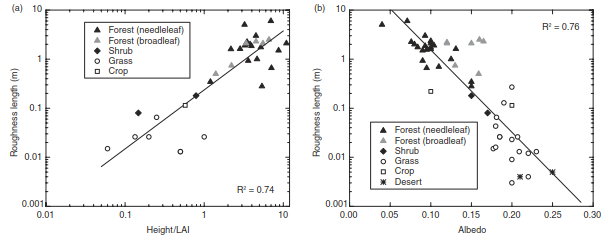
Fig. 17.18. Relationships among roughness length, canopy structure, and albedo for forest, shrub, grass, crop, and semidesert vegetation: (a) roughness length vs. the ratio of canopy height to leaf area index (h / LAI); (b) roughness length vs. albedo. Data from Cho et al. (2012).
Canopy structural architecture governs boundary-layer aerodynamics and momentum transfer. Roughness length (z₀ₘ) and zero-plane displacement height (d) are frequently approximated using canopy height (h) via simple linear parameterizations:
z₀ₘ = 0.1h
d = 0.7h
Advanced parameterizations incorporate canopy density and leaf area metrics (Raupach, 1994; Sellers et al., 1996a). Broad-scale cross-biome analyses demonstrate that aerodynamic roughness length scales directly with the ratio of canopy height to leaf area index (h / LAI) (Cho et al., 2012).
High-stature forest structures exhibit substantial aerodynamic roughness combined with lower surface albedo, whereas lower-stature vegetation (grasslands, crops, and deserts) displays reduced roughness lengths and higher albedo values. This inverse relationship between surface albedo and aerodynamic roughness reflects an inherent biophysical trade-off in terrestrial ecosystems, balancing net radiative energy absorption against turbulent heat exchange with the atmosphere.
Date added: 2026-09-24; views: 1;