
Resource Allocation Strategies and Trade-Offs in Plant Growth
Plants use the carbon absorbed by leaves during photosynthesis to maintain cellular structures and grow new tissues. Maintenance of existing tissues requires an expenditure of carbon during respiration, which reduces the net carbon available for new growth. The net carbon available to a plant, along with essential environmental nutrients, is partitioned among leaves, roots, stems, reproductive structures (flowers and seeds), and defensive secondary metabolites for protection against insects and herbivores. Collectively, this partitioning of fixed carbon and nutrients to various plant parts and physiological functions is known as resource allocation.
Resource allocation is most directly evident in the proportion of biomass invested in different plant organs. It serves as a primary determinant of plant growth, competitive ability, and evolutionary fitness across diverse terrestrial ecosystems.
1. Principles of Resource Allocation and Evolutionary Trade-Offs. Because plants possess a finite supply of energy and structural resources, allocation to one physiological function or organ inevitably comes at the expense of another. High allocation to foliage maximizes leaf area, enhancing light capture and carbon dioxide (CO₂) absorption to fuel further biomass accumulation. However, investing heavily in foliage becomes inefficient or non-viable if soil moisture or nutrient supplies are insufficient to support the expanded transpirational surface.
Consequently, plants must balance conflicting physiological requirements. The resulting ecological compromises and biophysical trade-offs dictate alternative life-history strategies that ensure survival, competitive persistence, and reproductive success in heterogeneous landscapes. Inter- and intraspecific variations in plant growth rates depend as much on how species partition resources and navigate environmental stress as they do on intrinsic photosynthetic capacities.
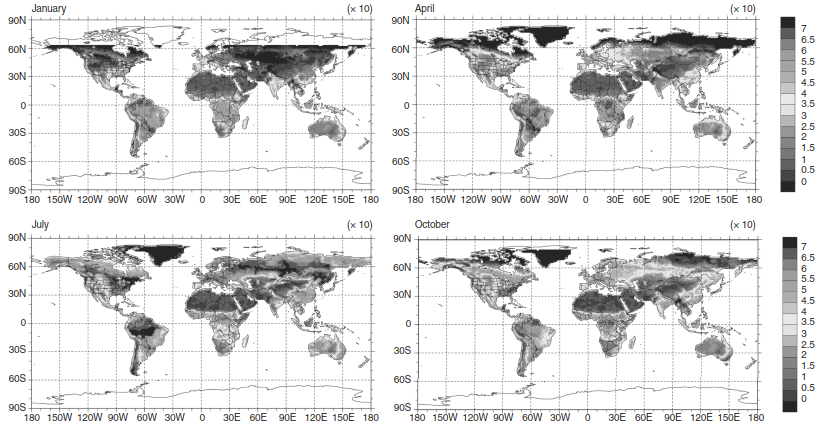
Fig. 18.4. The normalized difference vegetation index averaged for January, April, July, and October for 1982–1993. Low values indicate low plant production. High values indicate high production.
2. Reproductive Allocation: Seed Size and Dispersal Trade-Offs. Allocating fixed carbon to reproduction provides a clear illustration of evolutionary trade-offs. Producing a large quantity of seeds increases the probability of establishing offspring in future generations. Dispersing a wide blanket of seeds over broad spatial scales enhances the likelihood that at least some propagules encounter microenvironments suitable for germination and establishment.
However, high reproductive output often conflicts with vegetative growth. Diverting substantial photosynthate to seed crops during high-yield reproduction years can significantly depress stem radial increment and shoot expansion.
Seed Mass vs. Seed Quantity. The balance between seed mass and seed quantity represents an evolutionary compromise between dispersal efficiency and metabolic energy reserves available for early seedling survival. This relationship has been documented across diverse taxa by researchers including Grime and Jeffrey (1965), Leishman and Westoby (1994), Saverimuttu and Westoby (1996), Walters and Reich (2000), and Westoby et al. (2002).
- Small, Wind-Dispersed Seeds: Seed sizes range from less than 10⁻⁶ g in dust-like orchid seeds to 10⁻⁴ g in light birch seeds. Small seeds carry minimal carbohydrate reserves and force the emerging seedling to rely on autotrophic photosynthesis rapidly. Their small mass, however, allows them to be produced in large quantities and dispersed widely by wind vectors over vast geographic regions.
- Large, Nutrient-Rich Seeds: Large seeds range from 0.1–10 g in nuts (beech, oak, chestnut) to over 10⁴ g in large coconuts. Large seeds supply initial carbohydrate and nutrient reserves to sustain growth through extended periods of environmental stress or low light availability. However, large seeds are produced in smaller numbers, exhibit limited dispersal distances, and face higher rates of predation by seed-eating wildlife.
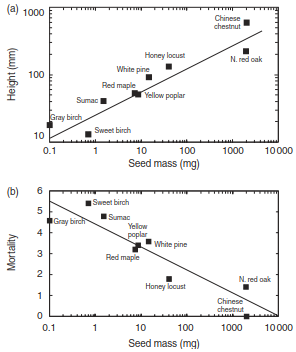
Fig. 18.5. Relationship between seed weight and seedling growth and survival for nine species of trees grown in shade. Seeds were germinated and then transplanted to grow in shade. (a) Height growth after 12 weeks. (b) Number of seedlings that died over the 12 weeks. Adapted from Grime and Jeffrey (1965).
Controlled experimental studies demonstrate the adaptive significance of seed size. For instance, Grime and Jeffrey (1965) evaluated shade-grown seedlings across nine tree species and observed that after 12 weeks, seedling height correlated positively with initial seed mass, while seedling mortality decreased sharply. Species with low seed mass (such as gray birch, sweet birch, and sumac) exhibited the lowest height growth and highest mortality under shaded conditions. Conversely, large-seeded species (such as northern red oak and Chinese chestnut) achieved greater height growth and sustained lower mortality rates due to their substantial metabolic reserves.
3. Aboveground vs. Belowground Biomass Allocation. Plants encounter additional operational trade-offs when acquiring essential environmental resources. Foliage captures photosynthetically active radiation (PAR) and assimilates CO₂. Stems provide mechanical support for the canopy and establish hydraulic pathways for long-distance water and solute transport. Large woody trunks and branches store water, non-structural carbohydrates, and nutrients. Belowground, root networks absorb soil moisture and essential mineral ions.
Increased allocation to aboveground shoot and foliage biomass enhances carbon gain but limits root development. Conversely, shifting carbon allocation toward roots facilitates nutrient and moisture uptake at the expense of shoot elongation and light interception. Resource acquisition therefore represents a dynamic equilibrium between aboveground light harvesting and belowground soil mining.
4. Acclimation of Biomass Allocation to Environmental Stresses. Because natural environments are rarely optimal, plants adjust their biomass allocation patterns in response to localized microclimatic and soil stresses. Under light, moisture, or nutrient limitations, plants alter their structural investments to optimize survival.
According to the optimal partitioning theory—formulated and expanded by Bloom et al. (1985), Chapin (1991), and Gleeson and Tilman (1992)—plants shift biomass allocation toward the specific organ responsible for acquiring the most limiting environmental resource, thereby balancing growth limitations across all essential inputs.
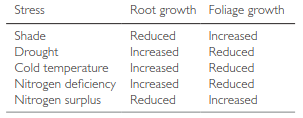
Table 18.1. Changes in carbon allocation in trees in relation to various stresses. Note: Adapted from Waring (1991); see also Poorter et al. (2012).
In nutrient- and moisture-rich environments, plants allocate photosynthate primarily to leaf production, increasing leaf area index (LAI) and gross primary productivity. Conversely, deficits in soil moisture or nitrogen shift allocation toward root systems to maintain nutrient uptake rates. Agricultural practices such as irrigation and fertilization artificially remove belowground limitations, shifting plant allocation toward foliage development.
Cold soil temperatures also promote root allocation. Low root temperatures increase water viscosity and reduce cell membrane permeability, impairing hydraulic conductance and ion uptake mechanisms. Plants compensate for reduced uptake efficiency per unit root mass by increasing total root biomass investment.
Date added: 2026-09-24; views: 2;