
Plant Life History Strategies: Environmental Adaptation and Ecological Succession
The evolutionary trajectory of terrestrial vegetation is shaped by environmental dynamics, where ecological forces determine species persistence, resource allocation, and reproductive modes. The roles of environmental disturbance and interspecific competition for limited physical resources—primarily photosynthetic photon flux density (light), volumetric soil moisture, and essential soil nutrients—dominate the theoretical foundation of plant ecology.
Recurring landscape-level disturbances, such as high-severity forest fires or severe windthrow events, create open, unshaded habitats where establishing seedlings experience negligible canopy interception. Evolutionary success in these open environments favors fast-growing pioneer taxa. Their small, highly mobile propagules land on exposed substrates, germinate under high light levels, and undergo rapid vegetative growth to capture canopy space.
Conversely, undisturbed, closed-canopy forest communities maintain dark forest floor environments with minimal light availability. These competitive ecosystems select for shade-tolerant species capable of enduring low photon availability in the understory for extended periods, waiting until a canopy gap opens upon the death of an overstory tree.
Theoretical Models of Life History: The r/K Selection Continuum. The distinction between disturbance-driven and competition-dominated regimes is formalized in the classical paradigm of r- and K-selection developed by MacArthur and Wilson (1967) and expanded by Gadgil and Solbrig (1972). r-selected species maintain population viability across changing landscapes through high fecundity and widespread seed dispersal. These plants are typically short-lived, allocating a minor fraction of their energy budget to long-term vegetative maintenance while prioritizing early, high-volume reproduction. They produce numerous small seeds optimized for long-distance transport, allowing rapid colonization of temporarily available, open habitats created by recurring disturbances.
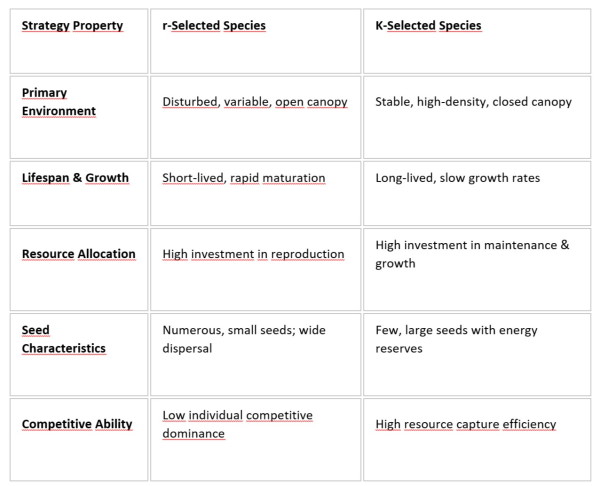
In contrast, K-selected species thrive in crowded environments near the carrying capacity ($K$) of their habitat. Characterized by long lifespans and slow growth rates, these plants dedicate a large portion of their metabolic resources to somatic growth, structural tissue, and roots. This structural investment enables them to survive intense competition for soil moisture, nutrients, and light, though it reduces total seed production. Their propagules are fewer but larger, providing new seedlings with energy reserves to establish under dense forest canopies. Rather than forming a strict dichotomy, r- and K-selected strategies represent the endpoints of a continuous spectrum, with most plant species occupying intermediate positions.
Grime’s C-S-R Triangular Scheme and Adaptive Life Forms. Recognizing that the r/K selection model omits the impact of environmental stress, Grime (1979) introduced a three-way life history classification based on competition, disturbance, and resource stress:
· Ruderal plants (R): Opportunistic taxa adapted to frequently disturbed but resource-rich environments. They feature short lifespans, fast growth, and early reproductive efforts.
· Competitor plants (C): Species adapted to stable, low-stress environments with low disturbance frequency. They optimize resource capture, grow larger, mature later, and outcompete neighboring plants.
· Stress tolerators (S): Plants specialized for extreme habitats subject to severe resource limitations, such as low moisture, cold temperatures, or poor nutrient availability. They survive through slow growth and dedicated tissue maintenance.
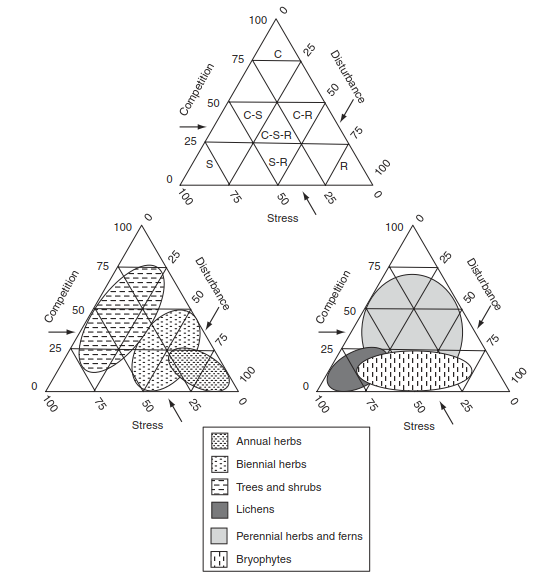
Fig. 18.11. The C-S-R life history model illustrating plant adaptation strategies along gradients of competition, stress, and disturbance.
Varying combinations of these ecological pressures give rise to intermediate life history strategies (Figure 18.11):
1. Competitive Ruderals (C-R): Adapted to low-stress environments with moderate, recurring disturbances that keep interspecific competition at intermediate levels.
2. Stress-Tolerant Competitors (C-S): Adapted to stable, low-disturbance environments subject to moderate environmental stress.
3. Stress-Tolerant Ruderals (S-R): Adapted to uncompetitive, low-productivity habitats subject to recurring physical disturbances.
4. C-S-R Strategists: Adapted to habitats where moderate stress and intermediate disturbance frequencies combine to limit total competition.
Ecological life forms segregate along these environmental gradients. Trees and shrubs typically occupy regimes with low to moderate disturbance, tolerating wide variations in stress and competition. Annual herbs specialize in high-disturbance, low-stress environments where competition is minimal. Perennial herbs and ferns exhibit broader ecological amplitude across these environmental constraints.
Physiological Differentiation in Ecological Succession. The functional differences between early successional species (pioneer plants) and late successional species highlight key physiological trade-offs in forest development (Table 18.3). Early successional plants colonize freshly disturbed, unshaded sites. Their seeds often require direct light to break seed dormancy and can remain viable in soil seed banks for decades awaiting canopy-opening disturbances.
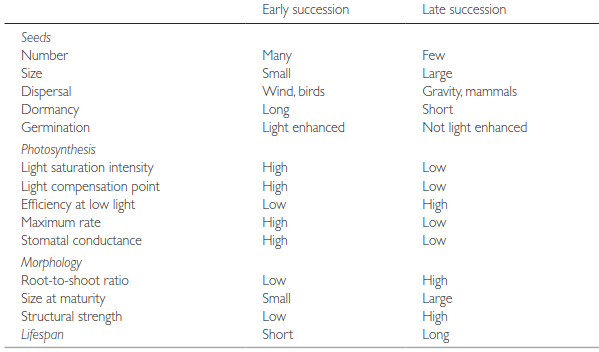
Table 18.3. Physiological and ecological traits distinguishing early and late successional plant species.
Physiologically, pioneer species are shade-intolerant, maintaining high light-saturated photosynthetic rates under full sunlight but exhibiting poor carbon balance under low light. Their light saturation point occurs at high photon fluxes.
Early Successional (Pioneer) Strategy:[ High Light ] ──> [ Rapid Germination ] ──> [ High Max Photosynthesis ] ──> [ Short Lifespan ] Late Successional (Climax) Strategy:[ Low Light ] ──> [ Shade Adaptation ] ──> [ Efficient Low-Light Assimilation ] ──> [ Long Lifespan ]In contrast, late successional seedlings germinate under dense canopy shade, where full sunlight is absent. Their seeds do not require direct light for germination and generally lose viability quickly if un-germinated. These shade-tolerant plants possess shade-adapted photosynthetic machinery, operating with higher light-use efficiency under low photon flux densities.
These physiological adaptations correlate closely with tree lifespan. Based on long-term forestry data (Figure 18.10), shade-intolerant broadleaf deciduous trees reach an average maximum longevity of 147 years, whereas shade-tolerant species achieve an average longevity of 191 years. This longevity reflects an evolutionary allocation strategy that prioritizes wood density, defense mechanisms, and shade adaptation over rapid vertical growth.
Date added: 2026-09-24; views: 1;