
Plant Functional Types and Evolutionary Traits in Ecology
Understanding how terrestrial plants respond to global environmental change requires simplifying the vast diversity of the plant kingdom into structured ecological categories. The classification of species into r- and K-selected plants (MacArthur and Wilson 1967; Gadgil and Solbrig 1972), ruderal, competitor, and stress tolerator plants (Grime 1979), or early and late successional plants (Bazzaz 1979, 1996; Huston and Smith 1987) represents broad classes of plant functional types (PFTs). These classifications effectively reduce the hyper-complexity of species diversity in ecological function down to a few tractable, representative plant operational types.
Plant functional types are fundamentally defined by key physiological, morphological, and life history characteristics. These traits collectively determine ecosystem dynamics, community assembly, carbon cycling, and species responses to shifting climate regimes.
Defining Plant Functional Types via Remote Sensing and Physiology. The combination of physiological and morphological traits alongside climatic preferences provides the primary empirical basis for defining plant functional types. Categorizations such as annual versus perennial, evergreen versus deciduous, and broadleaf versus needleleaf are particularly powerful. These structural traits are readily observable via satellite remote sensing techniques, while simultaneously representing core ecological properties that govern stomatal conductance, photosynthesis, and internal carbon allocation.
Based on the permanence of aboveground biomass, leaf longevity, and leaf structural type, ecologists categorize terrestrial vegetation into six major functional types (Running et al. 1995; Ustin and Gamon 2010):
1. Needleleaf evergreen perennial
2. Broadleaf evergreen perennial
3. Needleleaf deciduous perennial
4. Broadleaf deciduous perennial
5. Broadleaf annual
6. Grass (Graminoid)
By applying straightforward climate rules, land surface models can further subdivide these groups into thermal- and moisture-defined ecological variants (Nemani and Running 1996; Bonan et al. 2002).
Comparative Hydraulics: Angiosperms vs. Gymnosperms. Among woody perennial plants, a foundational functional distinction exists between angiosperms (flowering plants) and gymnosperms (non-flowering seed plants, including conifers, cycads, and Ginkgo).
Angiosperm Strategy: High Construction Cost ──> High Hydraulic Conductivity ──> High Net PhotosynthesisGymnosperm Strategy: Low Hydraulic Capacity ──> High Leaf Longevity ──> Extended Payback PeriodAs detailed in Table 18.4, angiosperm foliage exhibits higher photosynthetic rates and elevated stomatal conductance. Their leaves are economically inexpensive to construct—meaning they possess a lower leaf mass per unit area (LMA)—but they are relatively short-lived. In contrast, conifer foliage maintains lower maximum photosynthetic capacity and stomatal conductance, requires higher carbon investment per unit leaf area to build, and persists over multi-year lifespans (Brodribb et al. 2012).
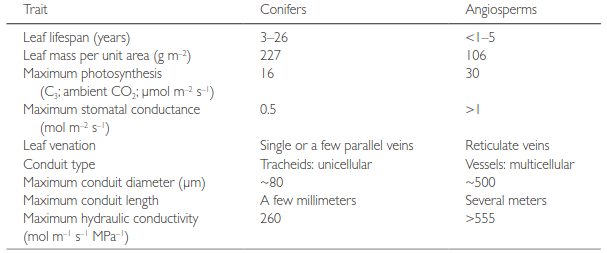
Table 18.4. Key functional differences between conifers and angiosperm trees (Adapted from Brodribb et al. 2012).
These functional divergence patterns are intrinsically tied to plant hydraulics. Angiosperms possess a highly developed xylem system featuring wide, elongated multicellular vessels and complex reticulate leaf venation. This structural architecture delivers substantially higher hydraulic conductivity, supplying the water flux needed to sustain elevated stomatal conductance and rapid photosynthetic carbon assimilation. Conversely, conifers rely on unicellular tracheids with narrow diameters and short conduit lengths, imposing structural limits on maximum water transport capacity.
The Leaf Economics Spectrum and Carbon Investment. Comparisons across functional groups reveal broad, predictable correlations among leaf structure, metabolic activity, and longevity. Key diagnostic metrics include maximum photosynthetic capacity per unit leaf mass (A_mass), leaf respiration rate per unit mass (R_mass), leaf nitrogen concentration per unit mass (N_mass), leaf lifespan, and the carbon construction cost per unit leaf area.
The construction cost of foliage is directly quantified by leaf mass per unit area (LMA), or its mathematical inverse, specific leaf area (SLA):
LMA = Leaf Dry Mass / Leaf Surface Area
SLA = Leaf Surface Area / Leaf Dry Mass = LMA⁻¹
Species exhibiting low LMA (high SLA) invest minimal carbon per unit of light-capturing surface area. They produce thin leaves optimized for rapid photosynthetic payback over a short period. Conversely, species with high LMA (low SLA) produce dense, structurally reinforced leaves requiring heavy initial carbon investment, which is recouped across extended leaf lifespans (Reich et al. 1998a).
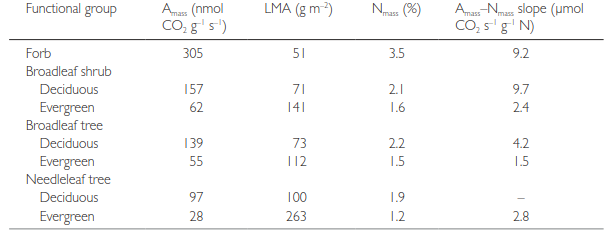
Table 18.5. Maximum photosynthetic capacity per unit leaf mass (A_mass), leaf mass per unit area (LMA), leaf nitrogen per unit leaf mass (N_mass), and slope for photosynthesis–nitrogen relationship for 257 species of forbs, shrubs, broadleaf trees, and needleleaf trees (Data from Reich et al. 1998a).
As demonstrated in a global study of 257 plant species (Table 18.5), forbs achieve the highest A_mass and N_mass paired with the lowest LMA. Among woody species, deciduous foliage consistently outperforms evergreen foliage in A_mass and N_mass, while maintaining lower LMA. The mathematical slope of the A_mass–N_mass relationship—representing photosynthetic nitrogen-use efficiency—is steepest in short-lived, low-LMA functional groups.
A parallel trend governs leaf respiration (R_mass). Maintaining high photosynthetic machinery requires elevated enzyme concentrations (notably RuBisCO), which incurs substantial metabolic maintenance costs (Reich et al. 1998b). Consequently, R_mass scales positively with N_mass and negatively with LMA and leaf longevity across biomes ranging from alpine tundra to tropical rainforests.
Global Distribution and Evolutionary Adaptations. The evolutionary choice between evergreen and deciduous leaf habits represents an integrated physiological response to climate, resource supply, and herbivory pressures (Chabot and Hicks 1982; Kikuzawa 1991; Wright et al. 2004).
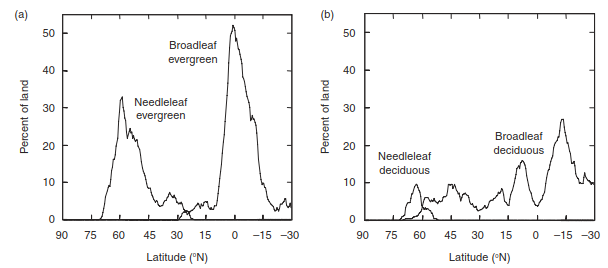
Fig. 18.12. Geographic distribution of (a) evergreen trees and (b) deciduous trees showing the percentage of land area covered by trees in relation to latitude. Trees are distinguished by needleleaf and broadleaf types (Derived from DeFries et al. 1999, 2000a,b).
· Evergreen Strategies: Evergreen leaves require a high initial carbon construction cost. However, because foliage is retained for multiple growing seasons, plants spread this initial expenditure over several years, continuously photosynthesizing whenever ambient conditions permit. Evergreen foliage also features structural and chemical defenses against herbivory, protecting nitrogen and carbon investments.
· Deciduous Strategies: Deciduous plants shed their foliage annually to avoid extreme abiotic stress such as freezing winter temperatures or seasonal drought. This strategy avoids winter desiccation and transpiration loss, but requires rebuilding the photosynthetic canopy each spring through annual carbon investment.
These functional trade-offs shape the global bimodal distribution of forest biomes (Figure 18.12):
1. Needleleaf Evergreens: Dominant across the nutrient-poor, high-latitude boreal forests of Canada, Northern Europe, and Russia, as well as high-elevation montane zones.
2. Broadleaf Evergreens: Dominant in equatorial tropical rainforests where year-round light and precipitation favor continuous carbon assimilation.
3. Broadleaf Deciduous: Dominant throughout temperate mid-latitudes and tropical seasonal forests where predictable cold or dry periods restrict year-round photosynthesis.
4. Needleleaf Deciduous: Specialized taxa like Larix (larch) dominate subarctic Eastern Siberia, where extreme winter cold triggers leaf drop to avoid fatal vascular desiccation (Gower and Richards 1990).
Disturbance and Adaptive Life History Trade-Offs. A comprehensive definition of plant functional types must integrate physiological traits with ecosystem disturbance regimes. Classifications such as r- and K-selection, C-S-R strategies, exploitive vs. conservative species (Bormann and Likens 1979), and gap vs. non-gap species (Shugart 1984, 1998) reflect the fundamental role of disturbance in structuring ecological communities.
Morphological and physiological constraints dictate linked life history suites. For instance, early successional plants combine physiological traits (shade intolerance, high maximum photosynthetic rates, high light saturation points) with specific regenerative traits: short lifespans, rapid maturity, and the production of small, highly mobile seeds.
Ultimately, plant evolution is governed by a fundamental allocation trade-off: species must allocate finite carbon resources either toward rapid light capture and growth, or toward nutrient storage, physical defense, and structural longevity. This underlying physiological compromise organizes ecological diversity into predictable plant functional types across Earth's biomes.
Date added: 2026-09-24; views: 1;