
Plant Functional Traits and Hydraulic Tradeoffs in Plant Ecology
Plant functional traits provide a comprehensive framework for understanding how terrestrial vegetation adapts to varying environmental constraints. Traditionally, ecological models categorized vegetation using discrete plant functional types. However, empirical evidence demonstrates that trait variation operates along a continuous spectrum of correlated physiological and morphological characteristics. By examining key physiological variables—such as photosynthetic capacity per unit leaf mass (Aₘₐₛₛ), leaf respiration rate per unit leaf mass (Rₘₐₛₛ), leaf nitrogen content per unit leaf mass (Nₘₐₛₛ), leaf lifespan (LL), and leaf mass per area (LMA)—ecologists can model functional strategies across diverse biomes.
Core Relationships in Leaf Functional Traits. The integration of structural and metabolic traits governs fundamental plant performance. Nitrogen serves as a core component of essential photosynthetic enzymes, most notably Rubisco, as well as light-harvesting pigments. Consequently, a strong positive correlation exists between leaf nitrogen content and maximum photosynthetic capacity, a relationship established in foundational ecological research (Field and Mooney, 1986; Schulze et al., 1994).
Subsequent empirical investigations (Reich et al., 1992, 1997; Wright et al., 2004; Poorter et al., 2009) expanded this physiological paradigm by demonstrating that LMA and leaf lifespan strongly interact with nitrogen allocation and metabolic activity.
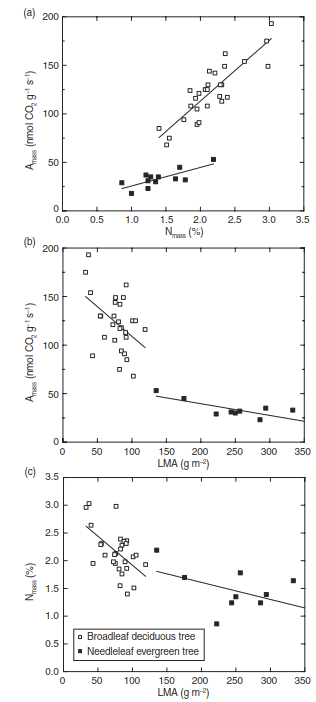
Fig. 18.13. Coordinated leaf traits for 22 broadleaf deciduous and 9 needleleaf evergreen temperate tree species. (a) Maximum rate of photosynthesis per unit leaf mass (Aₘₐₛₛ) in relation to leaf nitrogen per unit leaf mass (Nₘₐₛₛ). (b) Aₘₐₛₛ in relation to leaf mass per unit area (LMA). (c) Nₘₐₛₛ in relation to LMA. Data from Reich et al. (1995a).
Comparative analysis between functional groups illustrates distinct ecological strategies:
· Broadleaf Deciduous Trees: Characterized by lower LMA, higher Aₘₐₛₛ, and elevated Nₘₐₛₛ, enabling rapid carbon assimilation per unit of invested leaf mass.
· Needleleaf Evergreen Conifers: Possess structural adaptations featuring high LMA, lower Aₘₐₛₛ, and reduced Nₘₐₛₛ, favoring structural durability over immediate metabolic return.
Within both functional groups, Aₘₐₛₛ and Nₘₐₛₛ systematically decline as LMA increases, illustrating an evolutionary constraint between structural investment and metabolic intensity.
The Global Leaf Economics Spectrum (LES). Extending these observations across larger spatial scales, Wright et al. (2004, 2005) synthesized trait data spanning 2,548 plant species across 219 families and 175 global sites. This global dataset encompasses diverse terrestrial biomes, including arctic tundra, boreal forests, tropical rainforests, temperate grasslands, and arid deserts. Environmental gradients across these sites ranged from annual mean temperatures of -16.5 °C to 27.5 °C and annual precipitation levels from 133 mm to 5,300 mm.
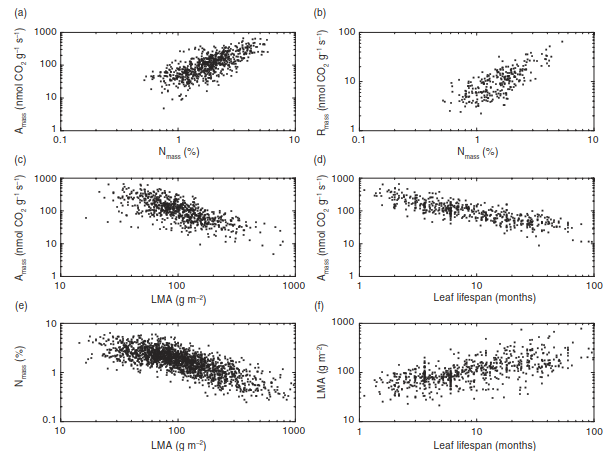
Fig. 18.14. Coordinated leaf traits for maximum rate of photosynthesis per unit leaf mass (Aₘₐₛₛ), leaf respiration rate per unit leaf mass (Rₘₐₛₛ), leaf nitrogen per unit leaf mass (Nₘₐₛₛ), leaf mass per unit area (LMA), and leaf lifespan (LL). (a) Aₘₐₛₛ–Nₘₐₛₛ, 712 species. (b) Rₘₐₛₛ–Nₘₐₛₛ, 267 species. (c) Aₘₐₛₛ–LMA, 764 species. (d) Aₘₐₛₛ–LL, 512 species. (e) Nₘₐₛₛ–LMA, 1958 species. (f) LMA–LL, 678 species. Data from Wright et al. (2004).
This synthesis established the concept of the Leaf Economics Spectrum (LES), which describes a global continuum of resource investment strategies:
1. Quick-Return Strategy. Species exhibiting short leaf lifespans display low LMA (minimal construction cost per unit area), elevated Nₘₐₛₛ, high Aₘₐₛₛ, and increased Rₘₐₛₛ. These plants prioritize rapid carbon acquisition and fast payback periods on invested resources.
2. Slow-Return Strategy. Species with extended leaf lifespans feature high LMA (significant structural investment), low Nₘₐₛₛ, reduced Aₘₐₛₛ, and lower Rₘₐₛₛ. These species produce durable leaves that recoup construction costs gradually over long time horizons.
The functional variations across structural, nutritional, and metabolic parameters represent an evolutionary trade-off between maximizing short-term carbon gain and ensuring long-term tissue persistence.
Hydraulic Architecture and Desiccation Risk. Beyond photosynthetic economics, plant persistence depends heavily on stem hydraulic architecture. Tree water transport reflects a balance between maximizing hydraulic throughput for carbon gain and mitigating the risk of desiccation during moisture stress.
Mechanics of Hydraulic Failure. Under high transpiration rates or prolonged drought, tension within the stem xylem increases significantly. Extreme negative xylem pressures can break the continuous water column, causing air bubbles to enter the conduit system—a process termed cavitation or embolism formation. Severe cavitation reduces stem hydraulic conductivity (Kₛ), restricting water transport to photosynthetic foliage and potentially causing branch dieback or plant mortality.
Conduit Structure and Vulnerability. The physical dimensions of xylem conduits govern transport efficiency and structural vulnerability:
· Wide, Long Conduits: Provide lower resistance to flow, achieving superior stem hydraulic conductivity, but exhibit increased susceptibility to drought-induced cavitation.
· Narrow, Short Conduits: Offer higher safety margins against cavitation under high tension, but incur greater resistance to sap flow.
Successional Status and Hydraulic Safety Margins. Detailed studies on tropical dry forest tree species (Markesteijn et al., 2011a, 2011b) highlight how hydraulic traits align with successional ecological niches.
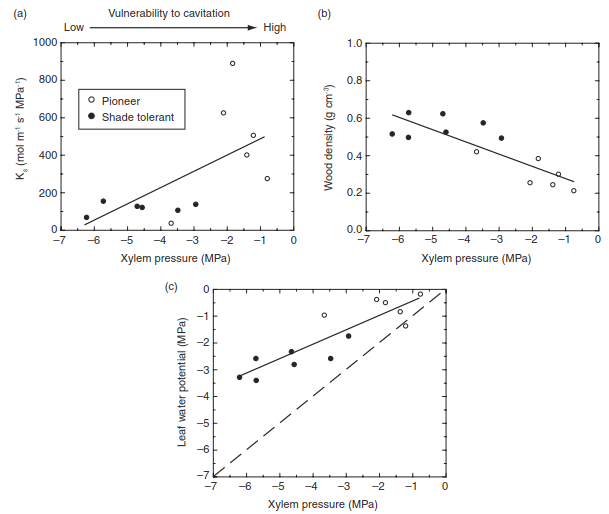
Fig. 18.15. Relationships between plant traits and vulnerability to cavitation for 13 tropical dry forest species. Vulnerability to cavitation is defined by the xylem pressure at 50 percent loss of stem hydraulic conductivity, signifying hydraulic failure and cavitation. High xylem pressure at hydraulic failure means high vulnerability to cavitation. (a) Stem hydraulic conductivity (Kₛ). (b) Wood density. (c) Dry season leaf water potential. The dashed line shows the point of hydraulic failure, where leaf water potential equals the xylem pressure at cavitation. The difference between that line and the regression line is the hydraulic safety margin (how close species operate to the point of hydraulic failure). Open symbols are pioneer species, and closed symbols are shade-tolerant species. Adapted from Markesteijn et al. (2011b).
Pioneer vs. Shade-Tolerant Strategies
1. Pioneer (Early Successional) Species:
- Characterized by high photosynthetic capacities and elevated transpiration rates.
- Require substantial volume flow through the stem, supported by high stem hydraulic conductivity and lower wood density.
- Operate with narrow hydraulic safety margins, maintaining leaf water potentials dangerously close to their thresholds for hydraulic failure.
- Prioritize rapid growth rates and early resource acquisition over cavitation protection.
2. Shade-Tolerant (Late Successional) Species:
- Feature higher wood density and lower stem hydraulic conductivity.
- Maintain safer, wider hydraulic safety margins, protecting the xylem network during extended drought conditions.
- Demonstrate lower growth rates and greater overall longevity.
Wood Density as a Master Functional Trait. Extensive trait analyses demonstrate that wood density serves as a unifying integrator of structural support, water transport mechanics, stem storage capacity, and life-history strategy (Kraft et al., 2010; Wright et al., 2010).
· Low Wood Density: Strongly correlates with high hydraulic conductivity, low resistance to cavitation, rapid growth rates, and shorter plant lifespans.
· High Wood Density: Correlates with lower hydraulic conductivity, greater resistance to cavitation, slower growth rates, and increased plant longevity.
Global analyses of 226 forest tree species across 81 sites reveal broad overlap in cavitation vulnerability, though conifers generally exhibit greater resistance to cavitation than angiosperms (Choat et al., 2012). Most evaluated species operate near their physiological hydraulic limits, reflecting a widespread ecological trade-off between maximizing growth rates during favorable conditions and incurring risk of drought-induced mortality.
References:
- Abrahamson, W. G., and Gadgil, M. (1973). Growth form and reproductive effort in goldenrods (Solidago, Compositae). American Naturalist, 107, 651–661.
- Bazzaz, F. A. (1979). The physiological ecology of plant succession. Annual Review of Ecology and Systematics, 10, 351–371.
- Bazzaz, F. A. (1996). Plants in Changing Environments: Linking Physiological, Population, and Community Ecology. Cambridge: Cambridge University Press.
- Bloom, A. J., Chapin, F. S., III, and Mooney, H. A. (1985). Resource limitation in plants – an economic analogy. Annual Review of Ecology and Systematics, 16, 363–392.
- Bonan, G. B., Levis, S., Kergoat, L., and Oleson, K. W. (2002). Landscapes as patches of plant functional types: An integrating concept for climate and ecosystem models. Global Biogeochemical Cycles, 16, 1021, doi:10.1029/2000GB001360.
- Bormann, F. H., and Likens, G. E. (1979). Pattern and Process in a Forested Ecosystem. New York: Springer-Verlag.
- Choat, B., et al. (2012). Global convergence in the vulnerability of forests to drought. Nature, 491, 752–755.
- Field, C., and Mooney, H. A. (1986). The photosynthesis-nitrogen relationship in wild plants. In On the Economy of Plant Form and Function (ed. T. J. Givnish), pp. 25–55. Cambridge: Cambridge University Press.
- Kraft, N. J. B., Metz, M. R., Condit, R. S., and Chave, J. (2010). The functional trait spectrum of a tropical forest canopy. Ecology, 91, 2101–2112.
Date added: 2026-09-24; views: 1;