
Allometric Constraints and Resource Allocation in Trees
Forest Ecology and Structural Resource Partitioning in Trees. Trees allocate their metabolic resources in patterns directly aligned with their morphology and extended lifespan. Early in ontogeny, young trees prioritize carbon allocation toward foliage expansion for photosynthetic carbon assimilation and root system extension to capture soil moisture and inorganic nutrients. As individuals mature, structural priorities shift; the overwhelming majority of accumulated biomass shifts into woody stems and structural branches, leaving foliage biomass to represent a progressively smaller fraction of total tree mass.
Achieving vertical stature grants significant evolutionary advantages in forest ecosystems. Elevated growth canopy position allows dominant trees to intercept maximum photon flux density while casting shade onto subcanopy competitors in the understory. However, vertical stature requires substantial energetic expenditure. Large quantities of assimilated carbon must be invested into constructing and maintaining non-photosynthetic trunks and structural branch networks that provide mechanical support and enable long-distance xylem vascular transport of water and mineral nutrients.
Allometric Scaling and Functional Wood Anatomy. Structural resource allocation in tree species is strictly governed by allometric constraints. These scaling laws preserve precise dimensional relationships between stem diameter and the proportional biomass of foliage, branches, and the main trunk (Figure 18.8). Tree anatomy and overall growth form are constrained by two primary requirements: maintaining structural stability and supplying sufficient water to leaves to balance water loss from transpiration.
Water moves upward through specialized vascular structures within the secondary xylem. However, not all secondary xylem functions as active conducting tissue. Mature trees contain a central core of non-conductive heartwood, which provides essential mechanical rigidity but no longer transports water. Long-distance water transport is restricted exclusively to the active, outer ring of sapwood.
Evolutionary lineage dictates the cellular architecture of water transport in wood:
· Angiosperms (broadleaf deciduous species) rely on continuous vessels formed by vessel elements stacked end-to-end to form efficient hydraulic channels.
· Gymnosperms (conifers) rely on elongated, overlapping tracheids connected via bordered pits to direct water upward through the xylem tissue.
Because sapwood provides the primary conduit for transpiration flow, a strong functional dependence exists between sapwood cross-sectional area and total foliage leaf area (Waring et al., 1982). Expanding leaf surfaces demand a proportional increase in sapwood cross-sectional area to sustain water supply to the canopy. This balance links carbon-fixing leaves with structural xylem tissues that supply water and inorganic ions.
Environmental Shifts in Leaf Area to Sapwood Area Ratios. Environmental stresses and local macroclimatic regimes significantly modify internal biomass allocation. Trees growing in stress-inducing or arid environments allocate significantly less leaf area per unit of sapwood cross-sectional area than those occupying mesic or mild maritime climates (Table 18.2).
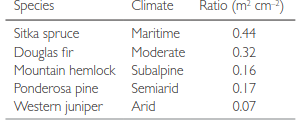
Table 18.2. Ratio of leaf area to sapwood area for tree species growing along a west-to-east transect in Oregon from the coast to the mountains. Source: From Waring (1991). See also Waring (1983).
Data compiled by Waring (1983, 1991) along a west-to-east climatic gradient in Oregon demonstrates this plastic shift. Sitka spruce (Picea sitchensis) and Douglas fir (Pseudotsuga menziesii), growing in maritime and moderate coastal environments, maintain leaf-to-sapwood area ratios of 0.44 m² cm⁻² and 0.32 m² cm⁻², respectively. In contrast, species adapted to harsh inland, subalpine, or xeric microclimates—such as Mountain hemlock (Tsuga mertensiana), Ponderosa pine (Pinus ponderosa), and Western juniper (Juniperus occidentalis)—support far less leaf area per unit sapwood area, ranging from 0.16 m² cm⁻² down to 0.07 m² cm⁻².
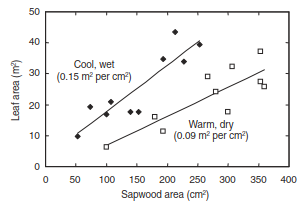
Fig. 18.9. Relationship between leaf area and sapwood area for Scots pine trees growing on a cool, wet site and a warm, dry site. Adapted from Mencuccini and Grace (1994).
This plastic shift in structural allocation is further highlighted in experimental studies on Scots pine (Pinus sylvestris) by Mencuccini and Grace (1994) (Figure 18.9). When genetically similar stands of identical age, stand density, and soil fertility were compared across different environments, trees on the warm, dry site exhibited a lower slope (0.09 m² cm⁻²) than those on the cool, wet site (0.15 m² cm⁻²). Chronic soil moisture limitations on the warmer site forced trees to reduce leaf area relative to sapwood area to prevent excessive transpiration deficits.
This physiological equilibrium balances soil water availability, evapotranspiration, and leaf area index (Grier and Running, 1977; Woodward, 1987, 1993; Nemani and Running, 1989). Excess leaf area increases atmospheric water demand beyond soil recharge capacities, causing xylem cavitation and desiccation. Conversely, insufficient leaf area leads to unutilized soil moisture resources and reduced overall carbon assimilation.
Hydraulic Constraints and Biophysical Limits on Tree Height. Vertical growth enhances photon capture, but increasing height introduces severe hydraulic constraints on water transport (Ryan and Yoder, 1997; Koch et al., 2004; Ryan et al., 2006; Niklas, 2007). As water ascends to upper canopy leaves, path length resistance increases, causing a decline in overall hydraulic conductance.
Water movement through the xylem is driven by differences in water potential between root soil interfaces (Ψ_root) and leaf stomatal chambers (Ψ_leaf), multiplied by total hydraulic conductance (K_hyd):
Water Flow Rate = (Ψ_root - Ψ_leaf) × K_hyd
As tree height increases and K_hyd decreases, maintaining water flow requires a steeper tension gradient (a more negative Ψ_leaf). Under high negative pressure, water columns become vulnerable to cavitation, where air bubbles enter xylem conduits and break hydraulic continuity.
To prevent catastrophic embolism during peak transpiration, trees close their stomata. Stomatal closure reduces internal intercellular carbon dioxide (CO₂) concentrations, which restricts photosynthetic carbon assimilation. These hydraulic limitations establish a biomechanical limit to maximum tree height.
Life History Trade-Offs: Growth, Maturity, and Longevity. The high ongoing carbon costs of maintaining woody support structures require trade-offs among vegetative growth rate, structural maintenance, and reproductive maturity. An empirical analysis of 87 broadleaf deciduous species by Loehle (1988) illustrates these life history trade-offs across forest species (Figure 18.10).
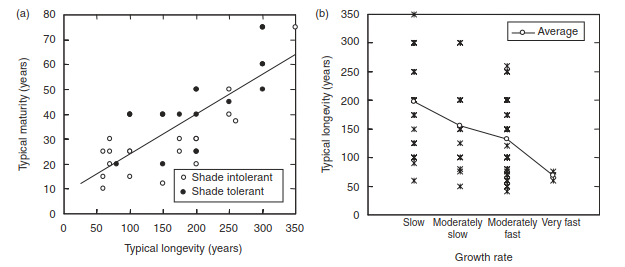
Fig. 18.10. Relationships among growth, maturity, and longevity in 87 species of broadleaf deciduous trees. (a) Age of reproduction in relation to longevity. Species are separated into shade intolerant and shade tolerant classes. (b) Longevity in relation to growth rate. Data are shown for each species and as the average longevity for each growth class. Data from Loehle (1988).
Key life history patterns identified by Loehle (1988) include:
Reproductive Maturity and Shade Tolerance. Across both shade-tolerant and shade-intolerant species, typical age of reproductive maturity scales directly with maximum typical longevity. Early-successional, shade-intolerant species reach sexual maturity early (often within 10 to 20 years) to secure rapid colonization before canopy closure. Late-successional, shade-tolerant species delay sexual maturity for several decades, channeling early carbon gains into structural persistence under low-light conditions.
Growth Rate versus Lifespan Trade-Offs. Maximum species longevity shares an inverse relationship with juvenile growth rate. Fast-growing deciduous species exhibit an average longevity of approximately 68 years. In contrast, slow-growing species achieve an average lifespan of nearly 190 years—nearly three times longer.
These comparative patterns indicate that long-lived trees reallocate carbon away from rapid vertical expansion and toward wood density, defensive secondary metabolites, and structural maintenance. Similar trade-off patterns occur in needleleaf evergreen conifers, confirming that these allocation balances reflect fundamental evolutionary mechanisms across woody plants.
Date added: 2026-09-24; views: 1;