
Plant Carbon Balance Dynamics and Phenology in Terrestrial Ecosystems
Plant life history strategies represent evolutionary adaptations for optimizing energy capture, metabolic persistence, and spatial distribution across varying environmental gradients. At the core of ecosystem ecology is the metabolic mechanism governing how individual vegetation units acquire, store, and utilize fixed carbon. Understanding plant carbon balance—the net dynamic balance between photosynthetic gross primary production and respiratory expenditure—is essential for modeling carbon cycling, predicting forest canopy succession, and analyzing plant responses to global climate shifts.
1. Ecological Life History Strategies and Resource Allocation. Plants utilize the net carbon fixed during photosynthetic carbon assimilation to sustain baseline metabolic survival, construct structural architecture (foliage, stems, and root systems), and fulfill reproductive imperatives. Because available physiological resources are finite, plants partition fixed carbon according to specialized evolutionary strategies known as life history patterns.
To maximize fitness within diverse habitats, species adopt distinct metabolic trade-offs along a continuum between high metabolic activity and long-term tissue persistence:
- r-Selected Strategies (Ruderals): Characterized by rapid vegetative growth, short lifespans, and high early investment in reproductive effort. These species produce abundant, highly dispersible seeds (e.g., herbaceous annuals) optimized for early colonization of disturbed sites.
- K-Selected Strategies (Competitors and Stress Tolerators): Characterized by long lifespans, larger structural biomass, and delayed reproduction. These plants produce fewer, larger seeds (e.g., climax forest trees) and prioritize tissue maintenance, structural durability, and stress tolerance over immediate reproductive output.
These structural trade-offs establish broad plant functional types, simplifying the immense complexity of interspecific plant diversity into predictable categories based on physiological, morphological, and demographic traits.
2. Mechanisms of Plant Carbon Balance. The net carbon gain available for structural growth and biomass accumulation represents the mathematical difference between gross photosynthetic carbon capture and total respiratory carbon loss.
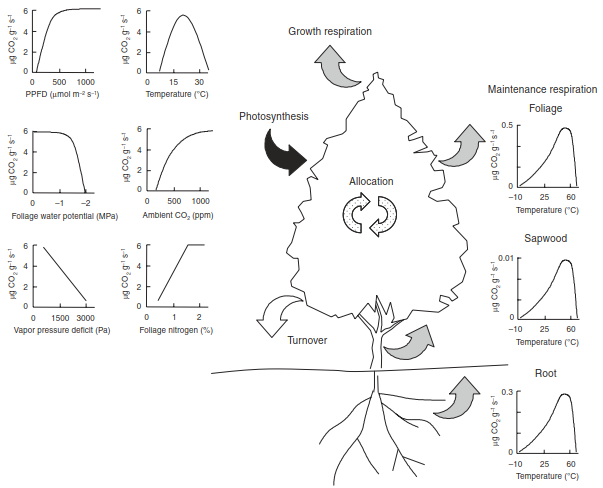
Fig. 18.1. The net carbon available for growth is the difference between carbon uptake during photosynthesis and carbon loss during growth and maintenance respiration. Photosynthesis varies with light, temperature, CO₂, water potential, and other factors. Maintenance respiration varies with temperature and differs among pools. Also shown are plant allocation of carbon and turnover loss.
Photosynthetic uptake across an entire canopy is integrated to derive Gross Primary Production (GPP). Conversely, total carbon expenditure across all living plant tissues constitutes autotrophic respiration (Rₐ), a process researched extensively by Ryan (1991), who demonstrated that Rₐ typically consumes approximately 50% of total annual GPP.
Autotrophic respiration is divided into two primary physiological components:
Growth Respiration. Growth respiration represents the metabolic energy required to synthesize new structural tissues from simple photosynthates. It accounts for carbon released during the construction of complex organic compounds (such as proteins, lipids, and lignin) and is independent of ambient temperature. On average, growth respiration accounts for approximately 25% of GPP.
Maintenance Respiration. Maintenance respiration supplies the metabolic energy needed to maintain living cell integrity, repair damaged proteins, and sustain ion concentration gradients across cellular membranes. Unlike growth respiration, maintenance respiration increases exponentially with rising ambient temperatures up to a critical physiological threshold. Maintenance respiration rates vary significantly among tissue types: active foliage and fine roots display substantially higher mass-specific maintenance respiration rates at equivalent temperatures than woody sapwood.
The net carbon remaining after accounting for autotrophic respiration represents Net Primary Production (NPP):
NPP = GPP − Rₐ
3. Diurnal and Seasonal Dynamics of Carbon Balance. The carbon balance of terrestrial plants fluctuates over annual cycles due to seasonal variations in solar irradiance, temperature, and hydrological availability. This temporal variation is most evident in temperate and boreal ecosystems characterized by distinct growing seasons.
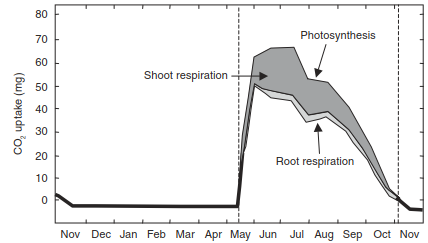
Fig. 18.2. Carbon balance (net photosynthesis, shoot respiration, root respiration) of pine seedlings growing near treeline over the course of a year. Adapted from Larcher (1995, p. 133).
During winter dormancy, daily carbon balances remain negative: photosynthetic uptake is virtually non-existent due to low temperatures and reduced daylength, while autotrophic respiration continues to consume stored non-structural carbohydrates. Net positive carbon uptake occurs exclusively during the growing season, when daily canopy photosynthesis exceeds combined shoot and root respiratory losses.
4. Plant Phenology and Microclimatic Drivers. Phenology is the study of the timing of recurring biological events, including budbreak, leaf emergence, flowering, fruit maturation, leaf senescence, and winter dormancy. The onset and duration of these phenological stages are controlled primarily by temperature, photoperiod, and moisture regimes.
Thermal Control and Degree-Day Modeling. Temperature acts as a key environmental driver of plant development by controlling enzymatic reaction rates. Plants accumulate thermal energy required to trigger developmental milestones, measured in growing degree-days—the cumulative daily temperature above a baseline physiological threshold (typically 5 °C).
Certain developmental phases, such as budbreak and seed germination, additionally require a chilling requirement, where plants must experience a critical duration of temperatures below a specific threshold to break endodormancy.
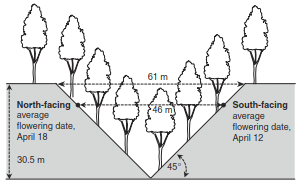
Fig. 18.3. Average flowering for nine species of spring wildflowers in an Indiana woodland growing on north- and south-facing slopes separated by 46 m. Data from Jackson (1966).
Topographic microclimates demonstrate the precision of thermal control over plant phenology. As documented by Jackson (1966) in an Indiana forest, spring wildflowers growing on steep 45° south-facing slopes flowered an average of six days earlier than identical species on opposing north-facing slopes situated just 46 m away. The increased solar irradiance received by south-facing slopes accelerates thermal accumulation, satisfying the requisite ~4650 °C-hours threshold earlier in the season.
Photoperiodism and Latitudinal Adaptation. Photoperiodism—the physiological response of organisms to the relative length of day and night—regulates key life history transitions:
- Long-Day Plants: Initiate flowering when daylength exceeds a critical temporal threshold during late spring and early summer.
- Short-Day Plants: Trigger reproductive structures when daylight falls below a specific duration during late summer or autumn.
- Cold Hardiness Induction: Short daylengths combined with falling autumn temperatures signal deciduous woody species to initiate leaf senescence, reabsorb mobile nutrients into perennial tissues, and build cellular frost hardiness.
5. Remote Sensing of Phenology and Global Vegetation Patterns. Advancements in satellite remote sensing have enabled landscape-scale monitoring of canopy phenology and seasonal carbon dynamics using metrics such as the Normalized Difference Vegetation Index (NDVI). NDVI tracks chlorophyll absorption in red light wavelengths relative to high structural reflectance in the near-infrared spectrum, providing a reliable proxy for green leaf area index (LAI) and canopy photosynthetically active radiation uptake.
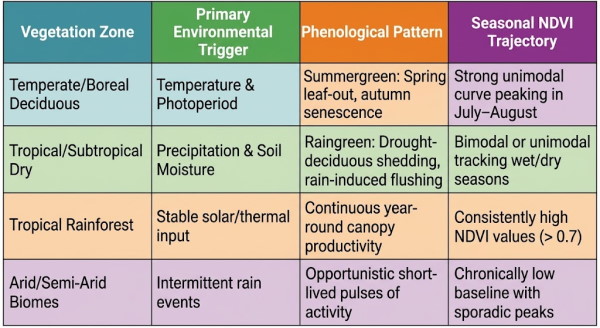
By integrating thermal degree-day models, photoperiodic requirements, and spatial remote sensing data, ecologists can effectively model seasonal ecosystem productivity and predict how plant communities will shift in response to global climate dynamics.
Date added: 2026-09-24; views: 2;