
Canopy Radiative Transfer and Leaf Area Index Dynamics
Introduction to Forest Canopy Architecture and Energy Balance. The biophysical principles governing temperature regulation, surface energy balance, and photosynthetic uptake at the leaf level scale directly to entire plant canopies when integrated over all constituent foliage elements. These canopy-scale fluxes depend fundamentally on total foliage quantity, classically quantified by the Leaf Area Index (LAI). Vertical distribution profiles of leaf area dictate how incident solar radiation penetrates, attenuates, and absorbs across canopy layers.
At low Leaf Area Index (LAI) values, plant canopies absorb minimal solar radiation, causing overall surface albedo to closely match the reflective properties of underlying soil. As foliage density accumulates, radiation absorption increases significantly, and surface albedo shifts to reflect foliage optical properties rather than ground substrate properties. Scaling leaf-level processes up to canopy-level dynamics requires integrating leaf response over vertical light profiles, microclimatic variations, and canopy depth gradients in foliage nitrogen content.
Canopy-scale carbon assimilation represents the mathematical integration of individual leaf photosynthetic rates. Similarly, canopy conductance provides an aggregate measure of individual stomatal conductances throughout the vertical profile. Beyond energy and gas exchange, vertical foliage density influences turbulent transport within and above the canopy. To model these interactions efficiently, land-surface schemes treat soil-vegetation systems either as effective bulk surfaces or via single-layer big-leaf models, such as the Penman-Monteith equation extended to plant canopies.
Quantification and Vertical Profiling of Leaf Area Index. Leaf Area Index (LAI) measures total foliage quantity per unit ground surface area. Quantified as projected (one-sided) leaf area per unit ground area, an LAI of 1.0 m² m⁻² corresponds to 1 cm² of projected leaf surface covering 1 cm² of ground. Flat broadleaf species exhibit a total surface area exactly twice their projected leaf area because both adaxial and abaxial surfaces are accounted for. In contrast, needleleaf species display complex cross-sectional geometries, yielding total surface areas greater than twice their projected leaf area. Healthy, productive forest ecosystems typically sustain an LAI ranging from 4 to 6 m² m⁻².
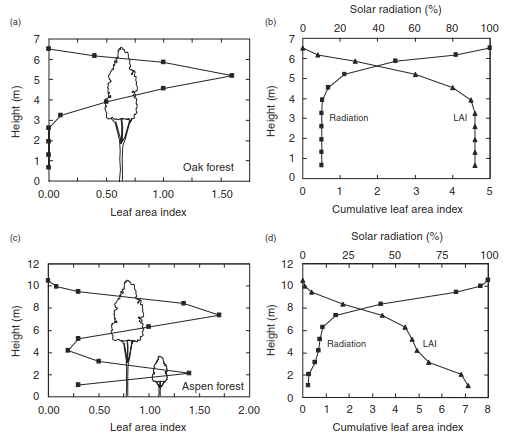
Fig. 17.1. Vertical profile of leaves in forests. The top panels show for an oak forest (a) the leaf area profile and (b) the cumulative leaf area and irradiance as a percentage of that at the top of the canopy. The bottom panels (c–d) show the same data for an aspen forest with understory. Data from Rauner (1976).
As documented in Figure 17.1, cumulative leaf area accumulates progressively from canopy top to forest floor. Measured foliage density rarely exhibits uniform vertical distribution. Many ecosystems feature a single canopy overstory layer; for example, an oak forest overstory positioned between 3.0 m and 6.5 m height displays a cumulative LAI of 4.6 m² m⁻², with peak foliage density concentrated near 5.0 m. In contrast, complex forest ecosystems—such as the aspen forest illustrated in Figure 17.1 with a total LAI of 7.1 m² m⁻²—feature distinct multi-layered structures comprising an overstory (5.5 m to 10.5 m height; LAI = 4.9 m² m⁻²) and an understory layer (below 3.0 m height; LAI = 2.2 m² m⁻²).
Radiative Transfer Dynamics and Light Attenuation Models. Sunlight attenuation through plant canopies follows a vertical gradient governed by foliage density and structural arrangement. Individual leaves absorb, reflect, or transmit incident solar radiation. In simplified radiative transfer frameworks where leaves act as blackbody absorbers without scattering, downward irradiance attenuation is modeled via Beer-Lambert exponential decay:
I↓(z) = I↓₀ e⁻ᴷᵇᴸ⁽ᶻ⁾ (17.1)
where I↓₀ represents incident solar radiation at the canopy top, K_b is the direct beam light extinction coefficient, L(z) is cumulative leaf area index at height z, and I↓(z) is irradiance reaching height z.
The extinction coefficient K_b depends on leaf angle distribution and solar zenith angle (Z), which dictate beam incidence geometry relative to leaf surface normals. Defining solar elevation angle above the horizon as B = 90° - Z, standard mathematical formulations for common leaf orientation distributions include:
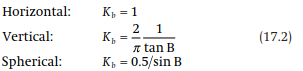
Conifer needles typically approximate a spherical leaf distribution, broadleaf trees generally display semi-horizontal foliage, and graminoids exhibit semi-vertical foliage. Assuming a mean value of K_b = 0.5, canonical radiation canopy transmission yields 61% penetration at LAI = 1 m² m⁻², 37% at LAI = 2 m² m⁻², 22% at LAI = 3 m² m⁻², and down to 5% under dense canopy conditions (LAI = 6 m² m⁻²).
To account for multiple scattering (reflection and transmission), the extinction expression incorporates single-leaf absorptivity (αₗ), as formulated by Sellers (1985) and Campbell and Norman (1998):
I↓(z) = I↓₀ e⁻⁽ⁿᵒᵗᵉ: √(αₗ) K_b L(z)⁾ (17.3)
As leaf absorptivity decreases, effective canopy extinction diminishes, allowing greater light penetration into lower canopy strata. Leaf absorptivity varies across solar spectral bands, ranging typical values from 0.8 in visible wavelengths to 0.2–0.3 in the near-infrared.
Sunlit and Shaded Canopy Partitioning. Radiation attenuation models establish average horizontal irradiance across canopy depth. However, photosynthetically active radiation (PAR) splits fundamentally between sunlit foliage receiving direct beam radiation alongside diffuse sky radiation, and shaded foliage receiving exclusively scattered light.
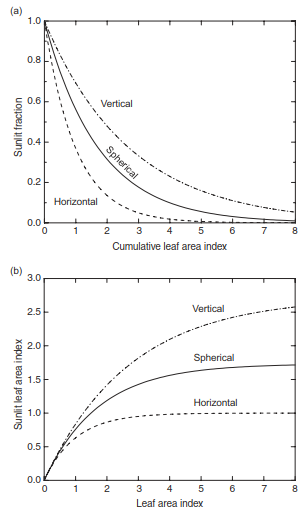
Fig. 17.2. (a) Sunlit fraction and (b) sunlit leaf area index for horizontal, spherical, and vertical leaves in relation to leaf area index with a solar zenith angle of 30°.
The sunlit fraction (f_sun) of canopy foliage at cumulative leaf area index x is expressed as:

Integrating f_sun(x) across total canopy Leaf Area Index (L) yields total sunlit leaf area index (L_sun):

As depicted in Figure 17.2, under high solar elevation (zenith angle Z = 30°), horizontal leaves attenuate direct radiation rapidly, yielding low total sunlit leaf area. Vertical leaf distributions maintain lower extinction coefficients, preserving higher sunlit leaf area across deep canopy profiles. When the sun approaches lower elevation angles (e.g., Z = 60°), total sunlit leaf area index drops below 1.0 m² m⁻² across all canopy orientation classes.
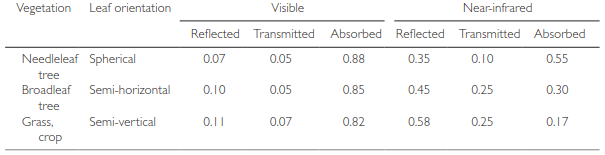
Table 17.1. Leaf orientation and reflection, transmission, and absorption of solar radiation by a leaf for visible and near-infrared wavebands. Source: Adapted from Dorman and Sellers (1989).
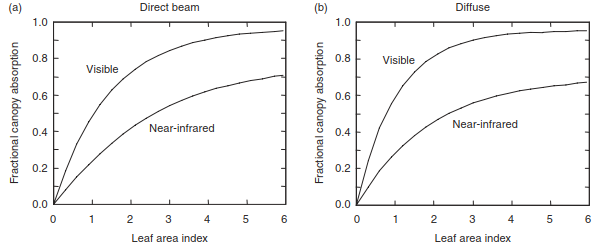
Fig. 17.3. Radiative transfer in a broadleaf forest with spherical leaf orientation in relation to leaf area index. Shown for the visible and near-infrared wavebands are (a) the fraction of direct beam solar radiation and (b) the fraction of diffuse solar radiation absorbed by the canopy using the radiative transfer model of Sellers (1985). The zenith angle is 45° and soil albedos are 0.10 (visible) and 0.20 (near-infrared). Leaf optical properties are from Table 17.1.
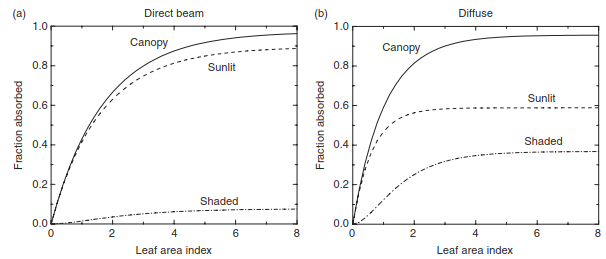
Fig. 17.4. As in Figure 17.3, but showing (a) the fraction of direct beam radiation absorbed by the total canopy and the sunlit and shaded portions of the canopy and (b) similarly for diffuse radiation. Radiative transfer uses a solution to the two-stream approximation for sunlit and shaded leaves (Dai et al. 2004) as described by Bonan et al. (2011).
As detailed in Table 17.1, green foliage absorbs over 85% of incident visible solar radiation (0.4–0.7 μm) to drive photosynthetic reactions, while absorbing under 50% of near-infrared radiation (0.7–1.1 μm) to prevent thermal overload. Complex two-stream radiative models (Sellers 1985; Dai et al. 2004; Bonan et al. 2011), illustrated in Figure 17.3 and Figure 17.4, track direct and diffuse radiation streams separately across sunlit and shaded fractions. At LAI = 4 m² m⁻², visible radiation canopy absorption exceeds 90%, saturating near 95% at LAI = 6 m² m⁻², while near-infrared absorption remains substantially lower.
Canopy Albedo and Satellite Remote Sensing Applications. Canopy albedo measures integrated shortwave reflection from vegetation elements and underlying ground surfaces.
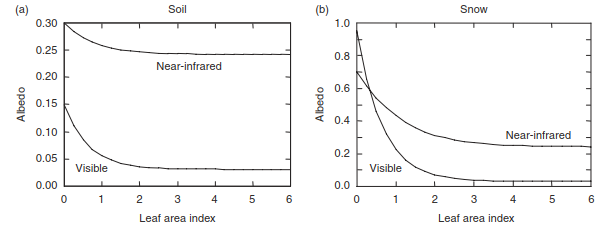
Fig. 17.5. Canopy albedo for direct beam solar radiation in the visible and near-infrared wavebands in relation to leaf area index. (a) Canopy albedo with a soil albedo of 0.15 (visible) and 0.30 (near-infrared). (b) Canopy albedo for snow-covered ground with an albedo of 0.95 (visible) and 0.70 (near-infrared). Data are for a broadleaf forest (Table 17.1) with spherical leaf orientation and for a zenith angle of 45° using the radiative transfer model of Sellers (1985).
At low LAI, total surface albedo is dominated by soil optical characteristics, as shown in Figure 17.5. As LAI increases, foliage optical properties dominate surface reflection. Over highly reflective snowpack (visible albedo = 0.95), canopy foliage masks underlying snow cover; for LAI values exceeding 3 m² m⁻², overall canopy albedo approaches snow-free vegetation baselines.
Direct-beam albedo increases at higher solar zenith angles (early morning and late afternoon) due to extended path lengths through upper foliage. Diffuse radiation albedo exhibits minimal zenith dependence. Across global biome types, broadband vegetation albedo ranges from 0.05 to 0.25, with coniferous forests exhibiting lower albedo than deciduous forests, crop canopy, or grassland ecosystems.
The sharp contrast between strong visible light absorption and high near-infrared reflectance provides a primary spectral signature for vegetation monitoring via satellite remote sensing (Tucker et al. 1985; Myneni et al. 1997). This spectral contrast underpins the Normalized Difference Vegetation Index (NDVI):

where r_nir and r_red represent surface reflectances in near-infrared and red wavebands, respectively. Non-vegetated surfaces (snow, water, exposed soil) yield NDVI values between -0.2 and 0.05. Healthy vegetated canopies produce NDVI values between 0.05 and 0.70, providing a robust proxy for land surface photosynthetic capacity and gross primary productivity.
Date added: 2026-09-24; views: 1;