
The Dual Role of Clouds in Earth's Climate and Radiation Balance
Cloud Formation and Classification. Clouds are beautiful, always changing, ever moving; we see them white and fluffy, high and wispy, black and threatening. Clouds form from liquid water droplets with temperatures above freezing, supercooled water droplets with temperatures below freezing, and solid particles. In the lower troposphere, condensation nuclei, small particles of dust, salt, or other matter, serve as the cores for condensing water vapor droplets. Clouds of the upper troposphere are composed of crystallized water vapor or ice crystals and snow.
Cloud Classification Systems. In 1803 Luke Howard, an English pharmacist, proposed the first useful classification of clouds: stratus (layered), cumulus (puffy), cirrus (wispy), and nimbus (clouds releasing snow or rain that travels to the ground); see box figure 7.2. This system is the basis for the cloud types recognized by today's World Meteorological Organization (WMO); see box figure 7.3. Different cloud types absorb radiant energy at different rates and affect the heat budget and climate of the Earth.

Box figure 7.2. Subtropical cumulus clouds over the Florida Keys.
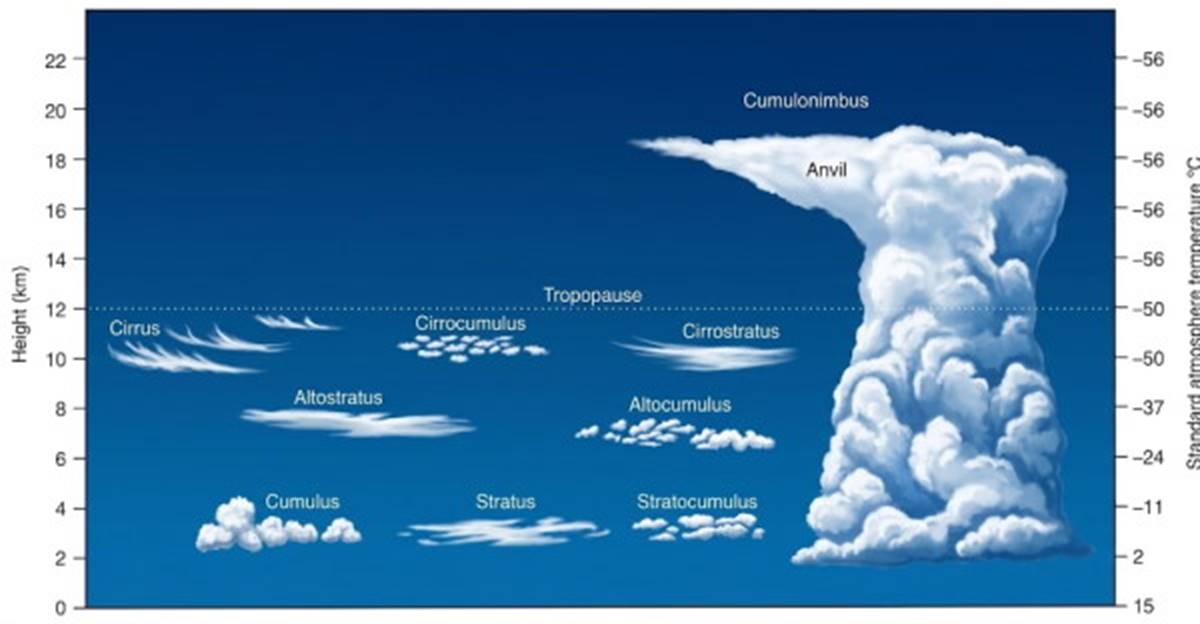
Box figure 7.3. Cloud types used by the World Meteorological Organization.
The Dual Role of Clouds: Heating and Cooling. Clouds have a dual role in the atmosphere: they simultaneously heat and cool the Earth. The tops and sides of clouds appear white because they reflect and scatter short-wave radiation. If clouds are dense enough, they absorb, reflect, and scatter sufficient incoming radiation to produce dark shadows on their undersides and on the Earth's surface. These dense clouds help to cool the Earth.
Clouds absorb long-wave radiation from the Earth's surface because of their water content, and, because they are generally cooler than the Earth, they reradiate only part of this absorbed long-wave radiation and absorbed solar radiation to space. The net effect is that clouds play a significant part in warming the Earth and its atmosphere. Recent research indicates that on a global scale the Earth's present cloud cover provides more shielding from incoming solar radiation than trapping of long-wave radiation.
At present the result is negative, a total net reduction in radiation to the Earth of about 14 to 21 watts per square meter per month. It is estimated that if there were no clouds, average Earth surface temperature would be warmer by about 10°C.
Cloud-Climate Feedbacks and Condensation Nuclei. Not only do the clouds affect the Earth's climate; they are also affected by it. This feedback mechanism could impose a new cloud-controlled radiation balance on the Earth's climate, if the Earth's climate changed. If the present negative radiation balance became less negative, the Earth's surface would warm; if cloud feedback produced a more-negative radiation balance, the Earth's surface would become cooler than it is at present.
If the Earth warmed because of the greenhouse effect, there could be an increase in evaporation and therefore an increase in low-level water-droplet clouds over the ocean; these clouds would absorb and reflect incoming short-wave radiation and help to cool the Earth. However, an increase in high-altitude ice clouds would warm the Earth because ice clouds pass incoming short-wave radiation but reduce the Earth's long-wave radiation loss. The formation of clouds is related to the availability of condensation nuclei.
If nuclei are sparse, the droplets are fewer and larger; the chance of precipitation is increased and the amount of nuclei is further decreased. Many small condensation nuclei produce abundant small droplets, increasing the cloud reflectivity and decreasing incoming radiation. In oceanic areas where precipitation is frequent, condensation particles are removed by precipitation and their low supply may hinder cloud formation.
In these areas satellite photos show passing ships leaving cloud trails as condensation occurs on particles from the ships' exhausts. Dimethyl sulfide is a source of condensation nuclei over ocean areas, and its availability is controlled by its own feedback system as discussed in this chapter. Volcanic activity contributes particles that act as condensation nuclei, as do severe dust storms and major land fires such as those that occurred in Brazil in 1997 and in Indonesia in 1998. The carbon particles in smoke increase the cloud absorption of solar energy while, at the same time, they reduce the size of water droplets.
Research and Modeling of Cloud Systems. Although clouds are among the most common of atmospheric phenomena, our understanding of cloud formation and distribution and of climate change and feedback mechanisms is presently incomplete. Scientists use large computer models known as general circulation models (GCMs) to test their ideas, modifying them as new information is acquired. There is an ongoing concerted effort to directly measure radiation levels above and below clouds to better understand the complexities of cloud-climate systems.
Early results indicate that the solar radiation shielding of clouds has been underestimated. By using improved GCMs to more clearly define the role of clouds in climate changes, scientists hope to better understand the consequences of modifying our atmosphere.
Academic Literature and Further Resources. To learn more about clouds and climate, researchers rely on a foundation of peer-reviewed literature and specialized data repositories.
- Glanz, J. 1993. Climate Researchers Look to Clouds. R and D Magazine, February, 56–62.
- Kaufman, Y. J., and R. S. Fraser. 1997. The Effect of Smoke Particles on Clouds. Science 277 (5332): 1636–39.
- Kiehl, J. T. 1994. Clouds and Their Effects on the Climate System. Physics Today 47 (11): 36–42.
- Levi, B. 1995. Clouds Cast a Shadow of Doubt on Models of Earth's Climate. Physics Today 48 (5): 21–23.
Date added: 2026-11-09; views: 2;