
Practical Considerations: Storm Tides and Climate Dynamics
Practical Considerations: Storm Tides and Storm Surges. Periods of excessive high water along a coast associated with changes in atmospheric pressure and the wind's action on the sea surface are known as storm surges or storm tides. These storm surges, combined with normal high-tide conditions, can spell disaster for low-lying coastal areas. Intense storms at sea, such as hurricanes or typhoons, are centered about intense low-pressure systems in the atmosphere.
Under the low-pressure area in the center of the storm, the sea surface rises up into a dome, or hill, while the surface is depressed farther away from the center, where the atmospheric pressure is greater. The atmospheric pressure change between the outside of a hurricane and its center can be as large as 7.5 cm (3 in) of mercury. Because mercury is 13.6 times denser than water, this pressure change produces a 97-cm (38-in) change in elevation of the water between regions outside the storm and those at the storm's center. In addition, the surface winds spiraling toward the center of the storm add to the sea's elevation under the storm center.
The elevated dome of water travels across the sea under the storm center and raises the water level at the shore when the storm reaches the coast. During the storm, the drag of the wind on the sea surface pushes surface water in the approximate direction of the wind. On the side of the storm where the winds are toward the shore, the water moving toward the shore is piled up against the coast, increasing the height of the sea surface and producing the storm surge.
The water will continue to pile against the shore, steepening the slope of the water until the tendency of the water to flow downhill and back to sea is equal to the force of the wind driving the water ashore. If the water along the shore is deep, some of the water moving landward will downwell and return seaward; this process decreases the height of the water being driven ashore. Along a shallow shore, the landward-moving layer of water extends to the sea floor; there is little downwelling or seaward return flow, and the height of the water along the shore is much greater. A storm surge may sustain a high water level for many hours until the storm winds diminish in the coastal area. Storm surges are often confused with tsunamis; these great sea waves are discussed in chapter 9.
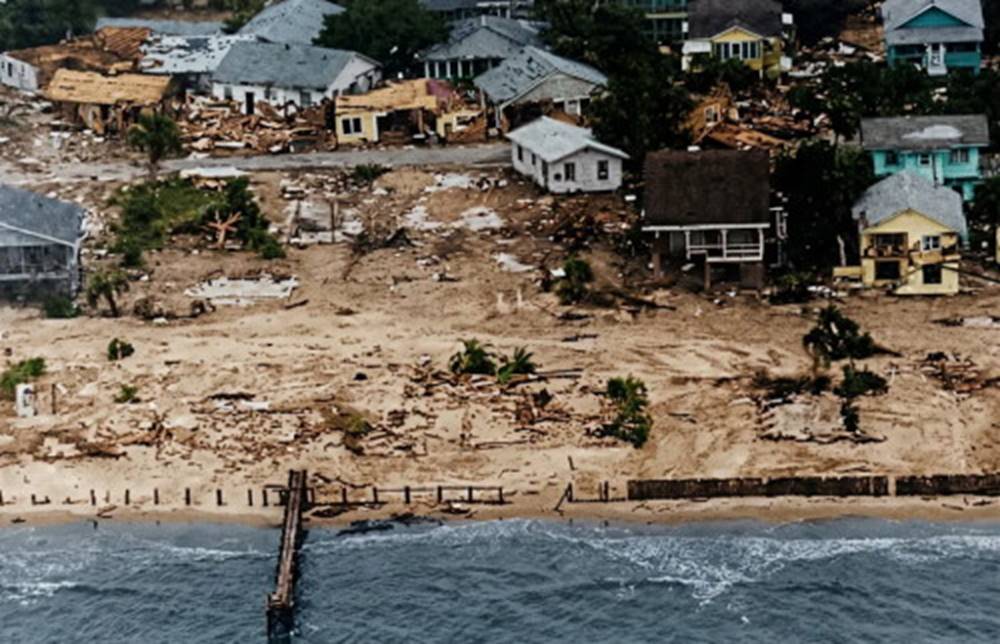
Fig. 7.24. Storm tide damage caused by Hurricane Hugo, Pawley's Island, South Carolina, September 1989.
Along shallow areas of the East and Gulf coasts of the United States, storm surges have caused considerable damage. In 1900 a storm surge caused "the great Galveston flood." It produced water depths of 4 m (13 ft) over the island of Galveston, Texas, destroying the city and killing 5000 people. Hurricane Camille, in 1969, was one of the strongest storms ever to hit the Gulf Coast. The high water levels caused severe property damage, and several hundred people were killed.
In 1989 a storm tide of 5 m (16.5 ft) came ashore with Hurricane Hugo in South Carolina, destroying much property along the coast and in the city of Charleston. Great loss of life was averted by early warnings and mass evacuation of low-lying coastal areas. See figure 7.24. In August 1992 Hurricane Andrew (fig. 7.25) struck Florida with the same intensity that Hurricane Hugo brought to the Carolina coast, but the coastal water damage in Florida was much less. Although the winds were high (220 km/h, or 138 mi/h), the storm surge was only 2.4 m (8 ft).
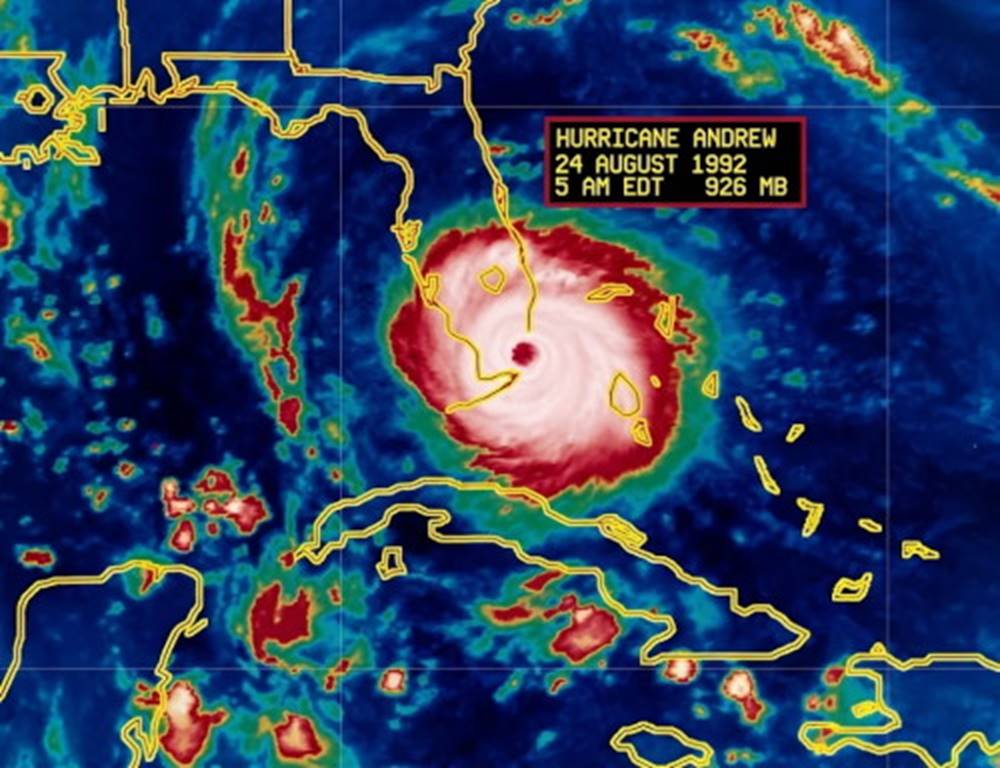
Fig. 7.25. A satellite image of Hurricane Andrew making its landfall south of Miami, August 24, 1992. Maximum sustained winds were 220 km/h (138 mi/h).
The storm traveled a short distance between the Bahamas and Florida at a fast rate of speed; it did not have enough time to build up a large mass of onshore moving water. In addition, some of Andrew's wave energy was absorbed by offshore reefs and coastal mangrove swamps. On shore, however, the wind damage was very severe, and Hurricane Andrew became the most costly storm in U.S. history.
Severe storms over the shallow Bay of Bengal spawned storm surges that took an estimated 300,000 lives in 1970. Another 10,000 people were killed in 1985, and in 1991 yet another storm surge struck this same area of Bangladesh, killing an estimated 139,000 people. The expanding populations of this area need land for homes and farms, and as fast as new land appears in the delta of the Ganges River, the people move seaward.
Global Mitigation Strategies. Although our ability to predict the severity and the route over which a hurricane will pass is improving, other factors work against the potential life-saving results of this ability. When a storm comes to a heavily populated, low-lying coast, the water rises rapidly and covers hundreds of square miles; such conditions make the evacuation of thousands of people extremely difficult. The Netherlands has constructed barrier dams to protect their coast from the storm tides of the North Sea. England has installed gates across the river Thames to bar a storm tide moving up the river. The great cost of engineering projects such as these may be justified in heavily populated industrial areas, but storm tides cannot be prevented and along many stretches of shore there is no defense. The costs to taxpayers and their governments for emergency services and cleanup of storm tide damage are enormous. Would it be wiser to vacate areas historically prone to storm surges and high-water damage and use them only in nonpermanent ways?
Summary of Atmospheric and Oceanic Dynamics. Most clouds and weather occur in the troposphere, where temperature decreases with altitude. In the stratosphere temperature increases with altitude because of the ozone and its ability to absorb ultraviolet radiation. The temperature of the higher mesosphere and thermosphere decreases with height. The atmosphere is a mixture of gases, including water vapor. Atmospheric pressure is the force with which air presses on the Earth's surface; high-density air creates high-pressure zones, and low-density air forms low-pressure zones.
Concern that the Earth's climate may be changing is related to changes in the balance of the gases in the Earth's atmosphere. Increases in CO₂ concentration due to burning and use of fossil fuels are leading to the prediction of global warming because carbon dioxide traps outgoing long-wave radiation by the greenhouse effect. There has been a significant depletion of the ozone layer, most probably due to the release of chlorine into the atmosphere. Dimethyl sulfide produced by plant cells at the sea surface is self-regulated by its role in cloud formation. Sulfur gases from industry and volcanic eruptions are also related to cloud formation and climate change.
The density of air is controlled by air temperature, pressure, and water vapor content. The winds are the horizontal motion in convection cells produced by heating the atmosphere from below. Winds are named for the direction from which they blow. Because of the Coriolis effect, winds are deflected to their right in the Northern Hemisphere and to their left in the Southern Hemisphere. This action produces a three-celled wind system in each hemisphere that results in the surface wind bands of the trade winds, the westerlies, and the polar easterlies.
Zones of rising air occur at 0° and at 60°N and S; these are low-pressure areas of clouds and rain. Zones of descending air at 30° and 90°N and S are high-pressure areas of clear skies and low precipitation. Surface winds are unsteady and unreliable at the zones of rising and sinking air, producing the doldrums and the horse latitudes. The doldrum belt is displaced north of the Earth's geographic equator.
Seasonal atmospheric pressure changes modify these wind bands and cause coastal winds to change direction seasonally in the Northern Hemisphere. Differences in temperature between land and water produce the monsoon effect. The seasonal reversal in wind pattern causes the wet and dry monsoons of the Indian Ocean; a similar daily reversal causes the onshore and offshore winds of any coastal area. Winds from the ocean rising to cross the land also produce heavy rainfall.
The jet streams are high-altitude, fast-moving winds found in both hemispheres; when greatly displaced, abnormal weather patterns result. Hurricanes develop from tropical low-pressure systems with high-wind systems; these storms carry enormous amounts of energy. In some years warm tropical surface water moves eastward across the Pacific and accumulates along the west coast of the Americas, blocking the normal upwelling. This phenomenon is El Niño; it is associated with changes in atmospheric pressure and wind direction. Colder-than-normal surface water temperatures off coastal Peru and associated weather phenomena are known as La Niña; La Niña episodes appear to alternate with El Niño events. A storm tide or a storm surge is produced by a storm-elevated sea surface when the storm reaches the shore; it is associated with severe coastal flooding and destruction.
Date added: 2026-11-09; views: 3;