
Major Ocean Currents: Gyres and Circulation in Global Oceans
Global Oceanic Gyre Systems. The currents that make up the large oceanic gyre systems and other major currents have been given names and descriptions based on their average positions. These are presented here ocean by ocean and can be followed on figure 8.5. As you follow these current paths, review their associations with the large gyre systems and their overlying wind belts.
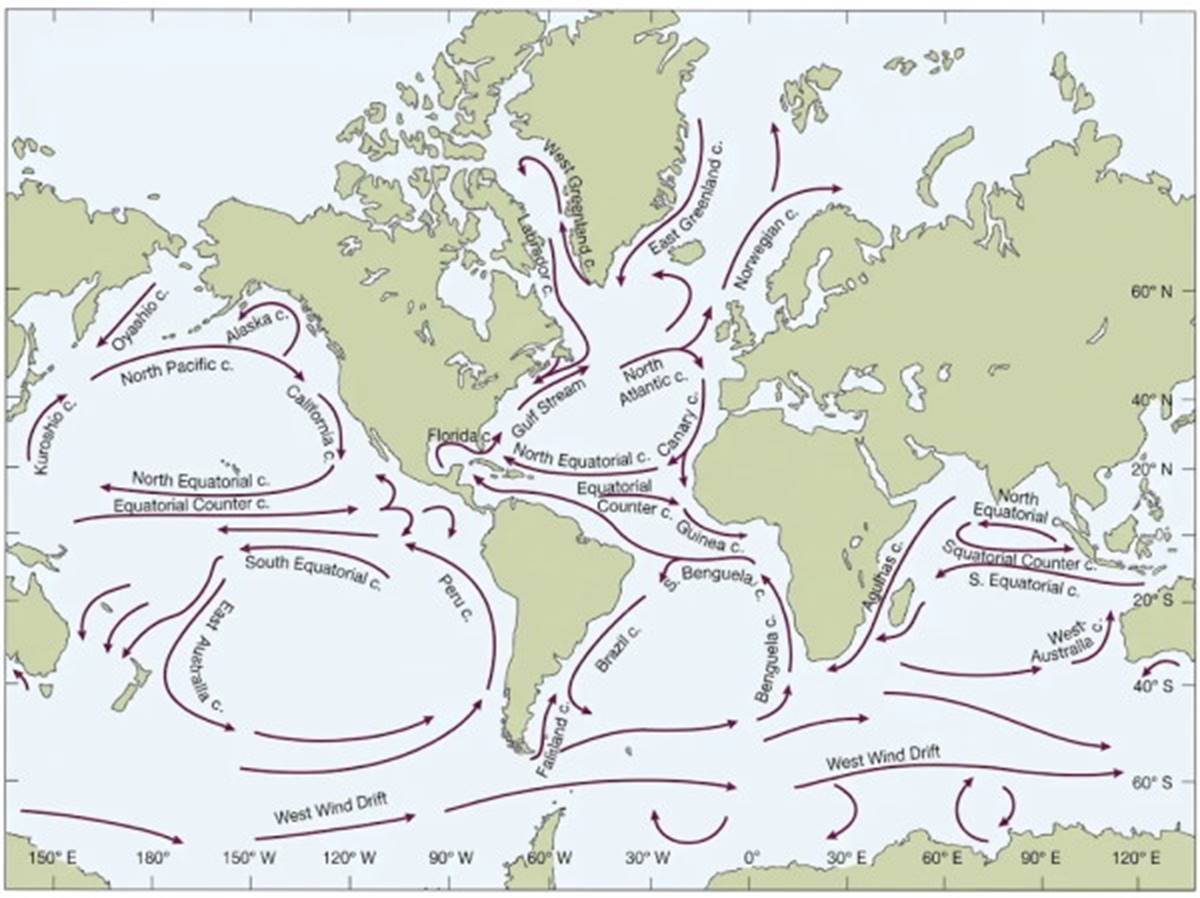
Fig. 8.5. The major surface currents of the world's oceans.
The Pacific Ocean Currents. In the North Pacific Ocean, the northeast trade winds push the water toward the west and northwest; this is the North Equatorial Current. The westerlies create the North Pacific Current, or North Pacific Drift, moving from west to east. Note that the trade winds move the water away from Central and South America and pile it up against Asia, while the westerlies move the water away from Asia and push it against the west coast of North America.
The water that accumulates in one area must flow toward areas from which the water has been removed. This movement forms two currents: the California Current, moving from north to south along the western coast of North America, and the Kuroshio Current, moving from south to north along the east coast of Japan. The Kuroshio and California currents are not completely wind-driven currents; they provide continuity of flow and complete a circular motion centered around 30°N latitude.
This circular, clockwise flow of water is called the North Pacific gyre. Other major North Pacific currents include the Oyashio Current, driven by the polar easterlies, and the Alaska Current, fed by water from the North Pacific Current and moving in a counterclockwise gyre in the Gulf of Alaska. There is little exchange of water through the Bering Strait between the North Pacific and the Arctic Ocean; no current exists that is comparable to the Atlantic Ocean's Norwegian Current, which moves warm water to the Arctic Ocean.
In the South Pacific Ocean, the southeast trade winds move the water to the left of the wind and westward, forming the South Equatorial Current. The westerly winds push the water to the east; at these southern latitudes the surface current so formed can move almost continuously around the Earth. This current is the West Wind Drift.
The tips of South America and Africa act to deflect a portion of this flow northward on the east side of both the South Pacific and South Atlantic oceans. As in the North Pacific, continuity currents form between the South Equatorial Current and the West Wind Drift. The Peru Current, or Humboldt Current, flows from south to north along the coast of South America, while the East Australia Current can be seen moving weakly from north to south on the west side of the ocean. These four currents form the counterclockwise South Pacific gyre.
The North Pacific and South Pacific gyres are formed not on either side of the equator (0°) but on either side of 5°N, because the doldrum belt is displaced northward owing to the unequal heating of the Northern and Southern hemispheres. Also between the North and South Equatorial currents and below the doldrums there is a current moving in the opposite direction, from west to east. This is a continuity current known as the Equatorial Countercurrent, which helps to return accumulated surface water eastward across the Pacific. Under the South Equatorial Current there is a subsurface current flowing from west to east called the Cromwell Current. This cold-water continuity current also returns water accumulated in the western Pacific.
The Atlantic Ocean Currents. The North Atlantic westerly winds move the water eastward as the North Atlantic Current, or North Atlantic Drift. The northeast trade winds push the water to the west, forming the North Equatorial Current. The north-south continuity currents are the Gulf Stream, flowing northward along the coast of North America, and the Canary Current, moving to the south on the eastern side of the North Atlantic.
The Gulf Stream is fed by the Florida Current and the North Equatorial Current. The North Atlantic gyre rotates clockwise. The polar easterlies provide the driving force for the Labrador and East Greenland currents, which balance water flowing into the Arctic Ocean from the Norwegian Current.
In the South Atlantic, the westerlies continue the West Wind Drift. The southeast trade winds move the water to the west, but the bulge of Brazil splits the South Equatorial Current. Much of this flow is deflected northward over the top of South America, into the Caribbean Sea, and eventually into the Gulf of Mexico, where it exits as the Florida Current, which joins the Gulf Stream. A portion of the South Equatorial Current slides south of the Brazilian bulge along the western side of the South Atlantic to form the Brazil Current. The Benguela Current moves northward up the African coast. The South Atlantic gyre is complete, and it rotates counterclockwise.
Because much of the South Equatorial Current is deflected across the equator, the Equatorial Countercurrent appears only weakly in the eastern portion of the mid-Atlantic. The northward movement of South Atlantic water across the equator results in a net flow of surface water from the Southern Hemisphere to the Northern Hemisphere. This flow is balanced by a flow of water at depth from the Northern Hemisphere to the Southern Hemisphere. This deep-water return flow is the North Atlantic deep water, discussed in chapter 6. Again, the equatorial currents are displaced north of the equator, although not as markedly as in the Pacific Ocean.
The Sargasso Sea. The Sargasso Sea is the classic example of an ocean gyre. It is located in the central North Atlantic Ocean, and its boundaries are the Gulf Stream on the west, the North Atlantic Current to the north, the Mid-Atlantic Ridge on the east, and the North Equatorial Current to the south. The circular motion of the current gyre isolates a lens of clear, warm water 1000 m (3000 ft) deep; the water is trapped by the geostrophic flow.
The region is famous for the floating mats of Sargassum, a brown seaweed, stretching across its surface. The extent of the floating seaweed frightened early sailors, who told stories of ships imprisoned by the weed and sea monsters lurking below the surface. Except for the floating Sargassum, with its rich and specialized community of small plants and animals, the clear water is nearly a biological desert.
The Indian Ocean Currents. The Indian Ocean is mainly a Southern Hemisphere ocean. The southeast trade winds push the water to the west, creating the South Equatorial Current. The Southern Hemisphere westerlies still move the water eastward in the West Wind Drift. The gyre is completed by the West Australia Current moving northward and the Agulhas Current moving southward along the east coast of Africa. Because this is a Southern Hemisphere ocean, the currents move to the left of the wind direction, and the gyre rotates counterclockwise.
The northeast trade winds in winter drive the North Equatorial Current to the west, and the Equatorial Countercurrent returns water eastward toward Australia. Again, these equatorial currents are displaced approximately 5°N. With the coming of the wet monsoon season and its west winds, these currents are reduced. The strong seasonal monsoon effect controls the surface flow of the Northern Hemisphere portion of the Indian Ocean. In the summer the winds blow the surface water eastward, and in the winter they blow it westward. This strong seasonal shift is unlike anything found in either the Atlantic or the Pacific Oceans.
The Arctic Ocean Currents. The relentless drift of water and ice in the Arctic Ocean moves in a large clockwise gyre driven by the polar easterly winds. This gyre is centered not on the North Pole, as early explorers expected, but is offset over the Canadian basin at 150°W and 80°N (fig. 8.6). Although the currents and the winds move the ice slowly at 0.1 knot (2 mi/day), Arctic explorers trying to reach the North Pole found that they traveled south with the drifting ice and water at speeds almost equal to their difficult progress north.
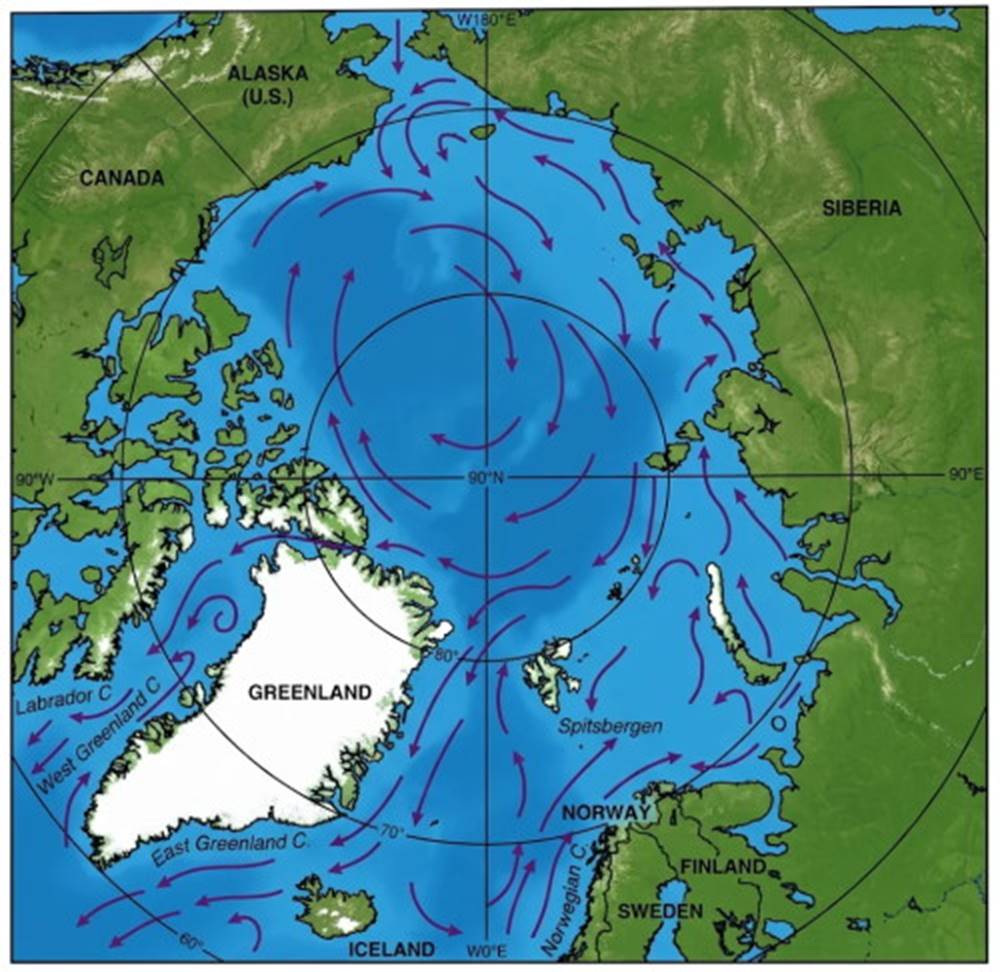
Fig. 8.6. The circulation in the Arctic Ocean is driven by the polar easterlies, which produce a large, clockwise gyre. Water enters the Arctic Ocean from the North Atlantic by way of the Norwegian Current and exits to the Atlantic by the East Greenland Current and the Labrador Current.
The Arctic Ocean is supplied from the North Atlantic by the Norwegian Current; some of this flow enters west of Spitsbergen, but most flows over the top of Norway and Finland and moves eastward along the Siberian coast into the Chukchi Sea. A small inflow of water entering the Arctic through the Bering Strait brings water from the Bering Sea to join the eastward flow along Siberia and the large Arctic gyre. The western side of the gyre crosses the center of the Arctic Ocean to split north of Greenland.
Here the larger flow forms the East Greenland Current flowing south and taking Arctic Ocean water into the North Atlantic. The lesser flow moves along the west side of Greenland to join the Labrador Current and move south along the Canadian coast. Outflow from Siberian rivers is caught in the eastward flow of water and ice along Siberia. Eventually this discharge joins the gyre, distributing sediments and pollutants throughout the Arctic (see the box in chapter 6, "The U.S.-Canada Arctic Ocean Section").
Date added: 2026-11-09; views: 7;