
The Essential Role of Soil Biodiversity Monitoring in Environmental Sustainability and Policy
Soils constitute a fundamental system for global agricultural production and the broader living environment. Consequently, maintaining their functions and quality is imperative for human survival. Systematic observation of soil health is essential to detect significant changes in quality as part of comprehensive environmental surveillance. This surveillance enables the reversal of undesirable trends through targeted soil conservation, protection measures, and sustainable land management. Soil monitoring is defined as the systematic determination of soil attributes to record their state and temporal changes within a general surveillance framework.
National monitoring programs typically operate through networks of designated sites where changes are documented via periodic sampling and analysis. For a location to be recognized as an official soil monitoring site, it must meet minimum conditions: its georeference must be known with accuracy appropriate to the sampling scale, and one or more sampling campaigns must have been conducted or are planned. The resulting raw data must be recorded in an accepted format, stored transparently in databases, and be accessible for scientific, policy, and land management analyses.
The international imperative for soil biodiversity monitoring was formally recognized by the Food and Agriculture Organisation (FAO). A recommendation to the Convention on Biological Diversity led to the International Initiative for the Conservation and Sustainable Use of Soil Biodiversity. This agreement advocates monitoring as a method for assessing soil quality or soil health, thereby informing better soil and land management policies. It is also critical for the early detection of biodiversity decline, enabling prompt corrective measures.
The adoption of dedicated monitoring programmes is driven by increasing anthropogenic pressures and limited existing knowledge. Primary drivers impacting soil biodiversity include soil overexploitation, climatic and hydrological changes, land-use alteration, and competition from invasive species. Furthermore, soil degradation processes like erosion, compaction, contamination, and decreased soil organic matter directly lead to biodiversity loss, underscoring the need for vigilant assessment.
Methodological Approaches for Effective Soil Biodiversity Monitoring. Specific methodologies exist for sampling and analyzing soil attributes related to organisms and biological processes. Some are routinely applied in large-scale networks, while others serve specific purposes, such as farm-level soil analysis or contaminated site risk assessment. Site selection for programmes can follow a hierarchical design or a grid-based scheme (regular, irregular, or stratified). The hierarchical approach prioritizes first-level categories like land use, soil type, and climate, which are major factors affecting soil biodiversity.
Monitoring typically begins with an inventory, estimating taxonomic or functional diversity, and measuring organism-related activity, such as enzymatic processes or burrow counts, at selected sites (see Fig. 8.13). Initial analyses establish a baseline, revealing differences across soil types, land-use categories, or management intensities. Subsequent monitoring cycles identify temporal trends. Known long-term land-use changes can even allow initial data to serve as a surrogate trend analysis. Measurements must rely on standardized, quantitative, and repeatable protocols, such as those in the ISO 23611 series published by the International Organisation for Standardisation (ISO), to ensure data comparability across space and time.
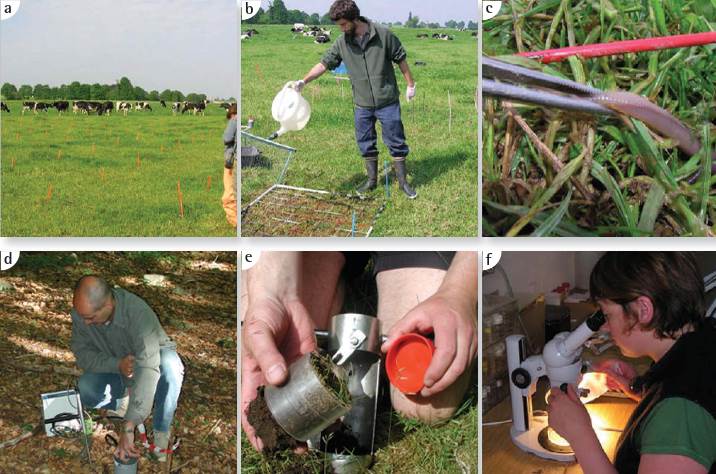
Fig. 8.13: The sequence of steps needed for one possible technique used for soil monitoring: (a) Marking out area; (b) Extracting worms; (c) Collecting worms; (d) Measuring soil respiration; (e) Extracting collembola and (f) Identifying organisms
Implementing a Framework at the European Union Level. A recent survey of EU soil monitoring practices revealed that biodiversity-related indicators are rarely measured. Only 5 of 29 European countries monitor earthworms, with exceptions like the Netherlands, France, Germany, Ireland, and Portugal where such measurements are implemented (see Fig. 8.13 and Box 2). While all soil organisms and their functions are relevant, practical constraints necessitate a focused approach. For feasibility, a minimum set of three surrogate indicators has been proposed: a) abundance, biomass, and species diversity of earthworms (representing macrofauna); b) abundance and species diversity of Collembola (representing mesofauna); and c) microbial respiration.
These key indicators were selected using stringent criteria: each requires a standardized methodology, complements other indicators, and is interpretable for both scientists and policymakers. This set covers basic biodiversity and key ecological functions. Where resources allow, this minimum set should be expanded to include macro-fauna, nematodes, and microorganisms like bacteria, fungi, and protozoa.
Beyond developing national initiatives to engage the public (see Box 1), soil biodiversity monitoring is urgently needed because soil organisms underpin critical soil ecosystem services. To protect this common heritage and ensure a sustainable future, a concerted EU-wide sampling and analysis effort is required. This will produce a comprehensive atlas of soil health, forming the basis for effective protection schemes, sustainable land-use planning, and the restoration of deteriorated soils.
Date added: 2025-12-15; views: 497;